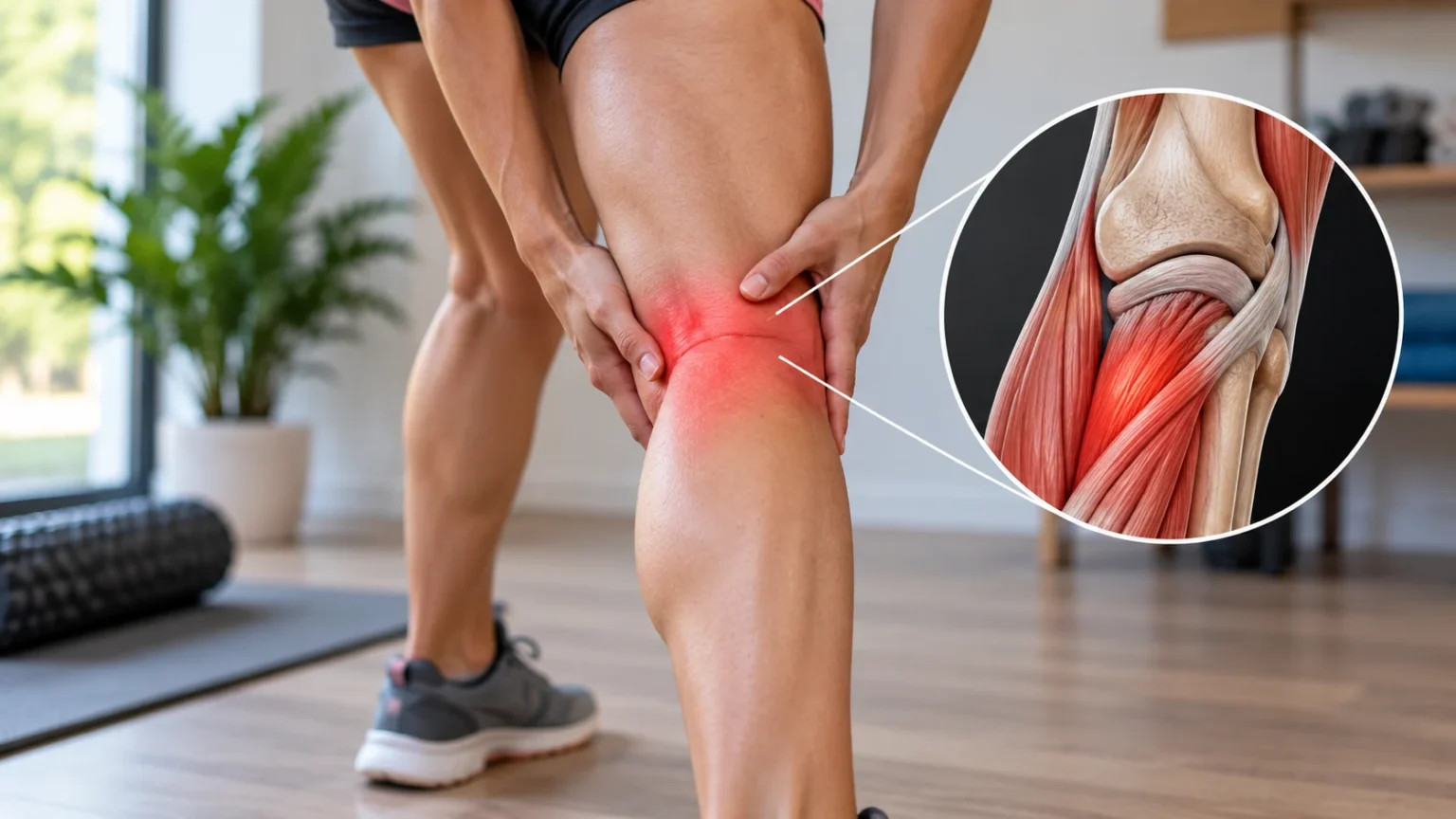

What Is the Popliteus Muscle?
The popliteus is a small triangular muscle located at the back of the knee. It runs between the lower end of the thigh bone and the upper part of the shin bone. Although it is relatively small, it plays an important role in controlling knee movement and helping the joint transition between straight and bent positions.
One of the popliteus muscle’s main jobs is helping “unlock” the knee when you begin bending it from a fully straight position. It also contributes to rotational control of the lower leg and helps stabilize the knee during walking, running, and changing direction. Because of this role, the muscle can become irritated during repetitive or demanding lower-body activity.
Pain involving this muscle is usually felt toward the back or slightly outer side of the knee. The discomfort may be difficult to identify because several tendons, ligaments, nerves, and other structures occupy the same area. Understanding the location and activities that trigger symptoms can help determine whether the popliteus may be involved.
What Does Popliteus Muscle Pain Feel Like?
Popliteus muscle pain often presents as an ache or tenderness behind the knee. Some people feel discomfort slightly toward the outside of the joint rather than directly in the center. The pain may become more noticeable when bending the knee, walking downhill, running, or rotating the lower leg during sports and everyday activities.
Symptoms can range from a mild pulling sensation to sharper pain during certain movements. The area may feel stiff after sitting for an extended period or after completing a demanding workout. People with an irritated popliteus may also notice that the knee feels uncomfortable when moving from a straight position into flexion.
Unlike pain that comes from the front of the knee, popliteus discomfort is usually deeper and less easy to pinpoint. Significant swelling is not always present with a mild muscle strain. However, swelling, instability, locking, or severe pain may indicate another knee condition and should not automatically be assumed to come from the popliteus muscle.
Common Causes of Popliteus Muscle Pain
Overuse is one of the most common reasons the popliteus becomes irritated. Repeated running, hiking, squatting, or sporting movements can increase stress on the small muscle, especially when activity levels rise quickly. The muscle may struggle to recover when training intensity, distance, or frequency increases faster than the surrounding tissues can adapt.
Sudden twisting can also strain the popliteus. Sports involving rapid direction changes, such as football, basketball, tennis, and skiing, can place rotational stress around the knee. If the foot stays planted while the body turns, the popliteus and nearby structures may be exposed to forces that exceed their current tolerance.
Direct trauma is another possible cause, although it is less common than repetitive strain. A fall, collision, or awkward landing can irritate tissues behind the knee. Because other knee structures can be injured during the same event, significant pain following trauma should be assessed rather than treated as an isolated muscle problem without further evaluation.
Can Running Cause Popliteus Pain?
Running can place repeated demands on the popliteus as it helps stabilize the knee throughout each stride. The muscle may work particularly hard when controlling rotation of the lower leg and transitioning the knee between flexion and extension. Long-distance running or suddenly increasing mileage can therefore contribute to irritation.
Downhill running is often especially demanding because the knee repeatedly absorbs braking forces while remaining partially bent. This can increase the workload on muscles responsible for controlling the joint. Runners may notice pain behind the knee during descents even when level running feels relatively comfortable.
Changing running surfaces, footwear, speed, or training volume can also affect how much stress reaches the knee. If symptoms begin after a training change, temporarily reducing the aggravating activity may help. A gradual return is usually preferable to immediately resuming the same mileage that repeatedly reproduces pain.
Can Squats Cause Pain Behind the Knee?
Squats involve substantial knee flexion, which places several muscles and tendons behind the joint under changing tension. The popliteus contributes to knee control during this movement, although pain behind the knee does not necessarily mean the muscle is injured. Hamstring tendons, calf muscles, or other joint structures may also produce similar symptoms.
Deep squatting may make discomfort more noticeable because the knee moves into a greater range of flexion. If the pain begins only at the deepest point, temporarily reducing squat depth can help determine whether range of motion is contributing. Technique, load, stance, and training volume should also be considered before blaming a single muscle.
Sharp or worsening pain should not be pushed through in an attempt to improve mobility. Try reducing weight, adjusting depth, or temporarily using another lower-body exercise that feels comfortable. If pain remains despite these changes, professional assessment can help determine which structure around the back of the knee is actually irritated.
Other Conditions That Can Cause Pain Behind the Knee
Pain behind the knee can come from several structures besides the popliteus muscle. Hamstring tendon irritation, calf strains, Baker’s cysts, meniscus injuries, and ligament problems can all create discomfort in the same general region. This overlap makes self-diagnosis difficult when symptoms are persistent or severe.
A Baker’s cyst, for example, involves fluid collecting behind the knee and may create fullness, pressure, or swelling. Meniscus problems can produce pain along with clicking, catching, or locking sensations. Tendon injuries may become especially painful when contracting or stretching the muscles connected to the irritated area.
Musculoskeletal pain can also develop in different regions through repetitive loading and overuse. Understanding how conditions such as forearm tendonitis develop highlights how repeated stress can irritate tissues when workload exceeds recovery. However, persistent knee pain requires assessment based on the specific structures and movements involved.
How Is Popliteus Muscle Pain Diagnosed?
A healthcare professional usually begins by asking where the pain is located and when it appears. They may ask whether symptoms began gradually or after a specific injury, as well as which movements make the discomfort worse. Information about running, sports, recent training changes, and previous knee problems can provide useful clues.
During the examination, the clinician may check knee movement, strength, stability, tenderness, and rotational control. They may gently test different positions to see whether specific movements reproduce the pain. Because the popliteus is a deep muscle, diagnosis often depends on the overall pattern rather than simply pressing on one obvious tender point.
Imaging is not always required when symptoms are mild and improve with conservative care. However, an MRI, ultrasound, or other imaging may sometimes be considered when pain is severe, persistent, or associated with suspected internal knee damage. The purpose is often to rule out ligament, meniscus, tendon, or other structural injuries.
How to Relieve Mild Popliteus Muscle Pain
Reducing the activity that repeatedly triggers pain is usually an important first step. This does not necessarily mean complete inactivity, especially when walking and gentle movement remain comfortable. Instead, temporarily lower running mileage, avoid painful downhill routes, or reduce exercise intensity while allowing the irritated area to settle.
A cold pack wrapped in a towel may help manage soreness after activity, particularly during the early stages of a mild strain. Apply it for short periods and avoid placing ice directly against the skin. Some people find gentle warmth useful later when stiffness is more noticeable than acute irritation.
Pain relief should be combined with attention to the underlying workload. If symptoms repeatedly return whenever training resumes, simply resting for a few days may not be enough. Gradual strengthening and controlled progression are usually more useful for building the knee’s ability to tolerate future activity.
Exercises That May Support Recovery
Gentle knee movement can help prevent unnecessary stiffness while symptoms are improving. Slowly bending and straightening the knee within a comfortable range may be a useful starting point. Avoid forcing the joint through pain or performing aggressive stretching when the area is already irritated.
Strengthening the muscles surrounding the knee can improve overall joint control. Exercises involving the quadriceps, hamstrings, calves, and hips may reduce the amount of stress placed on any one small structure. Start with low resistance and movements that do not reproduce significant pain, then gradually increase the challenge over time.
Balance and single-leg control exercises may also be useful once basic movement feels comfortable. Standing on one leg or performing controlled step-downs can challenge knee stability in a functional way. Progressions should be gradual, particularly for runners and athletes preparing to return to cutting, jumping, or downhill movement.
How Long Does Popliteus Muscle Pain Take to Heal?
Recovery time depends on the severity of the irritation and how quickly the aggravating activity is modified. A mild strain or overuse problem may begin improving within days to a few weeks. More persistent injuries can take longer, particularly if the knee continues to be repeatedly stressed during running, sports, or heavy training.
Feeling less pain does not always mean the muscle is fully prepared for normal training. Strength, control, and tolerance may take additional time to return even after everyday activities feel comfortable. Increasing workload too quickly can trigger another flare and make the recovery process longer than necessary.
A gradual progression is usually the safest approach. Begin with comfortable daily movement, then add controlled strengthening before returning to demanding activities. Runners can slowly increase distance and intensity while monitoring symptoms during exercise and over the following day to make sure the knee continues to tolerate the added workload.
How to Prevent Popliteus Muscle Pain
Training progression is one of the most important factors in preventing overuse problems around the knee. Avoid suddenly increasing running distance, hill work, sprinting, or lower-body training volume. Giving the muscles and tendons time to adapt can reduce the likelihood that smaller stabilizing muscles become overloaded.
Strengthening the entire lower body can also support knee control. Strong quadriceps, hamstrings, glutes, and calf muscles help manage the forces created during walking, running, squatting, and jumping. Balanced strength is generally more useful than focusing exclusively on one small muscle in isolation.
Warm up before demanding training and pay attention to early signs of persistent discomfort. Mild soreness that repeatedly appears after the same activity can be a signal that your current workload needs adjusting. Addressing these warning signs early may prevent a small irritation from developing into a problem that significantly affects training.
When Should You Worry About Pain Behind the Knee?
Seek medical attention when pain is severe, rapidly worsening, or follows a significant twisting injury or collision. Inability to bear weight, major swelling, or a feeling that the knee repeatedly gives way can indicate more than a simple muscle strain. These symptoms deserve evaluation before returning to exercise.
Locking, catching, or an inability to fully bend or straighten the knee can also suggest internal joint involvement. Persistent swelling or a noticeable lump behind the knee should be checked, particularly when it does not improve with rest. A clinician can determine whether fluid, tendon irritation, or another knee condition may be responsible.
Sudden calf swelling, warmth, redness, or significant tenderness requires prompt medical attention because not all pain behind the knee is musculoskeletal. Difficulty breathing or chest pain occurring alongside leg symptoms is an emergency. These warning signs should not be treated at home as ordinary popliteus muscle soreness.
When Can You Return to Exercise?
Returning to exercise should depend on how your knee responds rather than only on how many days have passed. Walking, stairs, and basic movements should generally feel comfortable before you resume more demanding activity. Significant pain during everyday tasks suggests the knee may not yet be ready for running or intense strength training.
Begin with lower intensity than you were using before symptoms developed. A runner might start with shorter, flatter routes before adding hills or speed work, while someone who lifts weights may reduce squat depth and resistance initially. Increase only one training variable at a time so you can identify how the knee responds.
Monitor symptoms during the workout and throughout the following day. Mild temporary awareness may be manageable, but increasing pain, swelling, or reduced function means the progression may have been too aggressive. Steady, gradual loading usually provides a more reliable return than testing the knee with a full-intensity workout immediately.
Conclusion
Popliteus muscle pain can develop when the small stabilizing muscle behind the knee becomes irritated through running, twisting, overuse, or sudden changes in activity. Symptoms may include aching, tenderness, or discomfort during knee bending and rotational movements. However, several other conditions can cause similar pain behind the knee.
Mild symptoms may improve with temporary activity modification, comfortable movement, and gradual strengthening of the muscles surrounding the knee. Runners and athletes should pay particular attention to hills, training volume, and sudden changes in intensity. Building workload slowly helps the knee adapt without repeatedly overloading sensitive tissues.
Persistent or severe pain should not be automatically attributed to the popliteus muscle. Significant swelling, instability, locking, inability to bear weight, or sudden calf symptoms require medical evaluation. Identifying the actual source of pain is the most reliable way to choose appropriate treatment and return safely to normal activity.
FAQs
Where is popliteus muscle pain usually felt?
Popliteus pain is generally felt deep behind the knee, often slightly toward the outer side. It may become more noticeable during knee bending, running downhill, or movements involving lower-leg rotation.
Can running cause popliteus muscle pain?
Yes. Repetitive running, especially downhill running or sudden mileage increases, can place additional stress on the popliteus. Reducing aggravating activity and gradually rebuilding training may help mild overuse symptoms.
Should I stretch a painful popliteus muscle?
Gentle movement may be comfortable, but aggressive stretching is not necessary when the area is irritated. Avoid forcing the knee into positions that cause sharp pain or noticeably worsen symptoms afterward.
How long does a popliteus strain take to heal?
Mild strains may improve within a few weeks, while more significant or persistent injuries can take longer. Recovery depends on severity, activity modification, strength, and how gradually normal exercise is resumed.
When should pain behind the knee be checked by a doctor?
Seek assessment for severe or persistent pain, major swelling, locking, instability, inability to bear weight, or symptoms following significant trauma. Sudden calf swelling or breathing difficulty requires urgent medical attention.