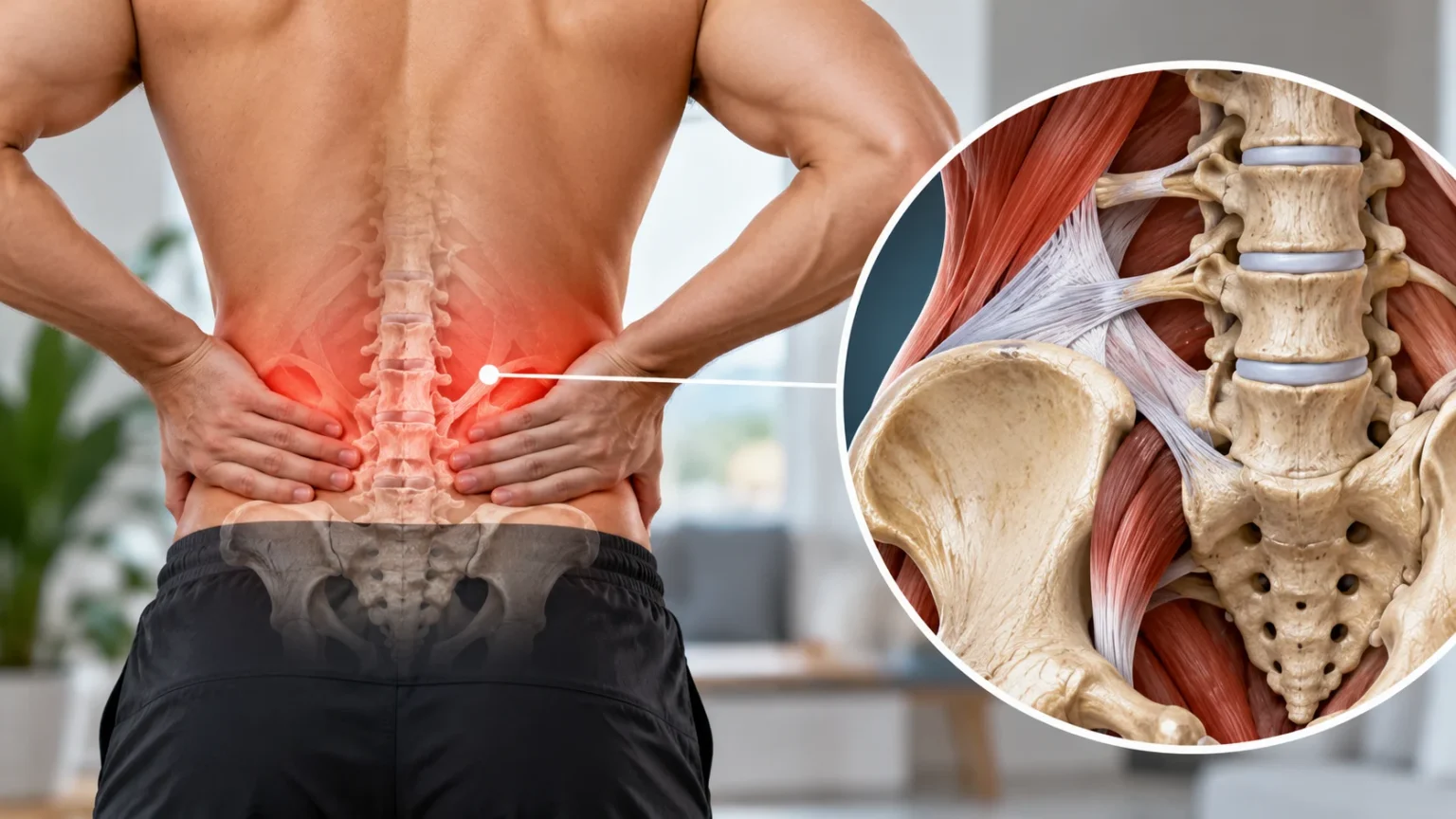

The iliolumbar ligament is an important structure that connects the lower spine to the pelvis and helps maintain stability during everyday movement. Although it is relatively small, this strong band of connective tissue supports the lumbosacral region, where the lumbar spine meets the sacrum. Understanding its anatomy and function can help explain how the lower back maintains balance while standing, walking, bending, and lifting.
The iliolumbar ligament also plays a role in controlling excessive movement between the lower lumbar vertebrae and the pelvic bones. When this ligament becomes strained or irritated, discomfort may develop around the lower back and the upper part of the pelvis. Learning about its location, attachments, functions, and possible injuries provides a clearer understanding of its importance in spinal health.
What Is the Iliolumbar Ligament?
The iliolumbar ligament is a strong band of fibrous connective tissue that connects the lower lumbar spine to the iliac crest of the pelvis. It is located on both sides of the lower back, helping create a stable connection between the vertebral column and pelvic structures. Its primary function is to limit excessive movement and support the mechanical stability of the lumbosacral junction.
This ligament forms part of the supporting structures surrounding the lower lumbar vertebrae, particularly the fifth lumbar vertebra, commonly called L5. Its fibers extend laterally from the transverse process of the vertebra toward the iliac bone. Some individuals also have attachments involving the fourth lumbar vertebra, reflecting normal anatomical variations in ligament structure.
Unlike muscles, which actively contract to produce movement, ligaments provide passive support by resisting excessive joint motion. The iliolumbar ligament works alongside surrounding muscles, joints, and other connective tissues to maintain stability. This supportive role becomes especially important during activities that place mechanical forces on the lower back, such as lifting objects or rotating the trunk.
Where Is the Iliolumbar Ligament Located?
The iliolumbar ligament is positioned deep within the lower back, between the lumbar spine and the upper portion of the pelvic bone. It extends from the transverse process of the fifth lumbar vertebra toward the iliac crest, which forms the curved upper border of the pelvis. This location allows the ligament to connect two major structures involved in supporting body weight.
The ligament lies near several important anatomical structures, including the quadratus lumborum muscle, the lumbar fascia, and nearby spinal ligaments. Its position also places it close to the sacroiliac region, where the sacrum meets the iliac bones. These surrounding tissues work together to distribute forces and maintain control during movements of the trunk and pelvis.
Because the ligament is situated beneath layers of muscle and other soft tissues, it cannot usually be identified through simple surface observation. Healthcare professionals rely on anatomical knowledge, physical examination findings, and occasionally diagnostic imaging when assessing potential problems in this region. Understanding its deeper location helps distinguish it from superficial back muscles and other structures that may produce similar discomfort.
Iliolumbar Ligament Anatomy and Structure
The iliolumbar ligament consists primarily of dense collagen fibers arranged to resist mechanical tension between the lower spine and the pelvis. Collagen provides strength and helps the ligament tolerate forces created during normal movement. Its fibrous structure allows limited flexibility while preventing excessive displacement between the anatomical structures it connects, contributing to overall spinal stability.
Anatomical descriptions commonly identify anterior and posterior portions of the iliolumbar ligament, although their appearance and arrangement can vary. These fiber groups extend between the lumbar transverse process and different regions of the iliac crest. Their orientation allows them to resist movement in multiple directions, including certain bending and rotational forces affecting the lower lumbar spine.
The ligament also has connections with nearby connective tissues that contribute to the stability of the lumbopelvic region. Some anatomical variations include additional fibers extending from the fourth lumbar vertebra or blending with surrounding fascial structures. These differences generally represent normal anatomical diversity rather than abnormalities, although they may influence how forces are distributed across the region.
Iliolumbar Ligament Attachments and Connections
The primary attachment of the iliolumbar ligament begins near the transverse process of the fifth lumbar vertebra. From this point, strong fibrous bands travel outward toward the iliac crest, creating a connection between the spine and pelvis. This arrangement helps stabilize the lower lumbar vertebrae during movements that produce bending, twisting, or compressive forces.
The ligament typically attaches to the posterior region of the iliac crest, although the precise attachment pattern can differ between individuals. Some fibers may extend toward nearby bony landmarks or blend with connective tissues surrounding the sacroiliac region. These relationships help integrate the ligament into the broader network of structures responsible for maintaining pelvic and lumbar stability.
Additional connections may involve the iliotransverse ligaments, surrounding fascia, and supporting tissues of the lower back. The iliolumbar ligament is also anatomically related to the quadratus lumborum muscle, which assists with trunk movement and postural control. Together, these structures help the lower spine remain supported while allowing the controlled mobility required for everyday activities.
What Is the Function of the Iliolumbar Ligament?
The main function of the iliolumbar ligament is to stabilize the connection between the lumbar spine and the pelvis. It helps restrict excessive movement at the lower lumbar levels, particularly around the lumbosacral junction. By providing passive resistance to mechanical forces, the ligament supports the spine during activities that involve changes in posture, movement, and weight distribution.
Another important function is limiting certain movements that could place unnecessary stress on the lower lumbar vertebrae. The ligament contributes to resistance against excessive side bending, rotation, and other forces affecting the lumbar region. Its exact mechanical contribution varies depending on spinal position, ligament fiber orientation, and the involvement of surrounding muscles and joints.
The iliolumbar ligament also helps coordinate force transfer between the lower spine and pelvic structures. During walking, lifting, or standing, mechanical loads pass through the lumbopelvic region as the body maintains balance. The ligament contributes to this supportive system, working with muscles and other ligaments rather than functioning as the sole source of stability.
Role of the Iliolumbar Ligament in Spinal Stability
Spinal stability depends on the coordinated activity of bones, intervertebral discs, ligaments, muscles, and the nervous system. The iliolumbar ligament contributes to this system by providing passive support around the lower lumbar vertebrae. Its position between the spine and pelvis helps resist unwanted movement while allowing the flexibility necessary for normal daily activities.
The ligament becomes particularly relevant when mechanical forces challenge the lower back, such as during trunk rotation or sideways bending. Its collagen fibers develop tension as movement approaches certain limits, helping prevent excessive displacement. However, the ligament does not work independently, because surrounding muscles and other supporting structures also influence how spinal loads are controlled.
Healthy spinal movement requires a balance between stability and mobility rather than complete restriction of motion. The iliolumbar ligament helps maintain this balance by supporting the lower lumbar segments without preventing normal movement. Understanding this relationship explains why ligament function is important for everyday activities and why injuries may affect comfort or movement tolerance.
Relationship Between the Iliolumbar Ligament and Sacroiliac Joint
The iliolumbar ligament is closely associated with the sacroiliac region, although it is not the same structure as the sacroiliac ligaments. The sacroiliac joints connect the sacrum to the pelvic bones and help transfer forces between the upper and lower body. The iliolumbar ligament supports nearby lumbopelvic structures, contributing indirectly to stability around this region.
Because the ligament connects the lower lumbar spine to the iliac crest, it helps influence how forces are transmitted across the pelvis. Its position may affect mechanical loading near the sacroiliac joints during standing, walking, and other activities. However, sacroiliac joint stability primarily depends on several supporting ligaments, joint surfaces, and surrounding muscles working together.
Pain around the iliolumbar ligament can sometimes resemble discomfort arising from the sacroiliac joint or nearby muscles. Both problems may produce localized lower-back pain near the upper part of the pelvis. A careful clinical assessment is therefore important, because the location of discomfort alone cannot reliably identify which anatomical structure is responsible.
Common Causes of Iliolumbar Ligament Pain
Iliolumbar ligament pain may develop when the ligament experiences excessive tension, repetitive loading, or sudden mechanical stress. Activities involving repeated bending, twisting, or heavy lifting can place demands on the connective tissues surrounding the lower spine. When these forces exceed the tissues’ tolerance, irritation or injury may occur and contribute to localized discomfort.
Sudden movements and physical injuries are other possible causes of iliolumbar ligament strain. A fall, awkward lifting movement, or unexpected trunk rotation may stretch the ligament beyond its comfortable range. However, lower-back pain following an injury can involve several structures, including muscles, joints, and discs, so the ligament should not automatically be assumed responsible.
Changes in physical activity, prolonged uncomfortable positioning, and reduced movement tolerance may also contribute to symptoms around the lumbopelvic region. These factors do not necessarily cause direct ligament damage, but they can increase mechanical demands on surrounding tissues. Understanding the broader causes of lower-back discomfort helps prevent an overly narrow focus on one anatomical structure.
Symptoms of Iliolumbar Ligament Injury
Iliolumbar ligament irritation or injury may produce localized discomfort near the lower back and the upper border of the pelvis. Pain is sometimes described around the area just above the posterior iliac crest, often on one side. Symptoms may become more noticeable during movements that load the lower spine, although the exact pattern varies between individuals.
Some people experience tenderness when pressure is applied near the affected region, along with stiffness or discomfort during trunk movement. Activities involving side bending, twisting, or prolonged standing may aggravate symptoms in certain cases. However, these findings are not specific to the iliolumbar ligament and can also occur with muscle strains, joint problems, or other conditions.
Severe pain, leg weakness, numbness, or symptoms extending down the lower limb require careful assessment because they may indicate another underlying problem. The iliolumbar ligament itself does not usually explain significant neurological symptoms. Persistent or worsening lower-back pain should be evaluated by a qualified healthcare professional rather than diagnosed solely from symptom location.
Iliolumbar Ligament Strain and Injury
An iliolumbar ligament strain occurs when the ligament is subjected to forces that exceed its normal tolerance, potentially causing microscopic or more substantial tissue damage. The severity of the injury depends on the amount of stress involved and the surrounding structures affected. Mild strains may produce temporary discomfort, while more significant injuries can interfere with normal movement.
Ligament injuries are commonly described according to their severity, ranging from mild fiber overstretching to partial or complete tearing. However, a specific iliolumbar ligament injury grade cannot usually be established from symptoms alone. Clinical examination and, when necessary, imaging may help identify structural damage or other causes of pain in the lower-back region.
Recovery depends on the nature of the injury, overall physical health, and the demands placed on the affected tissues. Mild irritation may improve with suitable activity adjustments, while more substantial injuries may require structured rehabilitation. Because the ligament lies close to multiple pain-producing structures, an accurate diagnosis is important before assuming that a particular treatment will be effective.
How Iliolumbar Ligament Problems Are Diagnosed
Diagnosing a suspected iliolumbar ligament problem begins with a detailed discussion of symptoms, injury history, and daily activities. A healthcare professional may ask about pain location, aggravating movements, and previous lower-back conditions. This information helps identify possible causes while considering other structures that can produce discomfort around the lumbar spine and pelvis.
During a physical examination, the clinician may assess spinal movement, muscle strength, tenderness, and neurological function. Certain movements or pressure near the iliac crest may reproduce symptoms, but these findings are not definitive tests for iliolumbar ligament injury. The examination may also include evaluating the sacroiliac region, hip joints, and surrounding muscles to identify alternative explanations.
Imaging is not routinely necessary for uncomplicated lower-back pain, but it may be considered when symptoms persist or serious injury is suspected. Magnetic resonance imaging can sometimes provide information about surrounding soft tissues, although isolated iliolumbar ligament abnormalities may be difficult to interpret. Diagnosis generally relies on the complete clinical picture rather than a single examination finding.
Treatment Options for Iliolumbar Ligament Pain
Treatment for suspected iliolumbar ligament pain usually begins with conservative measures aimed at improving comfort and restoring normal movement. Temporarily reducing activities that repeatedly aggravate symptoms may help decrease mechanical stress on the affected region. However, prolonged bed rest is generally discouraged for uncomplicated lower-back pain because gentle activity often supports better functional recovery.
Cold or warmth may provide temporary symptom relief depending on personal preference and the nature of the discomfort. Gentle movement and gradual activity progression can help maintain flexibility without unnecessarily stressing sensitive tissues. Pain-relieving medications may sometimes be considered under appropriate medical guidance, taking into account individual health conditions and potential medication risks.
Physical therapy may be helpful when symptoms continue or interfere with everyday activities. Rehabilitation often focuses on improving trunk strength, hip control, movement tolerance, and confidence with normal physical activity. More specialized interventions should only be considered after a thorough assessment, because pain near the iliolumbar ligament does not necessarily mean the ligament itself requires targeted treatment.
Exercises That May Support Iliolumbar Ligament Recovery
Gentle movement exercises may help maintain comfortable mobility around the lower back when symptoms allow. Pelvic tilts are one option, involving small controlled movements of the pelvis while lying on a supportive surface. These movements encourage awareness of spinal positioning and can be adjusted according to individual comfort without requiring large ranges of motion.
Trunk stabilization exercises may also be included in rehabilitation programs when appropriate for the person’s condition. Movements such as modified bridges or gentle abdominal bracing can help develop control around the lumbopelvic region. Exercise intensity should increase gradually, and movements that consistently worsen symptoms should be modified with guidance from a qualified professional.
Walking and comfortable hip mobility exercises can provide additional opportunities to maintain activity during recovery. The goal is not to stretch the injured ligament aggressively but to restore normal movement and tolerance to everyday physical demands. A personalized rehabilitation program is particularly useful when pain persists or when several structures contribute to lower-back discomfort.
How to Protect the Iliolumbar Ligament During Daily Activities
Maintaining comfortable movement habits can help manage mechanical demands on the lower back and surrounding ligaments. When lifting objects, keeping the load close to your body and using a controlled movement pattern may reduce unnecessary strain. Avoid sudden twisting movements while carrying heavy items, particularly when the lower back already feels uncomfortable.
Regular movement breaks can be helpful for people who remain seated or standing for long periods. Changing positions throughout the day prevents the same tissues from experiencing continuous loading in one posture. There is no single perfect sitting or standing position, so comfort, movement variety, and the ability to change posture are important considerations.
Gradually improving strength and physical activity tolerance may also help support the lower back during daily tasks. Exercises targeting the hips, trunk, and lower limbs can contribute to overall movement capacity. Paying attention to early discomfort and avoiding abrupt increases in physical demands may reduce the likelihood of aggravating sensitive tissues around the iliolumbar region.
When to See a Doctor for Iliolumbar Ligament Pain
Medical evaluation is recommended when lower-back pain persists, becomes progressively worse, or repeatedly interferes with normal activities. A healthcare professional can assess the symptoms and determine whether the iliolumbar ligament, muscles, spinal joints, or another structure may be involved. Persistent pain should not automatically be attributed to a ligament injury without appropriate assessment.
Prompt medical attention is important when back pain follows a significant fall, collision, or other traumatic event. Severe discomfort accompanied by fever, unexplained illness, or unusual neurological symptoms may indicate a condition requiring additional investigation. New or progressive leg weakness, significant numbness, or difficulty walking should also be evaluated without unnecessary delay.
Seek emergency medical care if lower-back pain is accompanied by new loss of bladder or bowel control or numbness around the groin. These symptoms can indicate serious nerve compression and require urgent assessment. Recognizing warning signs helps distinguish ordinary musculoskeletal discomfort from conditions that should not be managed through home exercises alone.
Conclusion
The iliolumbar ligament is a strong connective tissue structure that links the lower lumbar spine to the iliac crest of the pelvis. Its anatomical position allows it to contribute to stability around the lumbosacral junction during normal movement. By resisting excessive mechanical forces, the ligament helps support the relationship between the lower spine and pelvic structures.
Understanding the iliolumbar ligament’s anatomy, attachments, and functions provides useful insight into the complex mechanics of the lower back. Although irritation or injury may contribute to localized discomfort, many nearby structures can produce similar symptoms. Accurate assessment is therefore essential when pain persists, particularly when movements or daily activities become increasingly difficult.
Supporting lower-back health involves maintaining comfortable movement, gradually building physical strength, and avoiding sudden increases in demanding activities. When discomfort develops, appropriate activity adjustments and professional guidance may help restore normal function. Recognizing the ligament’s role within the wider musculoskeletal system encourages a balanced approach to spinal mobility, stability, and long-term physical well-being.
Frequently Asked Questions
1. What does the iliolumbar ligament do?
The iliolumbar ligament connects the lower lumbar spine to the pelvis and helps maintain lumbosacral stability. It limits excessive movement and contributes to the supportive system that controls mechanical forces during everyday activities.
2. Where is the iliolumbar ligament located?
The iliolumbar ligament lies deep in the lower back, connecting the fifth lumbar vertebra to the iliac crest. It is found on both sides of the spine near the upper pelvic region.
3. What causes iliolumbar ligament pain?
Possible causes include repetitive mechanical stress, sudden twisting movements, heavy lifting, or physical injury. However, pain in this area can also originate from muscles, spinal joints, or other surrounding structures.
4. How long does an iliolumbar ligament injury take to heal?
Recovery varies depending on injury severity, associated tissue involvement, and activity demands. Mild strains may improve within several weeks, while more significant injuries can take longer and may require structured rehabilitation.
5. Can iliolumbar ligament pain be treated with exercise?
Appropriate exercise may help restore comfortable movement, improve trunk strength, and support recovery. However, suspected ligament injuries should be assessed when symptoms persist, and exercises should avoid movements that significantly worsen discomfort.