
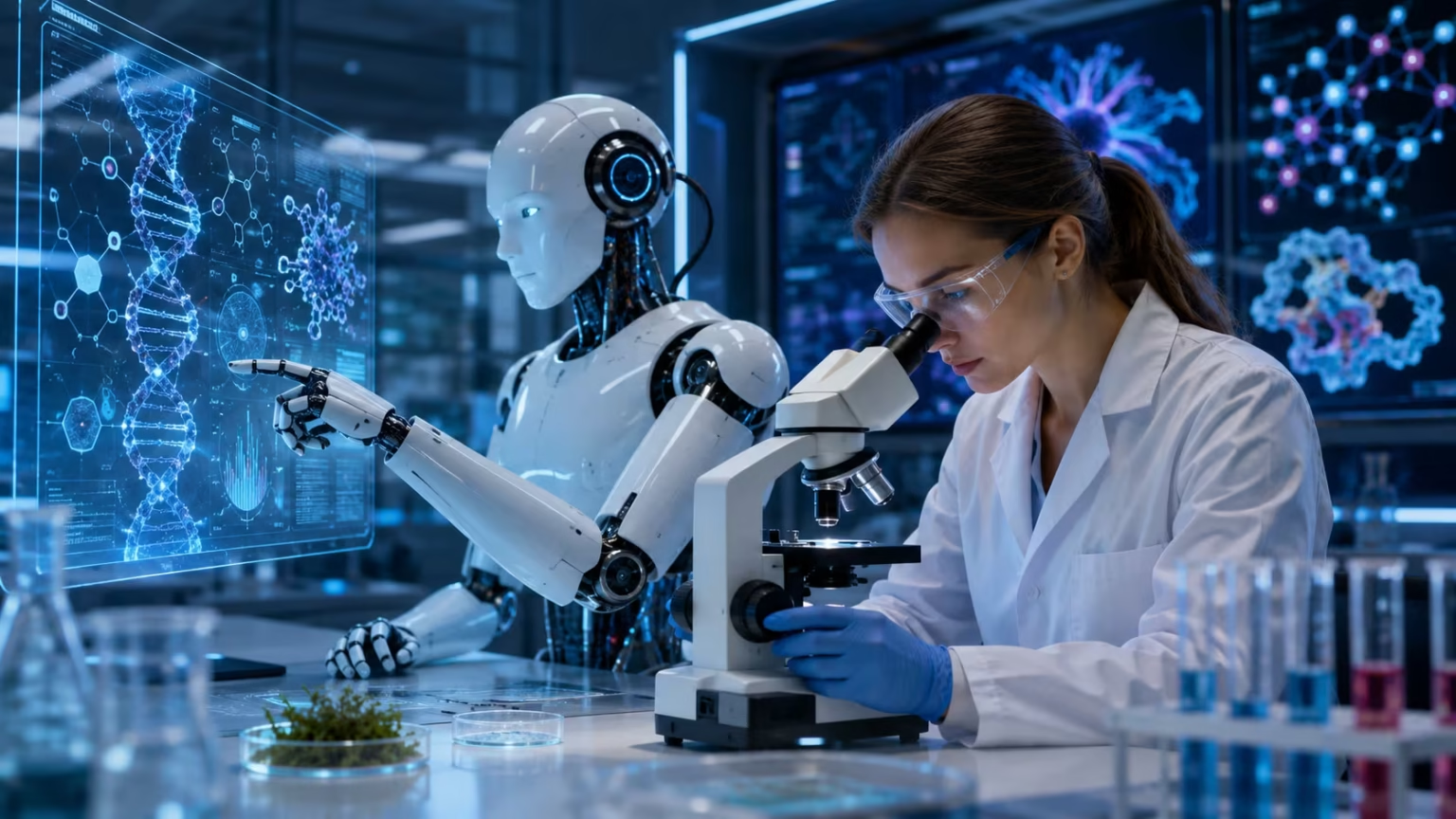

How Artificial Intelligence Is Changing Science
Scientific progress has always depended on better tools. Telescopes allowed researchers to study distant galaxies, microscopes revealed the hidden world of cells and computers made it possible to process calculations that would once have taken entire careers. Artificial intelligence is becoming the next major tool in that continuing story.
Today, AI can search enormous datasets, identify patterns, predict molecular structures, analyse medical images and suggest promising directions for experiments. These capabilities are changing how researchers move from an initial question to a testable hypothesis and, eventually, a useful discovery.
The biggest change is not that machines are replacing scientists. Instead, AI is helping researchers spend less time on repetitive analysis and more time interpreting results, designing meaningful experiments and deciding which scientific questions deserve attention. Human judgement remains central to every reliable discovery.
Understanding how artificial intelligence is changing science also requires looking beyond the excitement. AI systems can inherit bias, produce convincing errors and overlook information missing from their training data. Their greatest value appears when computational speed is combined with human expertise, transparency and real-world validation.
What Does AI in Scientific Research Mean?
Artificial intelligence is a broad term for computer systems designed to perform tasks that normally require human-like abilities, such as recognising patterns, interpreting language, making predictions or solving complex problems. Machine learning is a major branch of AI that learns patterns from data rather than relying only on fixed rules.
In scientific research, AI may analyse telescope images, predict how proteins interact or estimate which materials could have useful properties. It can also organise research papers, identify relationships between findings and help scientists write code for data analysis or computer simulations.
Not every scientific AI tool is a chatbot or generative model. Many systems are specialised for one narrow task, such as classifying cells in microscope images or forecasting atmospheric conditions. These focused models may be less visible to the public but are already deeply valuable within research laboratories.
The phrase AI for science describes this growing combination of artificial intelligence, scientific data and domain expertise. It includes machine learning in science, AI-powered simulations, generative models, autonomous laboratories and research assistants designed to support different parts of the scientific process.
Why Science Is Ready for Artificial Intelligence
Modern scientific instruments generate far more information than researchers can examine manually. Satellites constantly observe Earth, particle detectors record enormous streams of signals and medical laboratories produce detailed genetic and imaging data. Valuable discoveries may remain hidden unless scientists have efficient ways to search these datasets.
AI is particularly effective at recognising subtle patterns within large and complicated collections of information. A model may detect a relationship across millions of measurements that would be difficult for an individual researcher to notice, especially when several variables interact at the same time.
Scientific knowledge is also expanding rapidly. Thousands of new papers appear across different disciplines, making it difficult for researchers to follow every relevant development. Language-based AI tools can help organise literature, compare findings and reveal connections between fields that normally use different terminology.
At the same time, greater computing power and improved digital infrastructure have made advanced models more practical. Cloud platforms, research supercomputers and shared scientific databases now allow more teams to experiment with AI-driven discovery, although access remains unequal across countries and institutions.
Turning Massive Data Into Useful Knowledge
Collecting data is only one part of scientific research. Researchers must clean it, remove errors, classify observations and decide which patterns are meaningful. These steps can require months of repetitive work before the central scientific question can even be explored.
Machine learning can automate parts of this process by separating useful signals from background noise. It may classify millions of images, identify unusual observations or group data points with similar characteristics. Scientists can then concentrate on the examples most likely to reveal something important.
AI is also useful when information arrives faster than people can examine it. Space observatories, environmental sensors and genomic sequencing systems can create continuous streams of data. Automated models can provide an initial analysis and alert researchers when something unusual deserves immediate attention.
However, faster analysis does not guarantee correct interpretation. An AI system may find a statistical pattern that has no meaningful scientific explanation. Researchers still need to investigate whether the relationship is causal, accidental, influenced by bias or created by an error in the data.
AI Is Transforming Biology and Protein Research
Proteins perform essential jobs throughout living organisms, from transporting substances to controlling chemical reactions. Their function depends heavily on their three-dimensional structure, but determining that structure through laboratory experiments can be costly and time-consuming.
AI-based protein structure prediction has changed what researchers can investigate computationally. AlphaFold demonstrated that machine learning could predict many protein structures with remarkable accuracy, giving scientists new starting points for studying disease, evolution and biological mechanisms.
AlphaFold 3 expanded this approach by modelling joint structures involving proteins, DNA, RNA, small molecules, ions and modified residues. These predictions can help researchers explore how biological components may interact, although laboratory testing is still needed to confirm that a predicted structure reflects real behaviour.
This progress does not make traditional structural biology unnecessary. Experimental techniques remain essential for measuring movement, chemical conditions and interactions that a static prediction may not fully capture. AI works best as a guide that helps scientists decide which possibilities to investigate first.
AI Is Speeding Up Drug Discovery
Developing a new medicine traditionally involves searching through many possible compounds, testing their properties and examining whether they affect a biological target. Most candidates fail during development, making the process expensive, uncertain and often extremely slow.
AI can screen digital libraries of molecules and rank candidates according to their predicted behaviour. Researchers may use these models to estimate whether a compound can bind to a target, remain stable, enter the right tissue or create harmful side effects.
Generative AI for drug discovery can go one step further by proposing new molecular structures designed around selected requirements. Instead of searching only among known compounds, a system may suggest previously unexplored possibilities that scientists can manufacture and test.
Predictions are not medicines, however. A molecule that looks promising on a computer can fail in cells, animals or human trials. AI may reduce the search space and improve early decisions, but safety testing, clinical evidence and regulatory review cannot be skipped.
AI Is Discovering New Materials
Materials science involves searching for substances with useful combinations of properties. Researchers may need a material that conducts electricity, withstands heat, stores energy or remains strong while weighing very little. The number of possible chemical combinations is far too large to test individually.
Machine learning can predict which atomic arrangements are likely to be stable and which may possess desirable properties. Scientists can use those predictions to prioritise the most promising materials for computer simulations, synthesis and laboratory testing.
The GNoME project used deep learning to identify hundreds of thousands of potentially stable crystal structures. Researchers reported 381,000 new stable material candidates, substantially expanding the range of structures available for further investigation.
Potential applications include batteries, solar technologies, electronics, catalysts and low-carbon industrial processes. Yet a computationally stable structure is not automatically affordable, safe or easy to manufacture, so experimental materials research remains a necessary part of the discovery process.
Automated Laboratories Are Connecting AI With Experiments
A traditional experiment usually requires scientists to prepare materials, operate instruments, record results and decide what to test next. Laboratory automation can perform some of these tasks with robotic equipment, but an automated machine normally follows instructions created in advance.
An autonomous laboratory adds AI-driven decision-making to that equipment. The system analyses the latest results, selects the next experiment and adjusts its strategy based on what it learns. This creates a repeating cycle of prediction, testing and refinement.
Researchers have demonstrated autonomous systems that combine machine learning, robotics and experimental measurements to explore new inorganic materials. These laboratories can operate through many candidate experiments while documenting the conditions and outcomes of each attempt.
Human scientists still determine the research goals, safety boundaries and standards of evidence. The machine may decide which temperature or chemical mixture to test next, but people must judge whether the broader question matters and whether the conclusion is scientifically justified.
Artificial Intelligence Is Changing Astronomy
Astronomy has become a data-intensive science. Modern telescopes can observe millions of stars, galaxies and transient events, producing more images than researchers could inspect manually. AI helps classify these observations and identify objects that deserve closer study.
Pattern-recognition models can search for signs of exoplanets, gravitational lenses, asteroids, supernovae and unusual galaxies. They can also distinguish meaningful signals from instrumental errors or background noise, allowing astronomers to use limited observation time more efficiently.
An AI-assisted investigation of archived Hubble Space Telescope observations uncovered hundreds of previously undocumented cosmic anomalies. The work demonstrated how machine learning can create new scientific value from data collected years earlier rather than only from future missions.
The next generation of observatories will make AI even more important because they will produce enormous, rapidly changing datasets. Astronomers will still verify unusual findings, compare them with physical theory and decide whether an apparent discovery can survive independent examination.
AI Is Improving Weather and Climate Research
Weather forecasting requires scientists to understand how temperature, air pressure, moisture and winds interact across the planet. Traditional numerical models use physical equations and powerful computers to estimate how atmospheric conditions will change over time.
Machine-learning weather models learn relationships from large archives of past atmospheric data. They can produce forecasts rapidly and help researchers explore multiple possible future conditions. This is valuable when severe weather decisions must be made under time pressure.
Systems such as GraphCast and GenCast have shown how AI can contribute to medium-range global forecasting and probabilistic weather prediction. NOAA is also integrating artificial intelligence into environmental research and decision-support tools while emphasising the importance of trustworthy scientific use.
AI forecasts should complement rather than automatically replace meteorological expertise and physics-based modelling. Official warnings still depend on national weather authorities, observational evidence and trained forecasters who understand local conditions and the consequences of uncertainty.
AI Is Helping Scientists Model Complex Systems
Many scientific problems involve systems that are too large, small, fast or slow to investigate directly. Researchers therefore build simulations of galaxies, chemical reactions, climate systems, disease spread and the movement of fluids around engineered structures.
Highly detailed simulations can require enormous amounts of computing time. AI can learn an approximation of a complex simulation and generate results much more quickly. These simplified models are often called surrogate models because they stand in for slower calculations.
A fast model allows researchers to test more scenarios, compare assumptions and identify the most informative experiments. It may help engineers evaluate thousands of possible designs or allow climate scientists to examine how uncertainty changes across different conditions.
Speed must be balanced with accuracy. An AI surrogate may perform well on situations resembling its training data but fail under unfamiliar conditions. Scientists must define the model’s limits and compare important predictions with physical equations, observations or higher-quality simulations.
AI Can Act as a Scientific Collaborator
Large language models can read, compare and generate scientific text, while multi-agent systems can divide a complex task among several specialised processes. This has encouraged researchers to explore whether AI can support hypothesis generation and experimental planning.
A scientific AI assistant might review literature, identify conflicting findings and suggest a mechanism that could explain them. It could then propose an experiment, list measurable outcomes and highlight evidence that would support or challenge the idea.
Google’s Co-Scientist was developed as a multi-agent system for structured scientific reasoning and hypothesis generation. Initial research explored its use as a collaborator that can propose, debate and rank scientific ideas rather than merely summarising existing text.
These systems can generate plausible suggestions, but plausibility is not the same as originality or truth. AI often builds from patterns in existing knowledge, while major scientific advances may depend on recognising anomalies, questioning accepted assumptions or developing an entirely new conceptual framework.
Generative AI Is Changing Daily Research Work
Not every use of AI leads directly to a major breakthrough. Much of its immediate influence comes from ordinary research tasks such as summarising papers, explaining unfamiliar methods, translating technical language and helping scientists write computer code.
Researchers can use generative AI to create a first version of an analysis script, reorganise notes or identify keywords for a literature search. These uses may reduce administrative effort and help scientists move more easily between specialised fields.
AI can also improve accessibility by helping non-native English speakers refine scientific communication. A researcher with strong experimental results may be able to express the findings more clearly without allowing language barriers to hide the value of the work.
Every output still requires verification. Language models can invent references, misrepresent a study or produce code that appears correct but contains subtle mistakes. Researchers remain responsible for checking sources, testing calculations and ensuring that submitted work accurately reflects what was done.
How AI Is Changing the Scientific Method
The traditional scientific method is often described as a sequence: observe a problem, form a hypothesis, run an experiment, analyse the results and draw a conclusion. Real research is less orderly, but this structure still captures the importance of testing ideas against evidence.
AI can participate in almost every stage of that cycle. It may detect an unusual pattern, suggest an explanation, select an experiment, analyse measurements and compare the results with earlier studies. This creates a faster and more connected research workflow.
The danger is that researchers may begin treating model-generated suggestions as neutral facts. AI systems reflect their training data, objectives and design choices. A model may prioritise questions that are easy to measure while overlooking complex, rare or socially important problems.
For that reason, the scientific method must continue to emphasise scepticism and independent validation. AI can generate a hypothesis, but it cannot declare that hypothesis true. Reliable knowledge still requires evidence that other researchers can examine, challenge and reproduce.
Major Benefits of AI-Driven Scientific Discovery
Speed is the most visible benefit. AI can process large datasets, screen possible molecules and analyse images much faster than manual methods. This allows scientists to explore more possibilities without increasing the length of every project.
AI may also improve precision by detecting patterns too subtle for unaided observation. A model can compare thousands of variables consistently and identify combinations associated with a particular outcome, giving researchers a focused starting point for deeper investigation.
Another benefit is the ability to connect disciplines. A language model may help a biologist understand a computational method or show a materials scientist that a technique from another field could solve a similar problem.
The greatest benefit may be better use of human attention. Scientists can delegate repetitive classification and initial screening while concentrating on creativity, interpretation and experimental design. This advantage depends on researchers understanding the tool well enough to recognise when its output is unreliable.
The Risks and Limitations of AI in Science
AI models learn from available data, which means missing, incorrect or unrepresentative information can shape their conclusions. A medical model trained mainly on one population may perform less reliably for people whose characteristics were underrepresented.
Models can also detect shortcuts that appear statistically useful but have no scientific meaning. An image classifier might rely on a hospital label, camera type or background feature instead of learning the biological pattern researchers intended it to identify.
Generative systems create another problem because they can produce confident but fabricated statements. False citations, invented findings and inaccurate summaries are particularly dangerous in science, where one unsupported claim can influence later experiments or clinical decisions.
AI may also encourage researchers to pursue similar, data-rich questions while neglecting less conventional topics. Recent research suggests that AI adoption can increase individual scientific output while narrowing the collective range of research and reducing some forms of researcher interaction.
Data Quality and Bias Matter More Than Model Size
A sophisticated model cannot repair every weakness in its training data. If measurements were collected inconsistently, important groups were excluded or labels contain mistakes, the system may learn a distorted version of the scientific problem.
Bias can enter at several stages, including the selection of research questions, collection of samples and interpretation of results. AI may make these patterns harder to notice because its output can appear mathematical, precise and independent of human judgement.
Researchers need to document where data came from, which populations it represents and how missing information was handled. Performance should be evaluated across relevant conditions rather than reported as one impressive average score.
Managing bias is not a one-time technical adjustment. It requires collaboration among scientists, statisticians, affected communities and ethics specialists. NIST identifies validity, reliability, safety, transparency, explainability and fairness as central characteristics of trustworthy AI.
Reproducibility Is Becoming a Central Challenge
Scientific findings should be open to checking by other researchers. In computational research, this often requires access to the data, code, model settings and analytical steps needed to regenerate a reported result.
Some AI models are proprietary, frequently updated or accessible only through an online service. Two scientists may send the same request at different times and receive different results, making it difficult to reproduce exactly how a conclusion was reached.
Complex models can also behave like black boxes, producing accurate predictions without offering a clear explanation. This may be acceptable for low-risk classification, but it becomes more concerning when researchers use the prediction to support a medical, environmental or policy decision.
Scientific teams should preserve model versions, prompts, code, parameters and evaluation data whenever possible. Recent discussions have highlighted how closed language models can obstruct transparency and reproducibility, reinforcing the need for clearer reporting standards.
Why Human Scientists Remain Essential
Science is not simply the production of predictions. It involves choosing meaningful questions, recognising weaknesses in evidence and deciding how discoveries should be used. These tasks depend on human values, experience and responsibility.
A model may suggest the most statistically promising experiment, but a scientist must consider whether it is ethical, affordable and safe. Researchers also understand practical details about instruments, samples and field conditions that may never appear in the training data.
Human creativity is especially important when existing knowledge is incomplete or misleading. Transformative discoveries often begin when someone notices that the accepted explanation does not fit an observation. AI systems trained on past patterns may be more likely to reinforce the dominant view.
The future of science is therefore more likely to involve human–AI collaboration than machine-only discovery. AI can widen the range of possibilities, while people provide judgement, curiosity, context and accountability for the decisions made.
Will Artificial Intelligence Replace Scientists?
Some research tasks will become increasingly automated. AI may handle routine image classification, basic coding, literature organisation and standardised laboratory procedures that previously required many hours of manual effort.
Scientific roles will change as a result. Researchers may spend more time designing workflows, checking model performance, managing data and interpreting machine-generated findings. Knowledge of AI will become valuable even for scientists who are not computer specialists.
Complete replacement is much less likely because research goals do not appear automatically. Society must decide which diseases, environmental problems and technologies deserve investment. Those choices involve economic priorities, ethics and human needs rather than calculation alone.
AI may replace certain tasks, but science depends on communities of people who challenge one another’s ideas. Peer review, debate, replication and collaboration provide forms of correction that cannot be reduced to generating a technically convincing answer.
How Science Can Use AI Responsibly
Researchers should begin with a clearly defined scientific problem rather than using AI simply because it is fashionable. The chosen system should offer a meaningful advantage over simpler statistical or computational methods.
AI-generated results should be compared with independent data and established scientific knowledge. High-stakes findings may require laboratory experiments, external replication or prospective testing before they influence healthcare, engineering or public policy.
Institutions should create clear policies for disclosure, authorship, data privacy and accountability. Readers need to know when AI helped generate code, analyse data, produce images or draft text, particularly when its role could affect interpretation.
Responsible AI in science also requires broader access to training and infrastructure. Researchers should understand both the capabilities and limitations of the technology. Otherwise, scientific authority may become concentrated among institutions that control the largest datasets and computing resources.
The Future of Artificial Intelligence in Science
Future AI systems will probably connect more directly with scientific instruments, robotic laboratories and real-time environmental sensors. Instead of analysing data only after an experiment, they may adjust measurements while the research is still underway.
Scientific foundation models may be trained across several forms of information, including text, images, molecular structures and numerical measurements. This could help researchers investigate relationships that are difficult to see within one type of data alone.
AI agents may also become better at coordinating long research workflows. By 2026, experimental systems were already being developed to support hypothesis generation, software creation, data analysis and parts of scientific writing, although their output still required human validation.
The most successful future will not be measured only by the number of papers produced. It will depend on whether AI helps science generate reliable knowledge, explore a diverse range of questions and deliver benefits that are shared fairly across society.
How Artificial Intelligence Is Changing Science: Final Thoughts
Artificial intelligence is changing science by making it easier to examine large datasets, predict complex structures and explore more possible solutions. It is accelerating work in biology, medicine, astronomy, materials science, weather forecasting and many other fields.
AI is also changing the daily experience of being a researcher. Scientists can use it to find literature, write analytical code, classify observations and generate possible hypotheses. This support can create more time for careful interpretation and creative thinking.
The technology still has serious limitations. Biased data, hallucinated claims, unclear model behaviour and poor reproducibility can produce findings that appear more trustworthy than they really are. Speed should never be confused with scientific certainty.
The future of discovery will depend on combining artificial intelligence with human curiosity and rigorous evidence. AI can help researchers see more possibilities, but people must still decide what to test, what to trust and how scientific knowledge should serve the world.
Frequently Asked Questions
How is artificial intelligence used in science?
AI is used to analyse large datasets, recognise patterns, predict outcomes, review literature and guide experiments. Applications include protein modelling, medical imaging, astronomy, weather forecasting and materials discovery.
Can AI make scientific discoveries by itself?
AI can identify patterns and propose hypotheses, but its findings require human interpretation and independent testing. A computer-generated prediction does not become a scientific discovery until evidence reliably supports it.
How is AI helping medical research?
AI helps researchers study biological structures, analyse medical images, identify disease patterns and screen potential medicines. These tools can accelerate early research but cannot replace laboratory studies or clinical trials.
What are the dangers of using AI in science?
The main risks include biased data, fabricated information, overconfident predictions and results that are difficult to reproduce. Poorly validated systems may also fail when used with unfamiliar populations or conditions.
Will AI replace scientists in the future?
AI will automate many repetitive research tasks, but scientists will remain responsible for selecting questions, designing ethical experiments and judging evidence. Human creativity, accountability and critical thinking remain essential.