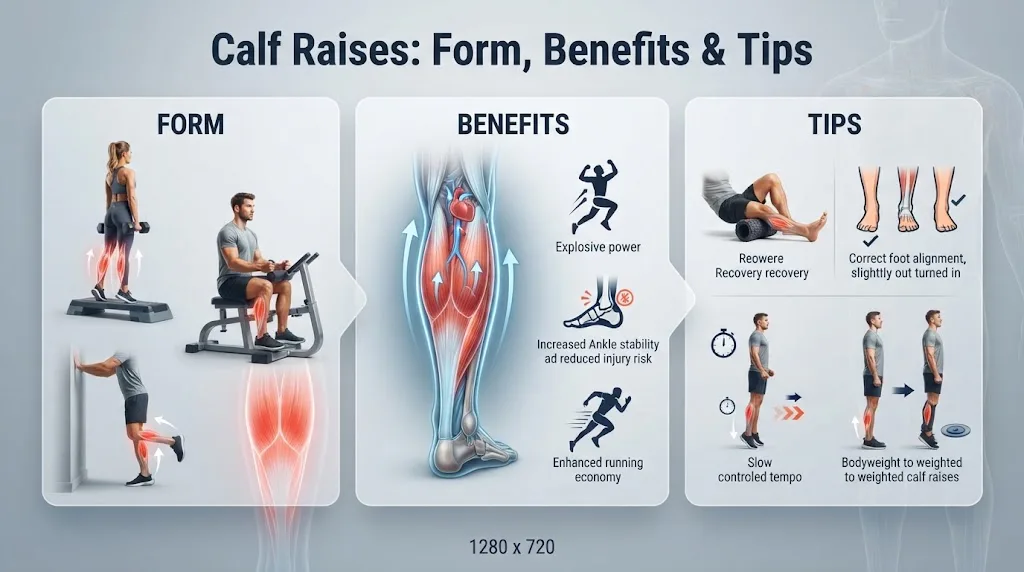

Calf raises are a simple strength exercise that targets the muscles at the back of the lower leg. The movement involves lifting your heels off the floor so your body rises onto the balls of your feet, then lowering with control. Calf raises can be performed with body weight, dumbbells, machines, resistance bands, or other forms of added resistance.
The main muscles involved are the gastrocnemius and soleus. The gastrocnemius is the larger, more visible calf muscle and works strongly when the knee is relatively straight. The soleus sits deeper and becomes particularly important when the knee is bent, which is why seated and standing calf raises can complement each other.
Calf raises are useful for much more than building visible lower-leg muscles. Strong calves contribute to walking, running, jumping, climbing stairs, and maintaining balance during everyday activity. Because the exercise requires little equipment and is easy to modify, it can fit into beginner workouts, strength programs, sports training, and many rehabilitation routines.
How to Do Standing Calf Raises Correctly
Begin by standing upright with your feet about hip-width apart and your weight distributed evenly across both feet. Keep your knees comfortably straight without forcefully locking them, and lightly hold a wall or stable surface if you need balance. Your toes should point mostly forward unless a slightly different foot position feels more natural for you.
Press through the balls of your feet and slowly raise your heels as high as you can without rolling your ankles outward. Pause briefly at the top and squeeze the calf muscles while maintaining your balance. Your body should move mostly upward rather than shifting forward, backward, or from side to side during each repetition.
Lower your heels slowly until they return to the floor, then repeat while keeping the movement controlled. Avoid bouncing through the bottom or using momentum to complete repetitions quickly. A slower lowering phase makes the calves work harder and can help you maintain better technique throughout the set.
Benefits of Calf Raises
One major benefit of calf raises is increased lower-leg strength. Strong calf muscles help create force when you push the ground away during walking, running, sprinting, and jumping. Developing this strength can make everyday activities such as climbing stairs, carrying groceries, or walking uphill feel easier and more controlled.
Calf raises can also improve muscular endurance. Your calves work repeatedly whenever you walk or stand for extended periods, so greater endurance can help them tolerate longer activity without becoming tired as quickly. Runners, hikers, field-sport athletes, and people who spend many hours on their feet may particularly benefit from better calf capacity.
Balance and ankle control may improve as well because calf raises challenge the muscles that stabilize the lower leg and foot. Single-leg variations increase this demand even more. Although calf raises cannot prevent every ankle or lower-leg injury, stronger tissues can help the body tolerate greater training loads and respond more effectively to everyday movement demands.
Standing vs Seated Calf Raises
Standing calf raises emphasize the gastrocnemius because this muscle crosses both the knee and ankle joints. When the knee remains relatively straight, the gastrocnemius is positioned to contribute strongly to plantar flexion, which is the action of pointing the foot downward. This makes standing variations useful for developing strength and size in the larger superficial calf muscle.
Seated calf raises place the knees in a bent position, which reduces the contribution of the gastrocnemius and places greater emphasis on the soleus. The soleus is especially important for walking, running endurance, and maintaining lower-leg stability. Training it directly can complement standing exercises rather than treating the two movements as interchangeable.
A balanced calf program can include both variations. You might perform standing raises on one training day and seated raises on another, or include both in the same session. The exact combination depends on your goals, equipment, and recovery, but training the calves with both straight-knee and bent-knee exercises can provide more complete development.
Common Calf Raise Mistakes
One common mistake is moving too quickly. Bouncing up and down may allow you to complete more repetitions, but momentum reduces how much controlled work the calf muscles perform. Slow down enough to feel the muscles working through the entire range, especially during the lowering phase where many people rush back to the starting position.
Another mistake is rolling the ankles outward or inward as the heels rise. This often happens when the resistance is too heavy or when balance becomes difficult. Focus on pressing through the base of the big toe and the ball of the foot while keeping the heel relatively centered, rather than allowing your weight to shift onto the outside edge.
Using too little range of motion can also limit the exercise. Try to rise comfortably onto the balls of your feet and lower with control rather than performing tiny pulses. However, do not force your heel into an extreme stretch if your ankle, Achilles tendon, or foot becomes painful at the bottom.
How Many Calf Raises Should You Do?
Beginners can start with two or three sets of around 10 to 15 controlled repetitions using body weight. If this feels challenging while your technique remains good, there is no need to add resistance immediately. Focus first on completing the full movement smoothly and feeling both calves working evenly throughout each set.
As the exercise becomes easier, increase the challenge gradually. You can add repetitions, use dumbbells, perform single-leg calf raises, or stand on a step to increase the available range of motion. Changing one variable at a time makes it easier to track progress and reduces the chance of suddenly overloading the calf or Achilles tendon.
For muscle growth and strength, the resistance should eventually become challenging enough that the final repetitions require real effort. You do not need to reach complete failure during every set. Consistent progressive overload, adequate recovery, and proper technique usually matter more than chasing extremely high repetition counts during every workout.
Calf Raises for Running and Sports
Running places repeated demands on the calf muscles and Achilles tendon with every step. Stronger calves can help produce force as the foot pushes away from the ground while also supporting ankle stability. Calf raises can therefore be useful accessory exercises for runners who want to improve lower-leg strength and prepare their tissues for repeated loading.
Athletes involved in basketball, football, tennis, volleyball, and other sports also rely heavily on their calves during jumping, sprinting, and rapid changes of direction. Calf raises cannot replace sport-specific training, but they can increase basic strength that supports these movements. Single-leg and loaded variations may be especially valuable once good technique is established.
Progression should still be gradual because runners and athletes already place substantial stress on the lower legs during their main training. Adding too many heavy calf exercises at once can create unnecessary soreness or overload. Consider total weekly running, jumping, and sport activity when deciding how much additional calf training your body can recover from comfortably.
Calf Raises and Knee Support
The calf muscles influence more than just the ankle because the gastrocnemius crosses the back of the knee. Strong lower-leg muscles can contribute to overall lower-body control during walking, running, and other weight-bearing movements. Calf strengthening is therefore often included alongside quadriceps, hamstring, and hip exercises in broader lower-body programs.
Calf raises are not a direct treatment for every type of knee pain, and discomfort around the knee can have many different causes. If you experience pain during extension, swelling, locking, or other symptoms, understanding knee pain when straightening the leg may help you recognize when the issue involves more than simple calf weakness.
When calf raises are comfortable, they can be one part of a balanced strengthening routine. Start with body weight and use support if necessary, especially if knee discomfort affects your balance. Stop or modify the exercise if it causes sharp knee pain, increasing swelling, or symptoms that continue worsening after the workout.
Single-Leg Calf Raises
Single-leg calf raises increase the difficulty because one calf must lift your entire body weight instead of sharing the load with the opposite leg. Stand near a stable surface for balance, lift one foot slightly off the floor, and raise the heel of the standing leg. Keep your pelvis level and avoid leaning heavily into the support.
This variation can reveal strength differences between your legs that are less obvious during two-legged exercises. One side may fatigue earlier, produce less range, or feel less coordinated. Small differences are common, but training each leg separately can help ensure the stronger side does not perform most of the work.
Begin with fewer repetitions than you would use for two-legged calf raises. If a full single-leg repetition is too difficult, use your opposite foot lightly for assistance or perform the upward phase with both feet before lowering on one leg. These modifications let you build strength progressively without sacrificing control.
Using a Step for Calf Raises
Performing calf raises on a step allows the heels to lower slightly below the level of the forefoot, creating a larger range of motion. Stand with the balls of your feet securely on the edge and hold a railing or sturdy surface for balance. Raise your heels under control, pause briefly, and then lower until you feel a comfortable stretch.
The extra range can make the exercise more challenging even without additional weight. Because the calf and Achilles tendon move through a deeper position, introduce this version gradually if you have only performed calf raises on a flat floor. Do not force the heels as low as possible simply because the step allows greater movement.
Safety matters because slipping from the edge can cause injury. Make sure the step is stable, your footwear has secure contact, and you have something reliable to hold when needed. People with significant Achilles pain, ankle injuries, or balance problems may be better starting on flat ground before attempting elevated variations.
How to Progress Calf Raises Safely
Progress should occur when your current variation feels manageable and you can maintain good form throughout every set. Add a small amount of weight, increase repetitions, or move to a harder variation instead of dramatically changing several variables at once. Gradual progression gives muscles and tendons time to adapt to greater loading.
You can hold dumbbells at your sides, use a calf raise machine, wear a weighted backpack, or use a Smith machine for additional resistance. Whichever option you choose, keep the movement controlled. Heavier weight is useful only when you can still reach a comfortable range without bouncing, shifting your weight, or losing ankle alignment.
Recovery also matters because calf muscles and the Achilles tendon can become irritated when training volume increases too quickly. Allow harder sessions to be separated by enough recovery that soreness does not continually worsen. If morning Achilles stiffness, persistent calf pain, or swelling begins developing, reduce the load and consider professional guidance if symptoms continue.
When Calf Raises May Not Be Appropriate
Calf raises can cause temporary muscle fatigue or mild soreness when you are new to the exercise, but sharp pain is different. Stop if you experience sudden calf pain, significant Achilles tendon pain, or difficulty bearing weight normally. Continuing to load an acutely injured muscle or tendon can make the problem more difficult to manage.
Calf swelling also deserves attention when it appears unexpectedly, especially if one leg becomes significantly more swollen, warm, red, or tender than the other. These symptoms should not automatically be treated as exercise soreness. Seek prompt medical evaluation because some causes of unexplained calf swelling require urgent treatment rather than stretching or strengthening.
People recovering from surgery, fractures, severe ankle injuries, or significant tendon problems should follow individualized rehabilitation advice. Calf raises may eventually become part of recovery, but the correct timing and resistance depend on the injury. A physical therapist or other qualified healthcare professional can help determine when loading is appropriate.
Conclusion
Calf raises are a simple but effective exercise for strengthening the gastrocnemius and soleus muscles. They can support walking, running, balance, jumping, and everyday lower-body movement while requiring very little equipment. Standing, seated, single-leg, and step variations allow the exercise to be adjusted for different fitness levels and training goals.
Proper form involves rising through the balls of the feet, maintaining stable ankle alignment, pausing briefly at the top, and lowering slowly. Avoid bouncing or rushing repetitions simply to complete more of them. As your calves become stronger, increase resistance or exercise difficulty gradually so the muscles and Achilles tendon can adapt safely.
Include calf raises as part of a balanced lower-body routine rather than relying on them as the only leg exercise. Combine them with appropriate training for the hips, thighs, and ankles while paying attention to pain or unusual swelling. With consistent practice and sensible progression, calf raises can be a valuable tool for improving lower-leg strength and function.
FAQs
What muscles do calf raises work?
Calf raises primarily work the gastrocnemius and soleus muscles at the back of the lower leg. Standing variations emphasize the gastrocnemius more, while bent-knee or seated raises increase the contribution of the soleus.
How many calf raises should beginners do?
Beginners can start with two or three sets of around 10 to 15 controlled repetitions. Increase repetitions or resistance gradually once the exercise feels easy and your technique remains consistent.
Are calf raises good for runners?
Yes. Calf raises can strengthen muscles used repeatedly during running and may improve lower-leg capacity. They should complement, rather than replace, gradual running progression and other strength exercises.
Should calf raises be done every day?
Daily light calf work may be comfortable for some people, but harder strength sessions generally require recovery. Avoid repeatedly training through significant soreness, Achilles pain, or declining exercise performance.
Why do my calves hurt after calf raises?
Mild muscle soreness can occur after unfamiliar or harder training and often settles within a few days. Sharp pain, severe swelling, or persistent Achilles discomfort should not be treated as normal exercise soreness.