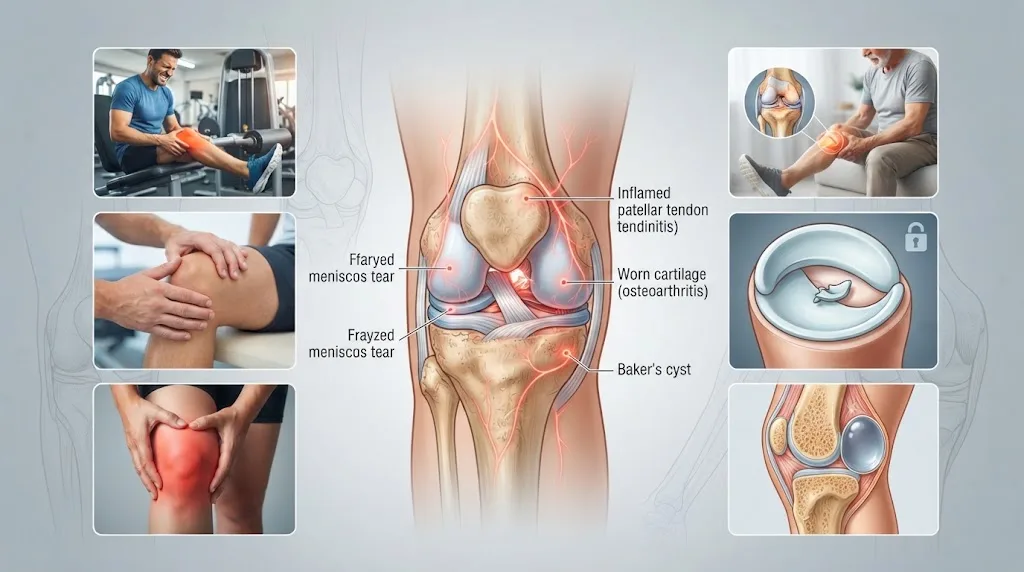

Knee pain when straightening the leg can come from several structures inside and around the joint. The kneecap, tendons, cartilage, meniscus, ligaments, and surrounding muscles all contribute to smooth knee movement. Pain may appear during the final part of straightening, after sitting, while walking, or when trying to fully extend the knee after exercise.
The location and type of pain can provide useful clues. Pain at the front of the knee may involve the kneecap or patellar tendon, while pain along the joint line can sometimes be related to the meniscus. Discomfort behind the knee may come from tight muscles, swelling, or other structures that become compressed when the leg reaches full extension.
Not every painful movement means serious damage is present. Temporary irritation after exercise, increased activity, or prolonged sitting can sometimes settle with load modification and gradual movement. However, locking, major swelling, instability, severe pain, or difficulty fully straightening the knee should be assessed by a qualified healthcare professional.
Patellofemoral Pain and Kneecap Irritation
Patellofemoral pain is a common cause of discomfort around or behind the kneecap. The kneecap moves within a groove at the front of the knee as the leg bends and straightens, and this area can become sensitive when training load increases. Pain may be more noticeable after stairs, squats, running, or prolonged sitting with the knees bent.
Several factors can contribute, including sudden increases in exercise, reduced hip strength, quadriceps weakness, and changes in movement habits. The condition does not necessarily mean the kneecap is permanently damaged or moving incorrectly. In many cases, symptoms improve when the knee is exposed to gradually increasing amounts of comfortable strength and activity.
Relief often involves reducing activities that clearly aggravate pain for a short period while maintaining tolerable movement. Strengthening the quadriceps, glutes, and hips can improve the knee’s ability to handle load. Squat depth, running volume, and stair activity may need temporary adjustment before being increased again as symptoms become more manageable.
Patellar Tendon Pain
The patellar tendon connects the kneecap to the shinbone and helps transfer force when the knee straightens. Repeated jumping, running, heavy squatting, and sudden increases in training can overload this tendon. Pain is usually felt just below the kneecap and may become especially noticeable when actively straightening the leg against resistance.
Patellar tendon irritation often develops gradually rather than after one obvious injury. Athletes involved in basketball, volleyball, sprinting, or strength training may notice pain during jumping or after repeated knee-dominant exercise. The tendon may also feel stiff after rest and become temporarily more comfortable once the body warms up.
Complete rest is not always the best long-term solution because tendons usually need progressive loading to regain capacity. Exercises such as controlled knee extensions, wall sits, or other resistance movements may be introduced at a tolerable level. If symptoms continue worsening despite sensible load changes, professional evaluation can help confirm the source of the pain.
Meniscus Problems
The menisci are cartilage structures inside the knee that help distribute pressure and improve joint stability. A meniscus can become irritated through repetitive deep bending or injured during twisting movements when the foot is planted. Pain may occur along the inner or outer joint line and can sometimes become more noticeable when the knee straightens fully.
Some meniscus injuries cause swelling, clicking, catching, or a sensation that something is blocking normal movement. A significant tear may make it difficult to fully straighten the knee, especially if a portion of tissue interferes mechanically with the joint. However, painless clicking alone is common and does not automatically mean the meniscus is damaged.
Mild meniscus-related symptoms may improve with activity modification and strengthening, particularly when there is no locking or major instability. Persistent swelling, repeated catching, or an inability to straighten the knee normally deserves clinical assessment. A healthcare professional can examine movement, joint-line tenderness, and other signs before deciding whether imaging or specialist care is appropriate.
Knee Osteoarthritis
Knee osteoarthritis involves changes within the joint that can affect cartilage, bone, and surrounding tissues over time. People may experience stiffness, aching, swelling, or reduced range of motion, especially after long periods of rest. Straightening the knee may feel uncomfortable when the joint is irritated or when swelling limits full extension.
Osteoarthritis is more common with increasing age, but structural changes do not always match the amount of pain someone experiences. Some people have visible joint changes with few symptoms, while others experience more noticeable discomfort. Activity, strength, body weight, sleep, previous injuries, and general health can all influence how the knee feels.
Exercise remains important because stronger muscles can help support the joint and improve daily function. Low-impact cardio, quadriceps strengthening, and gradual resistance training are often useful when adjusted to individual tolerance. Severe loss of motion, persistent swelling, or rapidly declining function should be discussed with a healthcare professional for a more specific treatment plan.
Hamstring and Calf Tightness
Tight or irritated muscles behind the thigh and lower leg can sometimes create discomfort as the knee approaches full extension. The hamstrings cross the back of the knee, while the calf muscles also influence movement around the joint. If these tissues are sore, fatigued, or recently strained, straightening the leg may create a pulling sensation rather than pain inside the joint itself.
This type of discomfort often appears after unfamiliar exercise, sprinting, long periods of sitting, or sudden increases in walking or running. The sensation may feel more like tension along the back of the leg than sharp pain at the kneecap. Gentle movement and gradual mobility work can help when the problem is mainly muscular.
Stretching should remain comfortable rather than aggressive. If extending the knee creates tingling, numbness, burning, or pain that travels far down the leg, nerve involvement may also need to be considered. Persistent symptoms are worth assessing because not every pulling sensation behind the knee is simply caused by tight hamstrings.
Swelling and Fluid Inside the Knee
Swelling inside the knee can make straightening uncomfortable because extra fluid changes pressure within the joint. This can happen after overuse, injury, arthritis flare-ups, or inflammation. The knee may feel stiff, full, or difficult to bend and extend normally, particularly after sitting or first getting up in the morning.
Small amounts of swelling may not always be obvious visually. You might instead notice that one knee feels tighter than the other or that the kneecap area feels less mobile. More significant swelling can make the knee look visibly enlarged and may limit both flexion and extension during normal walking or exercise.
Mild swelling after increased activity may improve with temporary load reduction and gentle movement. Rapid swelling after trauma, however, can indicate a more significant internal injury and deserves medical assessment. Redness, unusual warmth, fever, or severe tenderness also require attention because they can suggest causes beyond simple mechanical irritation.
Nerve-Related Pain Around the Knee
Nerve irritation can sometimes cause pain that is felt around the knee even when the source is higher in the leg, hip, or lower back. Burning, tingling, electric sensations, or numbness are more suggestive of nerve involvement than ordinary joint soreness. Straightening the leg may increase symptoms if the movement places more tension on an irritated nerve.
The sciatic nerve and its branches travel from the lower back through the leg, and irritation can occasionally produce symptoms near the knee. Pain may also be accompanied by discomfort in the buttock, thigh, calf, or lower back. If symptoms extend beyond the knee, understanding hip and lower back pain can help explain how nearby regions may contribute to leg symptoms.
Nerve-related pain should not be stretched aggressively without knowing what is causing it. Forceful hamstring stretching can sometimes make neural symptoms worse rather than better. Progressive weakness, persistent numbness, or pain traveling down the leg should be professionally evaluated so the treatment matches the actual source of irritation.
How to Relieve Knee Pain When Straightening the Leg
Start by reducing movements that clearly make the pain worse rather than avoiding all activity. You may temporarily limit heavy squats, repeated stairs, running, jumping, or deep knee bending if these activities trigger symptoms. Gentle walking and comfortable range-of-motion exercises can often keep the joint moving while irritated tissues settle.
Cold packs may help after activity when swelling or soreness is present, while warmth can feel better when stiffness is the main problem. Use either approach for short periods and protect the skin with a cloth barrier. Neither method fixes the underlying cause, but both may provide temporary relief that makes gentle movement more comfortable.
Over-the-counter pain medication can be appropriate for some people, but health conditions and other medications affect what is safe. A pharmacist or healthcare professional can provide guidance when needed. Long-term improvement usually depends more on restoring strength, controlling training load, and addressing the specific tissue involved than on relying only on symptom relief.
Exercises That May Help
Quadriceps strengthening can improve the knee’s ability to tolerate daily and exercise-related loading. Straight-leg raises, wall sits, step-ups, or controlled knee extensions can be useful depending on what feels comfortable. Begin with a level that does not cause sharp pain and gradually increase repetitions or resistance as the knee becomes more tolerant.
Glute and hip strengthening can also support better lower-body control. Exercises such as bridges, side steps, and split squats may improve stability around the pelvis and knee. These movements can be especially useful when the knee tends to move inward or when lower-body strength has decreased after a period of reduced activity.
Range-of-motion exercises can help when stiffness is limiting full extension. Gently straightening and bending the knee within a comfortable range may restore movement gradually. Avoid forcing the joint into a painful end position, especially when swelling, locking, or a recent injury is present.
When Knee Pain Is More Concerning
A knee that suddenly locks and cannot fully straighten should be assessed because a mechanical problem may be blocking movement. This can sometimes happen with certain meniscus injuries or loose tissue inside the joint. Repeated attempts to force the knee straight may worsen pain and are unlikely to resolve a true mechanical block.
Rapid swelling, severe pain after trauma, or inability to bear weight are also reasons to seek medical evaluation. A loud pop followed by instability can indicate ligament or other internal injury. These symptoms are different from mild exercise-related soreness and should not be managed by simply waiting for the pain to disappear.
Seek urgent care if the knee becomes very red, hot, swollen, and painful alongside fever or feeling significantly unwell. New calf swelling, severe calf tenderness, chest pain, or shortness of breath also require prompt assessment. These symptoms can be associated with conditions that need medical treatment rather than home rehabilitation.
How to Prevent Knee Pain During Everyday Movement
Build lower-body strength gradually so the knee is prepared for the activities you ask it to perform. Sudden jumps in running mileage, squat volume, or sports intensity can overload tissues that were tolerating a lower workload. Increasing training step by step allows muscles, tendons, and joints time to adapt to greater demands.
Regular movement can also reduce stiffness from long periods of sitting. Stand up, walk briefly, or gently bend and straighten the knees throughout the day rather than staying in one position for hours. Movement variety is generally more useful than trying to maintain one supposedly perfect sitting or standing posture.
Footwear, exercise surfaces, sleep, and overall recovery may also influence how the knee handles training. There is rarely one single factor responsible for pain, so prevention works best when several habits are addressed together. Consistent strength work and sensible progression are usually more valuable than relying on stretching alone.
Conclusion
Knee pain when straightening the leg can come from the kneecap, patellar tendon, meniscus, arthritis, muscle tightness, swelling, or nerve irritation. The location of the pain and whether symptoms include clicking, numbness, swelling, or locking can provide useful clues. Not every painful knee movement means serious damage is present.
Relief often begins with temporary activity modification, gentle movement, and progressive strengthening. Quadriceps, hip, and glute exercises can improve the knee’s ability to tolerate load, while mobility work may help when stiffness is present. Avoid forcing full extension when sharp pain, swelling, or mechanical blocking makes the movement difficult.
Seek professional assessment for locking, severe swelling, instability, inability to bear weight, progressive weakness, or persistent symptoms that do not improve. Urgent evaluation is appropriate for significant redness, fever, or other concerning signs. When serious causes are excluded, gradual rehabilitation can often help restore comfortable knee movement and confidence.
FAQs
Why does my knee hurt when I fully straighten it?
Pain with full extension can come from kneecap irritation, tendon problems, swelling, meniscus issues, or muscle tightness. The exact cause depends on where the pain is located and what other symptoms are present.
Can a meniscus tear cause pain when straightening the knee?
Yes. Some meniscus injuries cause joint-line pain, swelling, catching, or difficulty fully straightening the knee. Mechanical locking or repeated inability to extend the leg should be medically assessed.
Should I exercise if my knee hurts when I straighten it?
Gentle exercise may be appropriate when symptoms are mild and stable. Reduce painful movements and choose comfortable strengthening options, but seek evaluation if exercise causes worsening pain, swelling, locking, or instability.
Can tight hamstrings cause knee pain when straightening?
Yes. Tight or irritated hamstrings can create pulling discomfort behind the knee during extension. However, tingling, numbness, or radiating pain may suggest nerve involvement rather than simple muscle tightness.
When should I worry about knee pain when straightening?
Seek medical care for severe pain, locking, rapid swelling, instability, inability to bear weight, or symptoms after major trauma. Redness, fever, or significant calf swelling also require prompt evaluation.