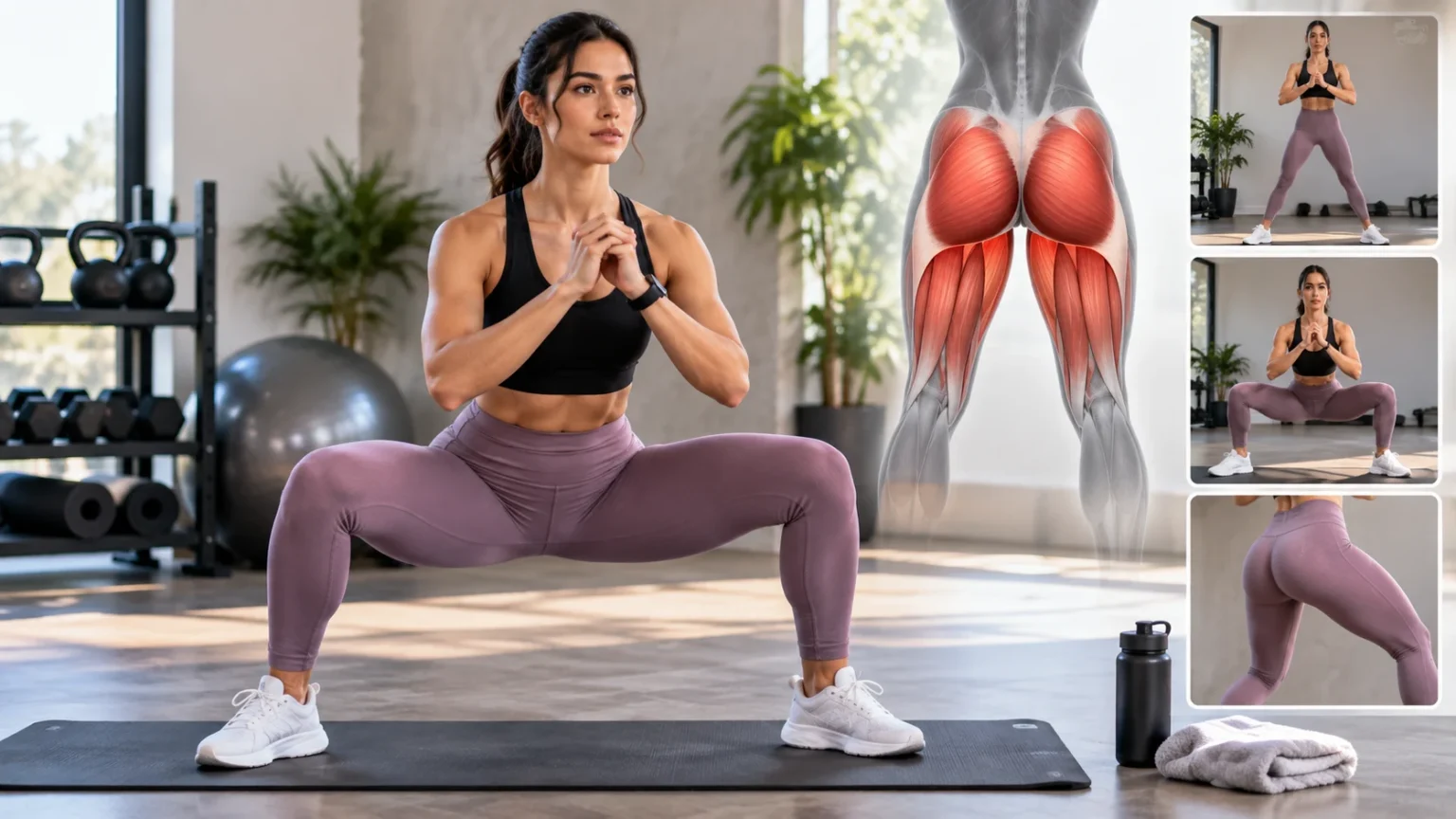

Sumo squats are a lower-body exercise performed with a wider stance and more outward foot rotation than a traditional squat. This position changes how your hips and legs share the workload, placing noticeable emphasis on the inner thighs, glutes, and quadriceps. When performed with controlled technique, sumo squats can be a useful addition to strength, mobility, and general fitness routines.
Many people add sumo squats to their workouts because they want stronger glutes or more inner-thigh engagement. However, the movement involves several muscle groups working together rather than isolating one specific area. Your core, calves, hamstrings, and hip stabilizers also contribute to keeping your body balanced and maintaining good alignment throughout each repetition.
Understanding which muscles sumo squats work is only part of using the exercise effectively. Your stance width, foot angle, squat depth, and ability to control your knees and pelvis can all influence how the movement feels. Learning proper form first helps you train more comfortably before adding dumbbells, kettlebells, or heavier resistance.
What Do Sumo Squats Work?
Sumo squats primarily work the quadriceps, gluteus maximus, adductors, and other muscles around the hips and thighs. Because your feet are positioned wider than in a standard squat, your inner thighs often contribute more strongly to controlling the movement. Your glutes also help extend the hips as you stand back up from the bottom position.
The quadriceps on the front of your thighs remain important because they help straighten your knees during the upward phase. Your hamstrings contribute to hip control and stability, although they are not usually the main muscles driving the exercise. Muscles around your ankles and calves also help maintain balance, especially when you squat through a comfortable range of motion.
Your core plays an important supporting role as well. Abdominal and spinal stabilizing muscles help keep your torso controlled while your hips and knees move through the squat. This makes the sumo squat a compound exercise, meaning several joints and muscle groups work together rather than one muscle being trained completely in isolation.
Which Muscles Do Sumo Squats Target Most?
The gluteus maximus is one of the major muscles involved in sumo squats because it helps extend your hips as you rise. A wider stance may also require additional work from muscles that stabilize and rotate the hip. If you control the lowering phase and drive upward without letting your knees collapse inward, your glutes can contribute effectively throughout the movement.
Your adductors, commonly called the inner-thigh muscles, are another important group. These muscles help control your hips and thighs while supporting the wider stance used in a sumo squat. The adductor magnus can contribute significantly to hip extension, particularly when you move from a deeper position back toward standing.
The quadriceps remain heavily involved because the knees bend and straighten during every repetition. How much each muscle contributes can vary based on body proportions, stance width, depth, mobility, and resistance. Rather than trying to force the exercise into one specific muscle, focus on smooth mechanics that allow your hips, thighs, and core to work together.
Sumo Squats vs. Regular Squats
A regular squat usually uses a stance around shoulder width, with the feet facing forward or turned slightly outward. A sumo squat uses a noticeably wider stance and generally more external rotation at the hips. This wider position changes the movement mechanics and often creates a stronger sensation through the inner thighs and muscles surrounding the hips.
Both exercises work the quadriceps and glutes, so one is not simply a replacement for the other. Traditional squats may feel more natural for some people and can be excellent for building general lower-body strength. Sumo squats provide another stance variation that can challenge the hips and adductors differently while still training many of the same major muscles.
Your anatomy can influence which variation feels most comfortable. Hip structure, ankle mobility, leg length, flexibility, and previous training experience can all affect squat mechanics. You do not need to force an extremely wide stance because it looks more like a sumo position; your goal should be a stable stance that allows smooth movement without pain.
How to Do a Sumo Squat Correctly
Begin by standing with your feet wider than shoulder width and turning your toes outward slightly. Brace your midsection and keep your chest comfortably upright while distributing your weight across your whole foot. Your exact stance does not need to match someone else’s because the most comfortable width will depend partly on your hip structure and mobility.
Push your hips back slightly while bending your knees and lowering your body toward the floor. Allow your knees to travel in roughly the same direction as your toes rather than collapsing inward. Descend only as far as you can while maintaining balance, foot contact, and control through your trunk, hips, and knees.
Pause briefly near the bottom if you can maintain good positioning, then push through your feet to stand. Think about straightening your knees and extending your hips together rather than suddenly throwing your body upward. Finish tall without aggressively leaning backward or squeezing your glutes so forcefully that your pelvis moves into an uncomfortable position.
Common Sumo Squat Mistakes to Avoid
One common mistake is choosing a stance that is much wider than your available hip mobility allows. An excessively wide position can make it difficult to keep your feet planted or maintain comfortable knee alignment. Start moderately wide and adjust gradually until you find a stance where you can squat smoothly without pinching, sharp pain, or excessive compensation.
Another problem occurs when the knees collapse inward during the lowering or rising phase. Try to keep your knees tracking in the general direction of your toes while maintaining contact through the heel, forefoot, and outer edge of each foot. You should not aggressively force your knees outward, but they should remain controlled instead of drifting unpredictably.
Rounding the lower back or leaning excessively forward can also reduce control. Some forward torso movement is normal, and the exact amount differs between people, but the spine should feel stable. Reducing the squat depth or resistance is often more productive than forcing yourself deeper while losing balance, changing pelvic position dramatically, or struggling to maintain good technique.
What Are the Benefits of Sumo Squats?
Sumo squats can strengthen several major lower-body muscle groups in one movement. They train the quadriceps, glutes, adductors, and hip stabilizers while also requiring core control and balance. Because the exercise uses a different stance from standard squats, it can add useful variety to a lower-body workout without requiring complicated equipment.
The wider stance also gives the hip adductors an opportunity to work through a different position. Strong adductors contribute to hip stability and are involved in activities such as walking, running, changing direction, and controlling the legs during many exercises. Training these muscles alongside the glutes and quadriceps can support a more balanced lower-body strength program.
Sumo squats are also easy to modify based on experience. Beginners can perform them with body weight, while more advanced exercisers can add a kettlebell, dumbbell, barbell, or other form of resistance. The movement can therefore remain useful as your strength improves, provided you increase difficulty gradually rather than sacrificing form simply to lift heavier loads.
Should You Use Weights for Sumo Squats?
Bodyweight sumo squats are often enough when you are first learning the movement. They allow you to practice foot position, knee tracking, balance, and squat depth without worrying about controlling an additional load. You can also slow the lowering phase or briefly pause at the bottom to make bodyweight repetitions more challenging before adding resistance.
A dumbbell or kettlebell can be held in front of the body once your technique feels comfortable. This is commonly called a goblet-style or weighted sumo squat, depending on how the load is held. Start with a manageable weight that allows you to complete your repetitions without losing control, rushing through the range, or changing your stance dramatically.
More experienced lifters may use heavier resistance, but progressive overload should remain gradual. Adding weight can increase the strength challenge, yet more resistance is not automatically more effective if your mechanics deteriorate. Increase the load only when your current resistance feels controlled and you can maintain consistent technique from the first repetition to the last.
How Sumo Squats Affect the Pelvic Floor and Hips
Squats involve coordinated movement around the hips, pelvis, abdomen, and trunk, so your pelvic floor participates as part of the broader pressure-management system. Breathing naturally and avoiding unnecessary straining can help you maintain control. Holding your breath aggressively or bearing down during every repetition may create more pressure than needed, particularly when using heavier resistance.
Some people already experience excessive tension or discomfort around the pelvic region, and aggressively forcing wide or deep squats may not feel appropriate for them. If this sounds familiar, learning more about tight pelvic floor muscles can provide useful background on symptoms, possible contributing factors, and when professional assessment may be appropriate.
Exercise should not produce pelvic pain, sharp groin pain, unusual pressure, or other concerning symptoms. If sumo squats consistently trigger discomfort, reduce the stance width, range of motion, or resistance and assess how you feel. Persistent symptoms are a reason to seek individualized guidance from an appropriate healthcare or rehabilitation professional rather than repeatedly pushing through pain.
How Many Sumo Squats Should You Do?
The ideal number of sumo squats depends on your training goal, exercise experience, and the resistance you use. Beginners practicing bodyweight technique might start with two or three sets of approximately 8–15 controlled repetitions. The exact number matters less than maintaining consistent form and finishing each set without pain or major breakdown in technique.
For muscle and strength development, resistance should eventually be challenging enough that the final repetitions require meaningful effort while remaining controlled. You might use fewer repetitions with heavier loads or moderate repetitions with manageable resistance. There is no single repetition range that everyone needs because training volume should reflect your broader workout program, recovery, and current ability.
You also do not need to perform sumo squats every day. Lower-body muscles require recovery after challenging resistance training, particularly when exercises are taken close to muscular fatigue. Including the movement one to three times per week may be reasonable for many routines, depending on how many other squats, lunges, deadlifts, and leg exercises you already perform.
How to Make Sumo Squats More Effective
Prioritize range of motion you can control rather than automatically trying to squat as deeply as possible. A deeper squat is not necessarily better if your heels lift, knees collapse, or pelvis shifts into an uncomfortable position. Over time, mobility and strength improvements may allow you to increase depth naturally while maintaining better control throughout the exercise.
Tempo is another simple way to make the exercise more challenging. Lowering yourself over two or three seconds and pausing briefly near the bottom increases time under tension without requiring much additional weight. This can help beginners become more aware of their movement and prevent the bouncing or rushing that sometimes occurs during high-repetition bodyweight squats.
You can also progress by increasing resistance gradually or adding complementary lower-body exercises. Lunges, Romanian deadlifts, step-ups, hip thrusts, and conventional squats train overlapping muscles through different movement patterns. A balanced program generally produces better results than relying on one squat variation for every goal related to strength, muscle development, stability, or athletic performance.
Who Should Be Careful With Sumo Squats?
People with current hip, knee, groin, or lower-back pain should avoid assuming that sumo squats will automatically solve the problem. The wider stance may feel comfortable for some individuals and irritating for others. Pain during the exercise is a reason to change the movement or seek appropriate professional advice rather than forcing more repetitions because the exercise is considered beneficial.
Previous injuries can also influence squat tolerance. Someone recovering from surgery, a significant muscle strain, joint injury, or pelvic health problem may require modifications based on their individual condition. Generic form advice cannot account for every injury history, so a physical therapist, sports medicine professional, or qualified rehabilitation provider may recommend a different stance, depth, or exercise.
People without existing problems should still progress gradually. Muscle fatigue is expected during strength training, but sharp pain, numbness, sudden weakness, or persistent joint discomfort should not be treated as normal training sensations. Paying attention to how your body responds makes it easier to distinguish productive effort from symptoms that deserve further assessment.
Conclusion
Sumo squats work several major muscles at the same time, particularly the glutes, quadriceps, and inner-thigh adductors. The wide stance changes how your hips and legs manage the movement compared with a traditional squat. Your core, hamstrings, calves, and hip stabilizers also contribute by helping you maintain balance and controlled alignment throughout each repetition.
Good technique matters more than creating the widest stance or deepest squat possible. Position your feet comfortably, keep your knees tracking with your toes, maintain full-foot contact, and lower only as far as you can control. Begin with body weight and gradually add resistance once your movement feels stable and repeatable.
Sumo squats can be a useful part of a balanced lower-body routine, but they do not need to replace every other squat or leg exercise. Combine them with other movements and allow adequate recovery between challenging workouts. If the exercise causes persistent hip, knee, groin, back, or pelvic discomfort, modify it and seek professional guidance when needed.
FAQs
Do sumo squats work your glutes?
Yes. The gluteus maximus contributes to hip extension as you rise from the bottom of a sumo squat. Your stance, depth, resistance, and individual anatomy can influence how strongly you feel the glutes working.
Do sumo squats work the inner thighs?
Yes. Sumo squats involve the hip adductors, which are located along the inner thighs. The wide stance places these muscles in a position where they help control the hips and contribute to the upward movement.
Are sumo squats better than regular squats?
Neither variation is universally better. Both train the lower body, but the different stance changes how muscles contribute. Using both variations can provide useful movement variety when each can be performed comfortably and with good control.
How wide should your stance be for sumo squats?
Start slightly wider than shoulder width and adjust according to your hip mobility and comfort. Your stance should allow your knees to follow your toes while keeping your feet stable and the movement free from sharp pain.
Can beginners do sumo squats?
Yes. Beginners can start with bodyweight sumo squats and a comfortable range of motion. Practice balance and technique first, then gradually add repetitions or resistance once you can perform the movement consistently without pain.