
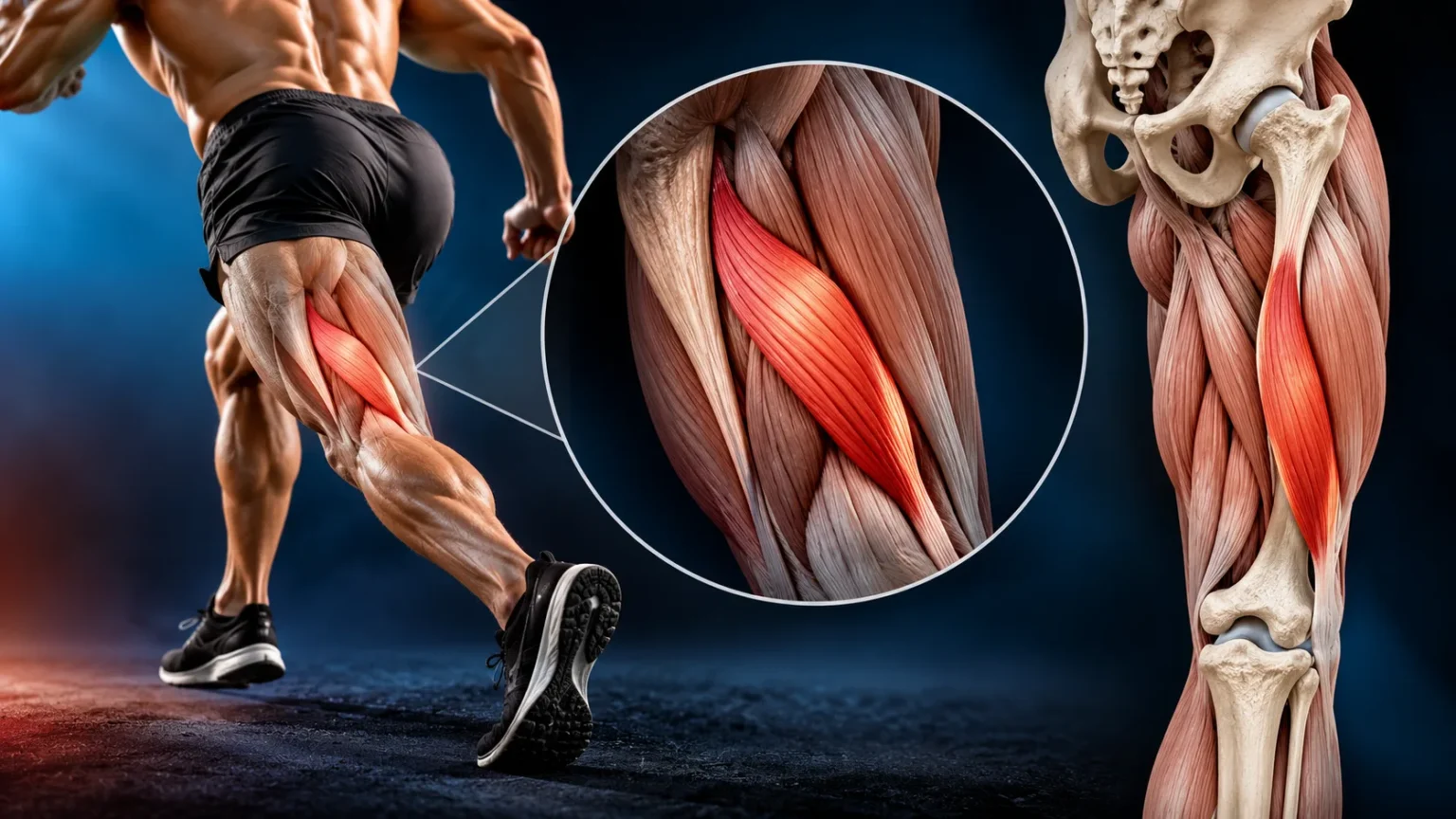

The biceps femoris, sometimes casually called the “bicep femoris,” is one of the major hamstring muscles located along the back of the thigh. It plays an important role in bending the knee, extending the hip, and controlling leg movement during walking, running, jumping, and many sports. Because it crosses important joints, it is exposed to considerable force during physical activity.
Understanding biceps femoris anatomy can help explain why this muscle is frequently involved in hamstring strains and pain around the back or outer side of the knee. Its two distinct heads have different origins but join near the lower thigh. Learning how the muscle functions, what can irritate it, and how it is strengthened can support safer exercise and better movement awareness.
What Is the Biceps Femoris?
The biceps femoris is one of three main muscles commonly grouped together as the hamstrings. The other two are the semitendinosus and semimembranosus. All three run along the back of the thigh and contribute to movements involving the hip and knee, although each muscle has slightly different attachment points and functions.
The name “biceps” refers to the muscle having two heads. These are known as the long head and the short head of the biceps femoris. Both eventually come together toward the lower thigh and share a tendon that attaches mainly near the head of the fibula on the outer side of the lower leg.
Because of its location, the biceps femoris can be felt working during activities such as hamstring curls, sprinting, climbing stairs, or pushing the leg backward. It is especially important for controlling forceful lower-body movements. Its position also explains why irritation can sometimes be experienced near the back or outside of the knee.
Where Is the Biceps Femoris Located?
The biceps femoris runs along the back and outer portion of the thigh. The long head begins higher up near the pelvis, while the short head starts from the back of the femur. The two sections travel downward before joining together as they approach the knee.
At the lower end, the biceps femoris tendon attaches primarily to the fibular head, a small bony area on the outer side just below the knee. This attachment makes the muscle easy to identify during knee flexion. If you bend your knee against resistance, the tendon can often be felt along the outer back edge of the knee.
Its position places the biceps femoris close to several other structures, including nerves, ligaments, and tissues surrounding the knee. Because many structures occupy this area, pain there cannot always be confidently blamed on one muscle. Persistent symptoms may require a broader assessment of the thigh, knee, and lower back.
Biceps Femoris Long Head Anatomy
The long head of the biceps femoris begins at the ischial tuberosity, commonly known as one of the sit bones. This upper attachment means it crosses both the hip and knee joints. As a result, the long head contributes to movement and stability at both areas rather than working only around the knee.
Because it crosses the hip, the long head helps extend the thigh backward. This movement occurs during walking, running, climbing, and rising from a bent position. It also assists with knee flexion and helps control the leg when the body is moving quickly or changing direction.
The long head is commonly involved in hamstring injuries because it can experience high levels of tension during sprinting. Rapid hip flexion combined with knee extension places substantial strain on the muscle. Sudden acceleration, high-speed running, and explosive movements may therefore challenge this part of the hamstring complex.
Biceps Femoris Short Head Anatomy
The short head of the biceps femoris starts from the back of the femur rather than the pelvis. Because of this origin, it crosses only the knee joint. It does not directly contribute to hip extension in the same way as the long head.
Its main functions include helping bend the knee and assisting with outward rotation of the lower leg when the knee is flexed. This rotational role contributes to control during walking, running, and direction changes. The short head also works alongside the long head to stabilize the outer part of the knee.
Although the short head is less frequently discussed than the long head, it remains important for coordinated knee movement. Weakness or injury can influence how the lower leg moves under load. Exercises that train knee flexion can usually engage both heads of the biceps femoris when performed with appropriate resistance.
What Does the Biceps Femoris Do?
One of the primary functions of the biceps femoris is knee flexion, which means bending the knee. This happens when you bring your heel toward the back of your thigh. Walking, running, climbing stairs, and performing leg curls all require the hamstrings to contribute to this movement.
The long head also helps extend the hip, meaning it assists in moving the thigh backward. Hip extension is essential during running, jumping, standing up, and many lifting exercises. The biceps femoris works with the gluteal muscles and other hamstrings to produce and control this movement.
Another function is external rotation of the lower leg when the knee is bent. This allows the shin to rotate slightly outward. Although the movement is relatively small, it contributes to knee control during sports and everyday activities that involve turning, stepping, or changing direction.
Biceps Femoris During Walking and Running
During walking, the biceps femoris helps control the leg as it swings forward and prepares for the foot to contact the ground. It assists in slowing knee extension before the next step. This controlled action helps keep movement smooth rather than allowing the lower leg to swing forward without muscular control.
Running places much greater demands on the muscle. During high-speed movement, the hamstrings lengthen while producing force as the leg swings forward. The biceps femoris then contributes to pulling the leg backward and helping generate powerful hip extension as the body moves into the next stride.
This combination of rapid lengthening and force production helps explain why hamstring injuries are common among sprinters and athletes. Sudden increases in speed, fatigue, inadequate conditioning, or returning to high-intensity activity too quickly may increase stress on the muscle beyond what it can comfortably tolerate.
Common Causes of Biceps Femoris Pain
Biceps femoris pain can develop after a sudden strain, repetitive overuse, or excessive training volume. Sprinting, jumping, kicking, and fast direction changes are common situations in which the muscle may become injured. Symptoms may appear suddenly during activity or gradually after repeated loading.
Tendon irritation can also occur near the lower attachment around the fibular head. This can create tenderness near the outer back portion of the knee. Because several structures can cause back knee pain, discomfort in this area should not automatically be assumed to come from the biceps femoris.
Pain higher in the thigh may be more consistent with a hamstring strain, especially when symptoms began during sprinting or forceful movement. Bruising, weakness, swelling, or difficulty walking can indicate a more significant injury. Severe or persistent symptoms are better assessed professionally than treated only with stretching.
Biceps Femoris Strain Symptoms
A mild biceps femoris strain may feel like tightness, soreness, or pulling along the back and outer side of the thigh. The discomfort can become more noticeable when bending the knee against resistance or stretching the hamstrings. Walking may remain possible, although faster movements can feel uncomfortable.
More significant strains can cause sudden sharp pain during activity. Some people describe feeling a pulling, tearing, or snapping sensation at the time of injury. Swelling and bruising may develop later, and running or even walking normally can become difficult depending on the severity.
Not every pain behind the thigh is a hamstring strain. Lower back or nerve-related problems can also create discomfort that travels through the leg. Numbness, tingling, or burning sensations are less typical of a straightforward muscle strain and may require a different type of assessment.
How to Strengthen the Biceps Femoris
Hamstring curls are one of the most direct ways to strengthen the biceps femoris. They can be performed using machines, resistance bands, or other equipment. Focus on controlled knee bending and avoid using momentum to move through the exercise, especially when starting with a new resistance level.
Hip hinge exercises such as Romanian deadlifts can train the long head because they involve significant hip extension. These movements also strengthen the glutes and other hamstring muscles. Proper technique matters because excessive rounding or uncontrolled loading can shift stress toward areas that are not prepared for it.
Nordic hamstring exercises can provide a more advanced strengthening challenge, particularly through eccentric loading. They should generally be introduced gradually because they can create substantial muscle soreness. Building strength over time rather than suddenly adding demanding hamstring exercises can improve training tolerance and reduce unnecessary overload.
How to Stretch the Biceps Femoris
A gentle standing hamstring stretch can lengthen the biceps femoris and other muscles along the back of the thigh. Place one heel on a low stable surface, keep the knee comfortably straight, and hinge forward slightly from the hips. Stop when you feel mild tension rather than trying to reach the toes.
A seated variation can also work well. Sit near the front of a chair, extend one leg with the heel on the floor, and gently lean forward while keeping the spine relatively long. The stretch should be felt mainly through the back of the thigh without sharp pain around the knee.
Stretching should not be aggressive after a suspected muscle injury. If the hamstring has recently been strained, forceful stretching can irritate healing tissue. Comfortable mobility may be appropriate, but severe pain, bruising, or weakness should be evaluated before attempting deeper flexibility work.
How to Reduce the Risk of Biceps Femoris Injury
Gradual training progression is one of the most practical ways to reduce excessive stress on the hamstrings. Avoid suddenly doubling sprint volume, adding heavy deadlifts, or returning immediately to maximum intensity after a long break. Muscles and tendons need time to adapt to higher workloads.
Regular hamstring strengthening can also improve the ability to tolerate running, lifting, and sports. Include both knee-flexion and hip-extension exercises so the muscle is challenged through its main functions. Eccentric training can be particularly valuable when introduced progressively and performed with appropriate technique.
A proper warm-up can help prepare the lower body for faster or heavier activity. Light jogging, dynamic leg movements, and gradually increasing exercise intensity are practical options. The warm-up should match the demands of the activity rather than relying entirely on long static stretches before explosive exercise.
When Should You See a Healthcare Professional?
Consider professional evaluation if biceps femoris pain persists for several weeks or repeatedly returns when you exercise. Ongoing weakness, reduced movement, or difficulty returning to normal activities may indicate that the muscle has not recovered fully. A clinician or physiotherapist can assess strength and movement more specifically.
Seek care sooner if the pain began with a sudden tearing sensation or is accompanied by substantial bruising or swelling. Inability to walk normally or bend the knee against light resistance can suggest a more significant injury. Severe trauma around the thigh or knee should also be assessed promptly.
Numbness, tingling, progressive weakness, or pain extending from the lower back into the leg may suggest nerve involvement rather than an isolated hamstring problem. Urgent care is needed for major neurological symptoms such as loss of bladder or bowel control or severe sudden weakness.
Conclusion
The biceps femoris is an important hamstring muscle located along the back and outer portion of the thigh. Its two heads contribute to knee flexion, lower-leg rotation, and, in the case of the long head, hip extension. These functions make it essential for walking, running, lifting, and athletic movement.
Because the muscle handles substantial force, it can become strained during sprinting, jumping, sudden direction changes, or rapid increases in training. Gradual strengthening, appropriate warm-ups, controlled mobility, and sensible workload progression can support healthy function. Stretching should remain comfortable and should never be forced through a suspected injury.
Pain around the biceps femoris does not always mean the muscle itself is damaged. Knee structures, nerves, and nearby tendons can produce similar symptoms. Persistent pain, major weakness, bruising, or neurological symptoms should be professionally assessed so the underlying cause can be identified accurately.
FAQs
Where is the biceps femoris located?
The biceps femoris runs along the back and outer side of the thigh. Its two heads join near the knee and attach mainly around the fibular head on the outer lower leg.
What is the main function of the biceps femoris?
Its main functions are bending the knee and rotating the lower leg outward when the knee is flexed. The long head also helps extend the hip during walking, running, and lifting.
What causes biceps femoris pain?
Common causes include hamstring strains, overuse, sprinting, sudden acceleration, heavy exercise, and tendon irritation near the knee. Pain from nerves or nearby knee structures can sometimes feel similar.
How do you strengthen the biceps femoris?
Hamstring curls, Romanian deadlifts, bridges, and appropriately progressed Nordic hamstring exercises can strengthen the muscle. Resistance should increase gradually while technique and comfortable movement remain the priority.
How long does a biceps femoris strain take to heal?
Recovery time depends on the severity of the strain and individual factors. Mild injuries may improve relatively quickly, while larger strains can take much longer and may require structured rehabilitation.