
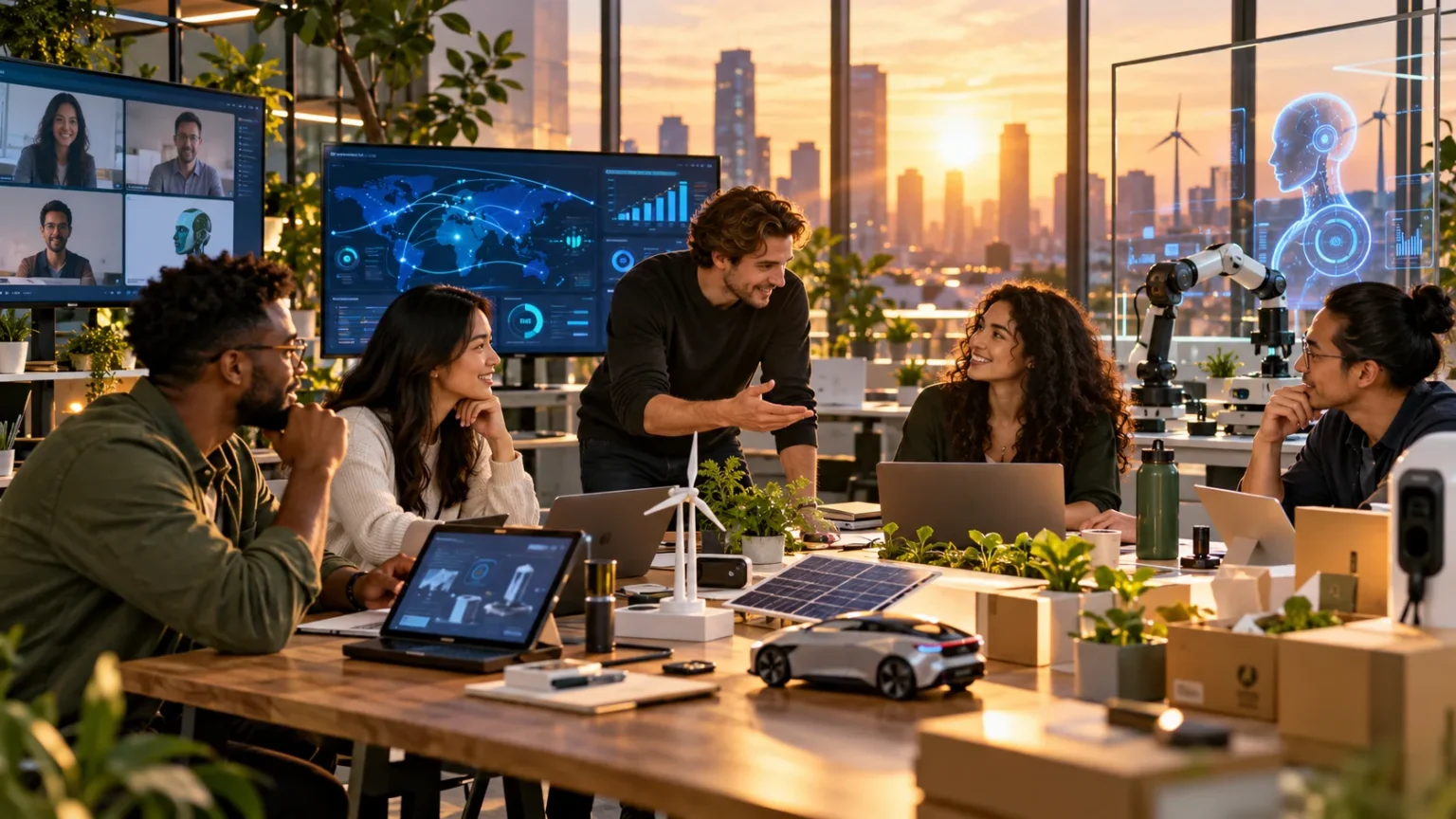

The startup landscape in 2026 is being shaped by rapid advances in artificial intelligence, robotics, energy technology, cybersecurity, financial infrastructure, and scientific computing. Founders are moving beyond experimental technology and looking for ways to solve practical business problems. At the same time, investors are concentrating significant capital in companies capable of building defensible technology and turning innovation into measurable outcomes.
For entrepreneurs, following startup trends should not mean copying whatever category receives the most attention. A promising opportunity still needs genuine customer demand, sustainable economics, strong execution, and a clear competitive advantage. Understanding where technology, customer budgets, and investor interest are moving can nevertheless help founders recognize problems that may become increasingly important.
The best startup trends to watch in 2026 show a noticeable shift from software experimentation toward real-world implementation. AI is becoming more specialized, intelligent systems are entering physical environments, and infrastructure is becoming increasingly important. These developments are creating opportunities for founders who can combine emerging technology with practical customer needs and reliable business models.
AI Agents Move From Experiments to Real Workflows
AI agents remain one of the most important startup trends in 2026, but expectations are becoming more practical. Businesses increasingly want systems that can complete useful tasks across existing tools rather than simply produce impressive demonstrations. Agentic software can potentially handle workflows involving customer support, research, sales operations, software development, reporting, and administrative processes.
This creates opportunities for startups that integrate AI with the systems where companies already work. Businesses need agents that can safely access databases, applications, documents, APIs, and internal processes while maintaining appropriate permissions. Products that reduce manual work without requiring customers to redesign their entire technology stack may be particularly attractive.
The challenge is reliability. Companies will be less interested in agents that work occasionally and more interested in systems that produce predictable outcomes, handle exceptions, and allow human oversight when necessary. Founders building in this category should therefore focus on workflow completion, measurable productivity, integration quality, and trust instead of marketing their products only around AI capabilities.
Vertical AI Becomes More Important
Generic AI applications face increasing competition because similar features can often be reproduced quickly. Vertical AI takes a different approach by building products specifically for industries such as legal services, construction, insurance, healthcare, logistics, accounting, manufacturing, or financial services. Industry-specific knowledge can create a stronger product advantage than offering the same general AI experience to everyone.
Vertical AI startups can build around specialized workflows, regulations, terminology, datasets, and purchasing requirements. An AI platform designed specifically for insurance claims, for example, can understand documents and approval processes that generic productivity software may not handle effectively. This specialization can create deeper integrations and make products harder for customers to replace.
Founders should still avoid adding AI to an industry simply because the category is attracting investment. The strongest opportunities are likely to appear where customers already spend significant money or employee time completing inefficient processes. When specialized AI can reduce those costs while fitting existing workflows, the commercial value becomes much easier to demonstrate.
Physical AI and Robotics Continue Accelerating
Robotics has become one of the most visible startup sectors in 2026 as AI increasingly moves beyond screens and into physical environments. Crunchbase reported that global robotics startups had already raised more funding during part of 2026 than during the entire previous year, reflecting increased interest in intelligent machines and industrial automation.
Opportunities extend beyond humanoid robots. Startups are developing systems for manufacturing, warehouses, construction, agriculture, logistics, inspection, autonomous vehicles, and specialized industrial tasks. Improvements in AI models, sensors, computing, and robotics hardware are allowing machines to handle increasingly complex environments rather than performing only highly repetitive programmed actions.
Building physical technology is considerably harder than launching a typical software application. Hardware development, manufacturing, maintenance, safety, and deployment can require substantial capital and expertise. Founders entering robotics therefore need a strong understanding of the specific operational problem and a realistic path from prototype to reliable commercial deployment.
AI Infrastructure, Compute, and Energy Become Bigger Markets
The AI boom is creating opportunities far beyond companies building models and applications. Data centers, chips, networking, inference infrastructure, developer tools, cooling, energy systems, and other supporting technologies are becoming increasingly important. McKinsey’s 2026 technology research highlights both rapidly increasing AI infrastructure spending and the growing importance of the energy required to support computing demand.
Startups may find opportunities by reducing the cost or complexity of running AI systems. Businesses increasingly need better inference efficiency, model deployment, monitoring, data infrastructure, compute management, and tools that help engineering teams use multiple models effectively. Infrastructure that makes AI faster, cheaper, or more reliable can create value even when customers never see the underlying technology.
Energy is becoming part of this infrastructure conversation because large-scale computing requires significant electricity. That creates potential markets around power generation, storage, grid technology, cooling, efficiency, and data-center infrastructure. Founders should look for bottlenecks created by AI adoption rather than assuming every promising AI company needs to build an end-user application.
Cybersecurity Expands for the Agentic AI Era
Cybersecurity is changing as organizations introduce AI agents capable of accessing data and performing actions without constant human involvement. Traditional identity and access controls were largely designed around human users and conventional applications. Autonomous systems create additional questions around permissions, monitoring, data access, accountability, and what happens when an agent behaves unexpectedly.
This creates opportunities for startups working on machine identity, AI governance, data security, access control, monitoring, threat detection, and secure agent infrastructure. Companies need to understand which agents exist, what information they can access, and which actions they are authorized to perform. Security systems may increasingly need to treat autonomous software as another category of active user.
Founders can also explore tools that help companies safely deploy AI rather than simply blocking it. Businesses want productivity improvements, so security products that enable controlled adoption may be more useful than solutions that add unnecessary friction. Clear auditing, policy enforcement, incident detection, and permission management can become valuable components of enterprise AI infrastructure.
Climate and Energy Technology Remain Important
Energy demand is creating renewed attention around climate and clean technology. Crunchbase reported continued substantial investment in cleantech during 2026 despite AI receiving much of the venture industry’s attention. Areas attracting interest include electricity generation, energy storage, grid infrastructure, electric transportation, advanced materials, and technologies supporting more efficient industrial operations.
The opportunity is increasingly connected to practical infrastructure rather than sustainability messaging alone. Data centers, electrification, manufacturing, transportation, and expanding computing requirements all create demand for reliable and affordable energy. Startups that improve efficiency or remove infrastructure bottlenecks may therefore serve both environmental and economic needs.
Climate technology can require longer development timelines than conventional software, particularly when products involve hardware, manufacturing, permitting, or scientific research. Founders should understand capital requirements and customer adoption cycles before entering the market. Strong opportunities are more likely when technology can demonstrate clear financial benefits alongside environmental improvements.
AI-Driven Biotech and Scientific Discovery Grow
Artificial intelligence is increasingly moving into scientific research, particularly biotechnology and drug discovery. Startups are developing models that analyze molecular information, identify potential drug candidates, support laboratory research, and help researchers navigate enormous biological datasets. Several large 2026 funding rounds have gone to companies operating at the intersection of AI and biotechnology.
The broader opportunity involves using computing to accelerate scientific work that traditionally requires significant time and manual experimentation. AI can help researchers prioritize promising candidates, analyze complex information, or design experiments more efficiently. Similar approaches may expand into materials science, chemistry, agriculture, and other research-intensive industries.
However, scientific startups face challenges that ordinary software companies rarely encounter. Laboratory validation, regulation, clinical development, specialized talent, and long research timelines remain important. Founders need credible scientific expertise and should avoid assuming that better AI models alone can eliminate the physical experimentation required to produce reliable scientific results.
Fintech Shifts Toward Financial Infrastructure
Fintech in 2026 is increasingly focused on infrastructure rather than simply launching another consumer financial application. Areas receiving attention include payments infrastructure, real-time money movement, stablecoins, fraud prevention, embedded financial services, and tools that help businesses manage complex financial operations. Industry discussions increasingly emphasize durable financial systems rather than growth based primarily on aggressive customer acquisition.
Stablecoins are particularly interesting because they can potentially support faster cross-border settlement and digital financial infrastructure. Startups are also developing tools around treasury management, compliance, payment orchestration, international business transactions, and financial APIs. Businesses that operate across several countries may provide especially strong use cases for improved money movement.
Regulation remains central to fintech strategy. Founders should understand licensing, compliance, fraud risks, customer protection, and the jurisdictions where they intend to operate. A technically strong financial product can still struggle if compliance is considered only after launch, making regulatory knowledge a potential competitive advantage rather than simply an administrative requirement.
Defense and Dual-Use Technology Attract Capital
Defense technology has moved much closer to the mainstream venture ecosystem. Crunchbase reported record levels of funding for defense-related startups in 2026, with investment flowing into autonomous systems, aerospace, national security software, robotics, space technology, and other advanced systems.
Some technologies in this category can also have civilian applications. Navigation, drones, satellites, cybersecurity, communications, logistics, sensing, manufacturing, and autonomous systems may serve commercial markets alongside government customers. This dual-use approach can potentially give startups multiple routes to revenue while supporting substantial research and development.
The market is still difficult for inexperienced founders because government procurement, regulation, security requirements, manufacturing, and long sales cycles create significant barriers. Success may depend as much on navigating institutional buying processes as developing impressive technology. Founders need patience, specialist knowledge, and enough capital to survive longer commercialization timelines.
Capital Efficiency Matters Despite Record Funding
Headline startup funding figures can create the impression that capital is easily available in 2026. In reality, much of the extraordinary increase in venture investment has been concentrated in a relatively small number of enormous deals, particularly within AI. Crunchbase reported that a majority of global funding during the first half of 2026 went into billion-dollar-plus rounds.
For most new founders, this makes capital efficiency just as important as technological ambition. Startups need to demonstrate that spending produces meaningful progress through revenue, customer adoption, technical milestones, or defensible intellectual property. Businesses that require continuous funding without proving demand may find fundraising considerably harder than headline market totals suggest.
AI may also allow smaller teams to accomplish work that previously required larger organizations. Automation across software development, research, marketing, support, and operations can potentially reduce some staffing requirements. Founders who combine these productivity improvements with disciplined spending may be able to reach meaningful milestones before raising very large financing rounds.
Conclusion
The best startup trends to watch in 2026 reflect a broader movement from experimentation toward useful implementation. AI agents, vertical AI, robotics, cybersecurity, financial infrastructure, energy technology, scientific computing, and advanced physical systems are all creating new business opportunities. The strongest startups will likely focus on solving expensive real-world problems rather than simply attaching new technology to existing ideas.
Founders should also recognize how closely many of these trends are connected. AI requires compute and energy, autonomous agents create cybersecurity requirements, robotics combines software with physical infrastructure, and biotechnology increasingly combines scientific expertise with advanced computing. Valuable startup opportunities can often appear at the intersection of several developing markets.
Most importantly, a popular trend does not automatically create a successful startup. Founders still need customer validation, a strong value proposition, sustainable economics, and excellent execution. Use trends to identify changing problems and emerging opportunities, then build around customer needs that remain valuable even after the initial excitement around a technology begins to fade.
FAQs
What are the biggest startup trends in 2026?
Major 2026 trends include AI agents, vertical AI, robotics, AI infrastructure, cybersecurity, energy technology, AI-driven biotechnology, fintech infrastructure, and advanced physical technologies serving industrial or government markets.
Is AI still a good startup opportunity in 2026?
AI continues creating significant opportunities, but generic applications face increasing competition. Founders may find stronger differentiation through specialized workflows, proprietary data, deep integrations, industry expertise, or measurable business outcomes.
Is robotics a growing startup sector?
Yes. Robotics and physical AI have attracted substantial investment as intelligent systems expand into manufacturing, logistics, construction, autonomous systems, and other physical environments where automation can create measurable operational value.
Which startup trends are suitable for bootstrapped founders?
Vertical software, AI-enabled services, workflow automation, specialized B2B tools, and certain fintech or cybersecurity applications may be more accessible than capital-intensive areas such as robotics, biotechnology, energy infrastructure, or advanced manufacturing.
How should founders choose a startup trend to pursue?
Start with a real customer problem rather than the trend itself. Evaluate demand, competition, founder expertise, capital requirements, margins, regulatory barriers, and whether your startup can build a meaningful advantage in that market.