
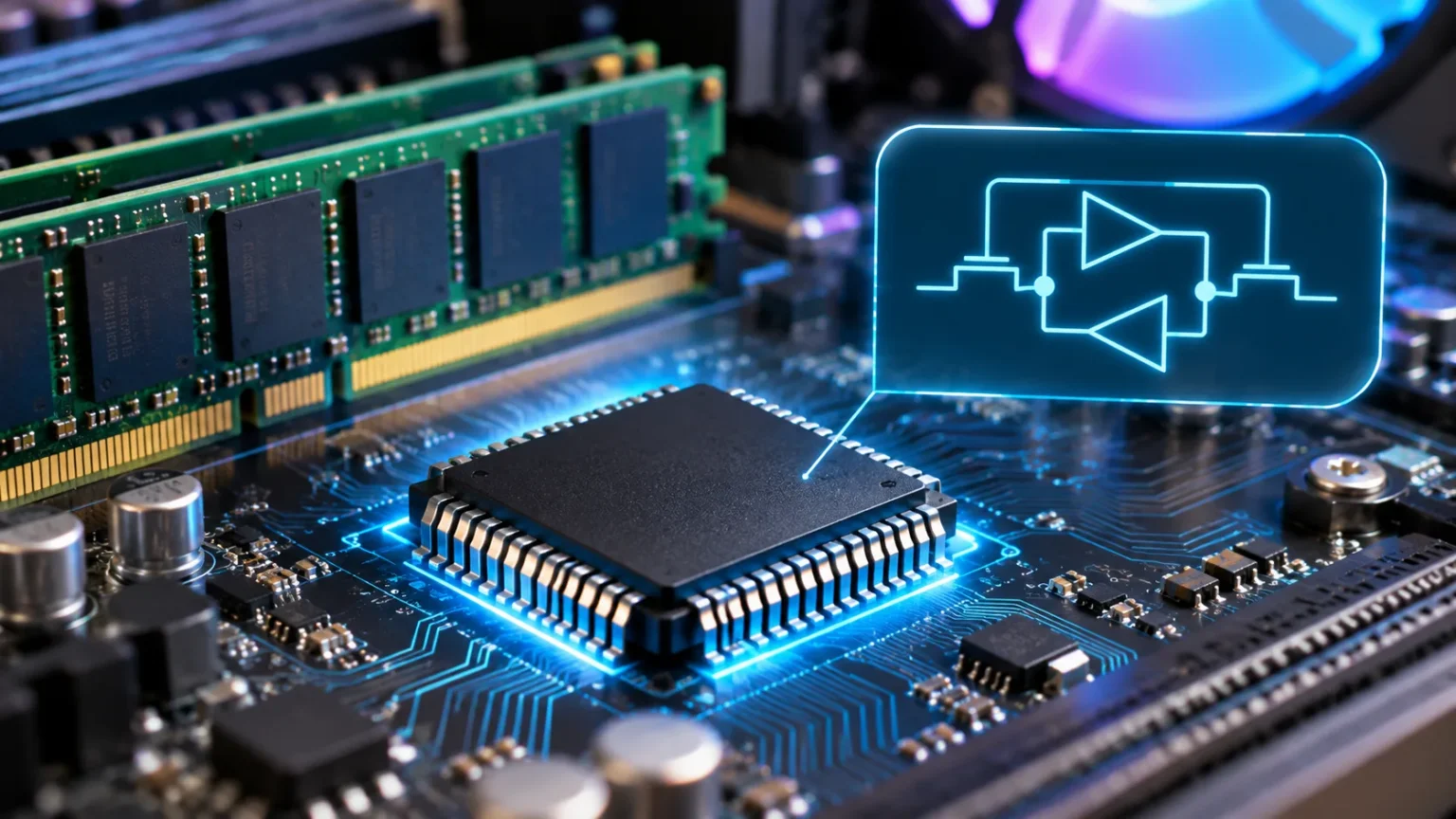

What Is SRAM Memory in a Computer?
SRAM memory, or Static Random Access Memory, is a type of computer memory designed to store data temporarily while providing extremely fast access. It uses electronic circuits to hold information as long as power remains available. Unlike ordinary system RAM, SRAM does not require regular refreshing to maintain stored data. This makes it useful for high-speed computing operations.
SRAM plays an important role in modern processors because computers frequently need immediate access to instructions and information. Instead of retrieving every piece of data from slower main memory, processors can use SRAM-based caches to store frequently needed information. This reduces waiting time and supports faster processing. As a result, SRAM contributes to overall computer performance and responsiveness.
Although SRAM offers excellent speed, it is more expensive and requires more chip space per stored bit than other common memory technologies. Therefore, manufacturers generally use it in relatively small quantities where fast access provides the greatest benefit. Understanding how SRAM memory works helps explain why processors have different cache levels and how computer memory systems improve efficiency.
How Does SRAM Memory Work?
SRAM memory works by storing binary information inside electronic circuits built from transistors. Each memory cell maintains one bit of information, represented as either zero or one. These cells are arranged into organized memory arrays that allow electronic components to locate stored information. The design makes it possible to access data quickly without repeatedly restoring it through periodic refresh cycles.
A typical SRAM cell uses six transistors arranged to create a stable electronic circuit. Four transistors form two connected inverters that maintain the stored value, while two additional transistors control access to the cell. This arrangement preserves information while the circuit receives sufficient electrical power. The stored state changes only when a write operation occurs or when power is interrupted.
When a processor needs information, the memory system selects the appropriate SRAM location and reads its stored value. The process happens electronically through control signals and connected data lines. Because SRAM cells maintain their states without refresh operations, they can respond efficiently to memory requests. This capability makes SRAM especially valuable in applications where low latency and predictable performance matter.
How SRAM Stores Data Using Transistors
Transistors are the fundamental electronic components that allow SRAM memory cells to hold digital information. A transistor can control electrical current and participate in circuits representing binary values. In a conventional six-transistor SRAM design, connected circuits maintain two opposing logic states. These states represent the information stored inside each memory cell until another operation changes the value.
The central storage structure consists of two cross-coupled inverters that reinforce each other’s electrical state. When one internal node represents a high logic level, the other represents a low level. This arrangement creates a stable condition that can persist while power remains connected. The circuit does not require a separate capacitor to store each bit.
Two access transistors connect the storage circuit to external bit lines when the appropriate word line becomes active. These connections allow information to move between the SRAM cell and supporting memory circuitry. When the word line becomes inactive, the cell remains isolated from those data lines. Its internal transistor arrangement continues holding the previously stored binary value.
How SRAM Reads and Writes Information
Reading information from SRAM begins when the memory controller or associated circuitry selects a particular location. A word line activates the access transistors, connecting the selected cell to its bit lines. In many designs, the bit lines are prepared before this operation to support accurate detection. A sensing circuit then identifies the stored value without intentionally changing it.
Writing data involves applying the desired binary value through the appropriate bit lines. The memory circuit activates the selected word line, allowing the external signals to establish the new internal state. Once the desired value is stored, the word line becomes inactive again. The SRAM cell then maintains this updated information until another write operation occurs or power disappears.
Read and write operations must be carefully designed to avoid accidental changes or unreliable electrical behavior. Engineers consider signal timing, voltage levels, transistor characteristics, and circuit stability when creating SRAM systems. Proper design helps cells retain information during normal operations while allowing intentional updates. These requirements become especially important as integrated circuits contain increasingly large numbers of densely arranged transistors.
Why SRAM Does Not Need Refreshing
SRAM is called static memory because it can maintain stored information without periodic refresh operations. Its transistor-based storage circuit continuously reinforces the stored logic state while sufficient electrical power is available. This differs from dynamic memory, which stores information using electrical charge that gradually leaks away. The difference affects how these two memory technologies operate.
Dynamic Random Access Memory, or DRAM, requires refreshing because its storage capacitors cannot hold electrical charge indefinitely. Memory controllers periodically restore the information inside DRAM cells to prevent data loss. SRAM avoids this particular requirement through its stable circuit structure. However, maintaining that state still consumes electrical power, including leakage power in modern transistor technologies.
The word static does not mean that SRAM can preserve information after a computer shuts down. SRAM is volatile memory, so its stored contents disappear when electrical power is removed. It also should not be confused with permanent storage technologies such as flash memory. Its main advantage is retaining active data without refresh cycles while delivering fast access during normal computer operations.
Where Is SRAM Memory Used in Computers?
One of the most common uses of SRAM memory is inside the processor’s cache system. CPU caches temporarily store instructions and data that the processor may need again soon. Keeping this information close to processing units reduces repeated requests to slower main memory. This arrangement helps computers perform calculations and execute software instructions more efficiently during everyday activities.
SRAM is also used in various microcontrollers, networking devices, and specialized electronic systems. These applications may need fast temporary storage for program variables, communication buffers, or time-sensitive operations. In embedded systems, SRAM can provide predictable access times for tasks requiring careful timing. Its reliability and straightforward access make it suitable for many performance-sensitive hardware designs.
Some graphics processors, communication chips, and digital signal processors also incorporate SRAM structures for local storage. These memory areas may hold frequently accessed values, temporary calculations, or information shared between processing components. The exact amount and organization depend on the device’s intended purpose. Designers select SRAM when performance benefits justify its additional area and power requirements.
How SRAM Works as CPU Cache Memory
CPU cache memory provides a fast storage area between the processor’s execution units and the computer’s main memory. Most conventional CPU caches use SRAM because it can deliver information with very low access latency. The processor checks appropriate cache levels when requesting instructions or data. If the needed information is available, execution can continue without waiting for a slower memory access.
Modern processors commonly organize cache memory into levels called L1, L2, and L3. L1 cache is generally the smallest and fastest, positioned close to individual processor cores. L2 provides additional capacity, while L3 often serves multiple cores and offers a larger shared storage area. These levels balance access speed, capacity, and hardware complexity to improve overall performance.
When requested information is found in the cache, the event is known as a cache hit. A cache miss occurs when the requested information is unavailable at the checked cache level. The processor may then access another cache level or retrieve data from main memory. Efficient caching reduces slow memory requests and helps processors complete workloads with fewer interruptions.
SRAM vs DRAM: What Is the Difference?
SRAM and DRAM are both forms of volatile random access memory, but their internal designs are different. SRAM typically uses multiple transistors to maintain each stored bit, while conventional DRAM uses one transistor and one capacitor per bit. These different structures influence speed, storage density, and manufacturing costs. Both technologies remain important in modern computing systems.
SRAM generally provides faster access and does not need periodic refreshing, making it suitable for processor caches. DRAM offers much higher storage density and a lower cost per bit, allowing manufacturers to build large memory modules economically. Consequently, computers commonly use DRAM as their primary system memory. SRAM supports smaller, performance-critical storage areas closer to processing components.
Power consumption also depends on how the memory is designed and used. SRAM avoids DRAM refresh operations but can consume significant leakage power, especially when large arrays remain active. DRAM requires refreshing, yet its dense storage cells make it practical for large memory capacities. Neither technology is universally better because each serves different performance, capacity, and cost requirements.
How SRAM Improves Computer Speed and Performance
SRAM improves processing efficiency by reducing the time required to access frequently used instructions and data. Modern processors can perform operations rapidly, but accessing main memory often takes considerably longer. Cache systems built with SRAM help bridge this performance difference. By storing useful information near processor cores, computers can reduce delays that would otherwise interrupt execution.
The performance benefits of SRAM depend on how effectively the cache stores information needed by running programs. Applications with repeated data access patterns often benefit from high cache hit rates. Programs working with large datasets may experience more cache misses when their active information exceeds available capacity. Therefore, cache organization and software behavior influence actual performance.
SRAM also supports technologies such as instruction caching, data buffering, and fast lookup structures within processing hardware. These applications help electronic systems manage information without repeatedly accessing slower storage locations. However, increasing SRAM capacity does not automatically guarantee proportional performance improvements. Engineers must balance memory size, access latency, bandwidth, and power consumption when designing efficient computing architectures.
Advantages of SRAM Memory
The biggest advantage of SRAM memory is its ability to provide very fast access to stored information. Its circuit structure avoids periodic refresh cycles, allowing memory systems to respond efficiently to processor requests. This makes SRAM valuable for applications requiring low latency and rapid data transfers. High-speed cache memory is one of the clearest examples of this advantage.
Another benefit is the stable storage behavior of properly designed SRAM cells while electrical power remains available. Their internal circuits maintain information without relying on charge stored in individual capacitors. This simplifies certain memory access requirements and supports predictable performance. Such characteristics are useful in processors, embedded controllers, networking equipment, and specialized digital electronics.
SRAM also offers flexibility for designers developing performance-sensitive electronic systems. Engineers can organize SRAM into different capacities, word sizes, and memory structures based on application requirements. These configurations can support temporary processing data, hardware buffers, and tightly coupled memory. When used appropriately, SRAM helps improve system responsiveness and reduces dependence on slower memory components.
Disadvantages and Limitations of SRAM Memory
Despite its performance advantages, SRAM memory has important limitations that prevent it from replacing every other memory technology. A conventional SRAM cell requires several transistors to store a single bit of information. This design occupies more chip area than a typical DRAM cell. Consequently, creating large SRAM capacities is expensive and consumes valuable semiconductor space.
Power consumption is another consideration, particularly when SRAM arrays contain many cells. Although SRAM does not require refresh cycles, its transistors can consume leakage power even while holding unchanged information. Active read and write operations also require energy. Hardware designers must carefully manage these power demands, especially in battery-powered devices and systems with strict thermal limits.
SRAM capacity is therefore usually much smaller than the main memory available in a computer. Manufacturers prioritize SRAM for tasks where speed is particularly valuable rather than using it for bulk data storage. Additionally, SRAM loses stored information when power is removed. These limitations explain why computers combine different memory technologies instead of depending entirely on SRAM.
The Future of SRAM in Modern Computer Technology
SRAM continues to play an important role as processors become more advanced and computing workloads grow increasingly demanding. Modern applications require efficient access to information for tasks involving artificial intelligence, graphics processing, and scientific calculations. Designers continue refining SRAM structures to improve performance and energy efficiency. These improvements help support increasingly complex processor and system architectures.
Semiconductor manufacturers are also working to address challenges involving transistor scaling, power leakage, and memory density. Smaller manufacturing processes can introduce new difficulties in maintaining stable SRAM operations under changing electrical conditions. Engineers must consider cell reliability, operating voltage, and physical design. Improvements in circuit techniques and manufacturing technologies may help overcome some of these limitations.
Future computing systems will likely continue combining SRAM with DRAM and other specialized memory technologies. Emerging processor architectures may use different memory arrangements to support particular workloads and performance requirements. However, SRAM’s ability to provide fast, directly accessible temporary storage remains highly valuable. Its continued development will help influence the performance and efficiency of future electronic devices.
Conclusion
SRAM memory is an important part of modern computer architecture because it provides fast and reliable temporary data access. Its transistor-based storage cells maintain binary information while power remains available without requiring periodic refreshing. This makes SRAM particularly suitable for CPU caches and other performance-sensitive applications. Understanding its operation helps explain how computers reduce memory access delays.
Although SRAM offers excellent speed, its higher cost, lower storage density, and power requirements limit its practical capacity. Computers therefore combine SRAM with DRAM and permanent storage technologies to meet different computing needs. Each memory type contributes distinct advantages to the overall system. Together, these technologies provide an effective balance between performance, capacity, and affordability.
As computer processors continue evolving, SRAM will remain an important technology for improving data access and processing efficiency. Advances in semiconductor design may help engineers develop more efficient memory structures while addressing current limitations. Whether used in processor caches or embedded systems, SRAM supports essential computing operations. Its speed and functionality make it a valuable component of modern digital hardware.
Frequently Asked Questions
What is SRAM memory used for in a computer?
SRAM memory is mainly used for CPU caches, temporary data buffers, and fast internal storage. It helps processors access frequently needed information quickly without repeatedly retrieving it from slower main memory.
Is SRAM faster than DRAM?
Yes, SRAM generally provides lower access latency than DRAM because of its circuit design and lack of periodic refresh requirements. However, SRAM costs more per bit and provides lower storage density.
Does SRAM lose data when power is turned off?
Yes, SRAM is volatile memory, meaning stored information disappears when electrical power is removed. Although it does not need periodic refreshing, it still requires power to maintain its stored binary values.
Why is SRAM used in CPU cache memory?
SRAM is used in CPU caches because it provides very fast access to instructions and data. This reduces processor waiting time and helps improve overall computing performance when frequently requested information remains cached.
What is the main difference between SRAM and DRAM?
SRAM typically stores data using multiple transistors per bit and does not require refreshing. DRAM uses capacitors that require periodic refreshing, but its higher density makes it more economical for large memory capacities.