
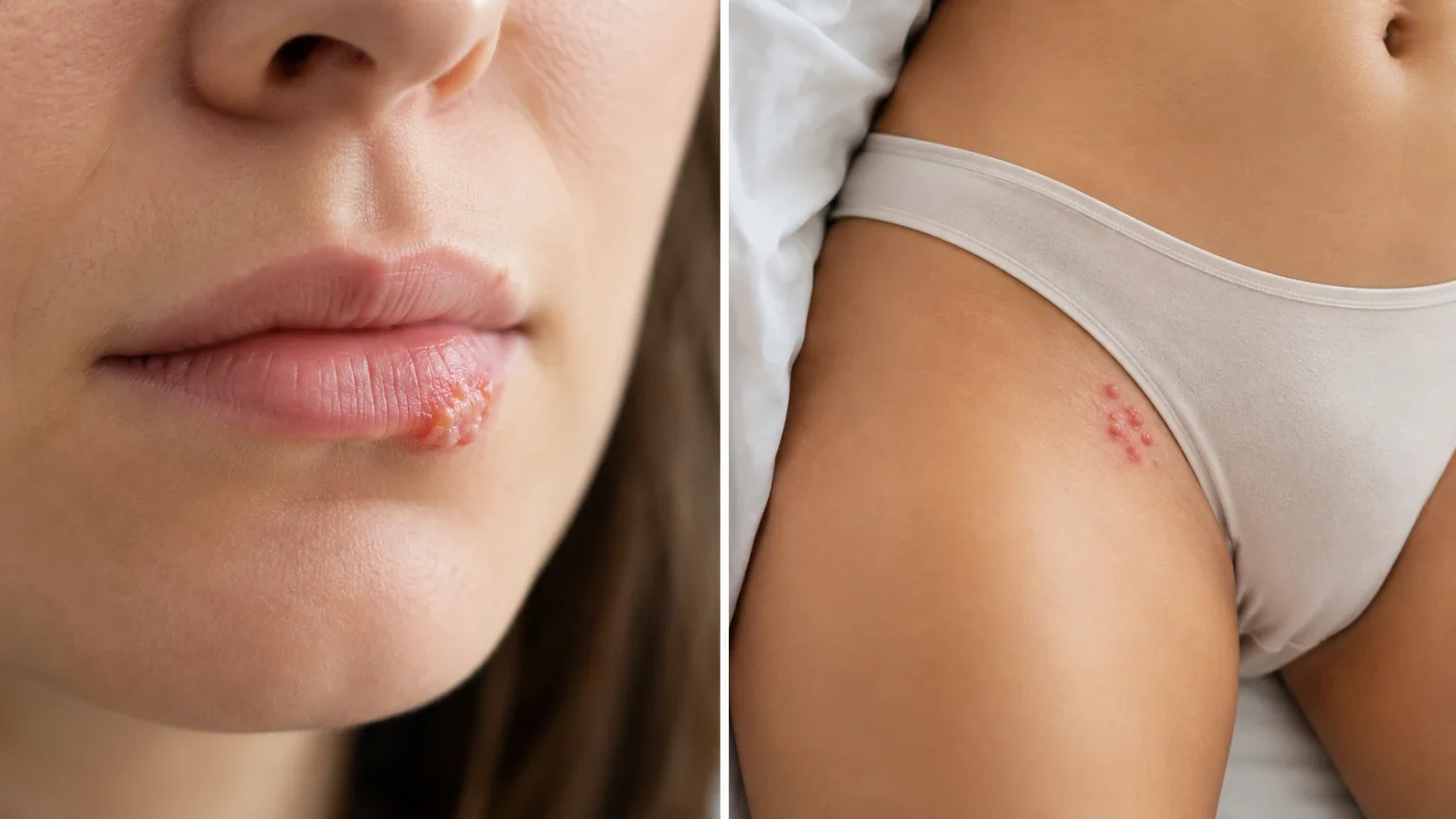

Herpes Pictures: What Oral and Genital Herpes Look Like
Looking at herpes pictures can be useful when you are trying to understand an unfamiliar blister, sore, rash, or irritated patch of skin. However, herpes simplex virus infections do not have one universal appearance, and real outbreaks can look less obvious than textbook photographs suggest. Some people develop clusters of fluid-filled blisters, while others notice only a tiny crack, red spot, shallow ulcer, or area that feels irritated. Many people with herpes have no recognizable symptoms at all, which means the absence of visible sores does not rule out infection. This guide explains what oral and genital herpes commonly look like while emphasizing when professional testing is more reliable than comparing symptoms with online photos.
Herpes simplex virus, usually shortened to HSV, exists mainly as HSV-1 and HSV-2. HSV-1 is commonly associated with oral herpes and cold sores, but it can also infect the genital area, particularly through oral-genital contact. HSV-2 primarily causes genital herpes and is usually transmitted through sexual contact involving genital or anal skin. Both types can remain in the body after infection and may reactivate periodically, although recurrence patterns differ between HSV-1 and HSV-2. Understanding those differences can make herpes pictures easier to interpret, but a photograph alone cannot determine which virus type is present or confirm that a suspicious lesion is herpes.
Herpes Pictures Can Help, but They Cannot Diagnose HSV
Herpes pictures usually show the most recognizable version of an outbreak: a group of small blisters positioned close together on reddened or irritated skin. These blisters may contain clear or slightly cloudy fluid before breaking and leaving shallow, painful sores. That classic appearance is useful for education, but many real cases never develop such a clear pattern, particularly when symptoms are mild. A person might instead notice one small bump, a tiny split in the skin, localized tenderness, itching, or a lesion that resembles an ordinary pimple. For this reason, comparing your skin with a herpes photo can provide clues, but it should not be treated as a definitive diagnostic method.
The appearance of herpes also changes considerably during different stages of an outbreak. Skin may initially look completely normal even though a person feels tingling, itching, burning, tenderness, or sensitivity in the area where lesions will later develop. Small red bumps or raised areas can appear next, sometimes followed by fluid-filled vesicles that become more noticeable over several hours or days. Once the blisters rupture, the affected area may resemble a scrape, cut, or shallow ulcer rather than the round blisters frequently shown in herpes pictures. Later, lesions begin drying and healing, so a photograph taken during the final stage may look very different from one taken early in the same outbreak.
Skin tone can further affect what herpes looks like in photographs and in everyday life. On lighter skin, inflammation surrounding herpes lesions may appear pink or bright red, whereas redness can be less obvious on brown or deeply pigmented skin. Instead, people may notice changes in texture, swelling, darker or lighter pigmentation, shiny skin, small fluid-filled bumps, or open areas that contrast subtly with surrounding tissue. Lighting, camera quality, dryness, shaving, friction, and previous scratching can also dramatically change how a lesion appears in a picture. Consequently, the absence of dramatic redness or textbook-looking blisters should never be used by itself to rule herpes in or out.
Another important limitation is that herpes can resemble numerous common skin and genital conditions. Pimples, folliculitis, razor burn, ingrown hairs, friction irritation, mouth ulcers, impetigo, contact dermatitis, and other infections may create bumps or sores that look surprisingly similar in photographs. Syphilis can also produce genital or oral sores, although a primary syphilis chancre is classically firm and painless rather than a painful cluster of blisters. These distinctions are useful but are not absolute, because infections do not always follow textbook descriptions. CDC guidance therefore emphasizes evaluating genital, anal, or perianal ulcers rather than relying only on their visual appearance.
The scale of HSV infection also explains why recognizing only dramatic herpes pictures can be misleading. WHO estimates that about 3.8 billion people under age 50 worldwide have HSV-1 infection and approximately 520 million people aged 15 to 49 have HSV-2 infection, yet most infections are asymptomatic or unrecognized. Some people never develop visible sores, while others mistake mild symptoms for shaving irritation, acne, or another minor skin problem. A person can therefore have HSV even when nothing visible resembles the images commonly found online. If you have a new unexplained genital sore, recurrent blister, painful ulcer, or concerning exposure, examination and appropriate testing provide far more useful information than image matching alone.
What Oral Herpes Looks Like
Oral herpes most often appears as a cold sore or group of cold sores around the lips or mouth. Before anything becomes visible, the affected area may tingle, itch, burn, sting, throb, or feel unusually sensitive for a day or two. Small, painful, fluid-filled blisters can then develop, often close together rather than as one isolated acne-like spot. The surrounding skin may become swollen or irritated, and several tiny blisters can merge into what appears to be one larger sore. Although the lips are the most recognizable location in oral herpes pictures, lesions can also develop around the mouth, beneath the nose, elsewhere on the face, or occasionally inside the mouth.
As oral herpes progresses, the fluid-filled blisters often break open and release a small amount of clear or cloudy fluid. The exposed surface may appear raw, moist, red, yellowish, or shallowly ulcerated, depending on the stage and the person’s skin tone. Afterward, the sore begins drying and may form a yellow, brown, or darker crust before gradually healing. This progression explains why two cold sore pictures can look completely unrelated even when both show HSV-1. The NHS describes cold sores as beginning with tingling, itching, or burning, followed within roughly 48 hours by painful blisters that eventually burst and crust over.
A first oral HSV infection can look different from the familiar single cold sore many adults recognize. When symptoms develop during an initial infection, particularly in children and younger people, multiple painful sores may occur inside the mouth or around the lips. The gums can become inflamed, eating or swallowing may hurt, and fever, swollen lymph nodes, headache, body aches, or sore throat can occur alongside the lesions. Because several mouth areas may be affected at once, the appearance can resemble severe mouth ulcers rather than one traditional fever blister. Later recurrences are commonly more localized and less severe than an initial symptomatic infection.
Cold sores should also be distinguished from canker sores, which are commonly confused with oral herpes. Canker sores usually occur inside the mouth, such as on the inner cheek, inner lip, tongue, or soft tissues, and often look like round or oval ulcers with pale centers. Typical recurrent cold sores more often develop along the outer lip border or nearby facial skin and commonly begin as fluid-filled blisters. A painful pus-filled facial bump can instead be a spot or boil, while red facial lesions that develop golden-brown crusting may indicate impetigo. Location and appearance provide useful clues, but persistent, unusually painful, widespread, or recurrent mouth sores may still require medical evaluation.
Oral herpes deserves more urgent attention when lesions occur near the eye or are accompanied by eye symptoms. HSV can affect the eye and potentially damage vision, so eye pain, light sensitivity, excessive watering, a gritty sensation, or a herpes-like sore close to the eye should prompt urgent professional assessment. People with significant immune suppression may also experience more extensive or severe herpes infections than otherwise healthy individuals. Likewise, widespread painful blisters in someone with eczema may represent eczema herpeticum, which requires prompt medical care. These situations are important exceptions to the idea that every cold sore can simply be managed at home until it disappears.
What Genital Herpes Looks Like
Genital herpes can begin with sensations rather than visible skin changes. Tingling, burning, itching, tenderness, or unusual sensitivity may occur around the genitals, buttocks, thighs, anus, or nearby skin before an outbreak becomes obvious. Small red bumps can then appear and develop into one or more tiny blisters containing clear fluid. Several blisters may occur in a tight cluster, but herpes does not always produce multiple lesions, and some people notice only one suspicious bump or sore. The classic herpes pictures seen online therefore represent only part of the range of possible presentations, especially because many genital HSV infections cause mild symptoms or none that people recognize.
When genital herpes blisters rupture, they typically leave tender open sores or ulcers. These lesions may look round or irregular and can appear moist, raw, shallow, or red before gradually drying and healing. Sores near the vaginal opening, urethra, foreskin, glans, or anus may be particularly uncomfortable because urine, sweat, movement, or friction can irritate the exposed skin. Some people experience burning when urinating because urine contacts nearby lesions rather than because HSV directly infects the urinary tract. If many sores develop at once, the area can look more like widespread irritation or broken skin than the neat cluster of bubbles commonly associated with herpes pictures.
A first recognized genital herpes outbreak may be more extensive than later recurrences. In addition to genital sores, people can develop fever, body aches, headaches, swollen lymph nodes, or a general flu-like feeling during a new symptomatic infection. Several lesions may appear at different stages simultaneously, meaning one area contains fresh bumps while another contains open ulcers or healing sores. Recurrences are often shorter and less severe than an initial outbreak, although patterns vary substantially between individuals. HSV-2 genital infection generally produces recurrent symptoms and viral shedding more frequently than genital HSV-1, which is one reason identifying the virus type can be useful after diagnosis.
Genital herpes pictures can also look surprisingly subtle. Instead of obvious blisters, a person may have a tiny linear crack, superficial erosion, small reddened patch, localized swelling, or several pinpoint lesions that resemble razor irritation. Symptoms on moist internal tissues may look different from outbreaks occurring on external skin, and some lesions inside the vagina or rectum may not be visible without an examination. CDC notes that clinical diagnosis can be challenging because the characteristic painful vesicles or ulcers are absent in many infected people when they are evaluated. This uncertainty is why a lesion swab is generally more informative than trying to decide whether a bump “looks exactly like herpes.”
Pain can provide another clue, although it is not diagnostic by itself. Herpes sores are commonly painful or tender, particularly after blisters have opened, whereas a classic primary syphilis chancre is generally painless and firm. An ingrown hair may instead have a visible hair or pus-containing center, while friction irritation often follows rubbing and lacks the typical cycle from clustered vesicles to shallow ulcers. Yet exceptions occur with all of these conditions, and people can have more than one skin or sexually transmitted infection simultaneously. Anyone with a new unexplained genital ulcer should therefore avoid assuming the cause based only on discomfort, location, or an online comparison image.
How Herpes Changes Through an Outbreak
The earliest stage of a herpes outbreak is often called the prodrome, and it may begin before any visible herpes pictures could be taken. A person may notice tingling, burning, itching, tenderness, shooting discomfort, or increased skin sensitivity in an area where outbreaks have happened previously. The skin can still look completely normal during this phase, although subtle redness or swelling may develop. Not every outbreak has a noticeable warning stage, and some people experience prodromal symptoms without subsequently developing obvious sores. Recognizing a familiar prodrome can nevertheless be useful for people with recurrent herpes because antiviral treatment for recurrent episodes tends to work best when started very early.
The next visible stage may involve small raised spots that become vesicles, which are tiny fluid-filled blisters. These lesions often appear close together, giving the surface a clustered or grouped appearance that is strongly associated with herpes simplex. Newly forming blisters can look shiny, translucent, whitish, skin-colored, pink, red, or darker depending on lighting and pigmentation. They may remain separate or begin merging as inflammation develops around them. Because this stage can be brief, someone who checks the area only once a day might never notice clearly intact blisters and may first discover herpes when the lesions have already opened.
After the blisters rupture, the lesions enter an ulcerative stage that can look more alarming than the original bumps. The blister roof disappears, exposing a shallow raw area that may sting significantly when touched or exposed to moisture. Several neighboring ulcers can merge into a larger irregular erosion, making the outbreak resemble abrasion, chafing, or broken skin. Oral lesions may ooze before crusting, while genital lesions on moist surfaces do not always develop the obvious dry scab seen in cold sore photographs. WHO describes herpes blisters as capable of breaking open, oozing, and then crusting as healing progresses.
Healing begins as inflammation decreases and the exposed surface gradually closes. Oral cold sores commonly dry and form visible crusts, whereas genital lesions may simply become shallower, less red, less painful, and progressively smoother. Temporary discoloration can remain after the actual sore has healed, especially when inflammation affects darker skin, and this residual color does not necessarily mean the lesion is still active. Picking scabs or repeatedly touching sores can prolong irritation and may introduce a secondary bacterial infection. Most recurrent episodes heal without permanent scarring, although the exact recovery period depends on the location, severity, immune status, and whether treatment was started early.
The timing of an outbreak varies enough that strict visual timelines should not be treated as diagnostic rules. The American Academy of Dermatology notes that recurrent cold sores often crust after breaking and generally resolve in healthy people within roughly 5 to 15 days, while genital episodes can follow a somewhat different course. A first symptomatic genital outbreak may persist longer than a typical recurrence, and new lesions can appear while older ones are already healing. Antiviral medication can reduce the duration and severity of symptomatic episodes but does not eliminate HSV from the body. If sores are worsening rather than healing, unusually extensive, or persisting beyond the expected course, medical evaluation is appropriate.
Where Herpes Can Appear on the Body
Oral herpes is most strongly associated with the lips, especially the border where the lip meets surrounding facial skin. However, HSV lesions can also develop above or below the lips, around the nose, on the chin, elsewhere on the face, and occasionally inside the mouth. During a first symptomatic infection, the tongue, gums, throat, and other oral surfaces may be involved, creating a much broader pattern than the familiar cold sore. Because HSV enters through susceptible skin or mucosal surfaces, location depends partly on where exposure occurred. A herpes-like lesion outside the classic lip area should therefore not automatically be dismissed simply because it does not match a familiar cold sore photograph.
Genital herpes can affect external genital skin as well as surrounding areas. Lesions may occur on the penis, scrotal region, vulva, vaginal opening, perineum, buttocks, upper thighs, anus, or nearby skin, depending on the affected nerve distribution and site of infection. Some genital lesions can develop internally and may therefore cause discomfort without being easily visible in a mirror. Outbreaks can also recur in somewhat different locations within the same general region because HSV remains latent in nearby nerve cells between episodes. The precise position of a lesion therefore cannot establish whether HSV-1 or HSV-2 caused the infection.
Both HSV-1 and HSV-2 can cause genital infection, which is an important point when interpreting herpes pictures or discussing transmission. Oral HSV-1 can be passed to genital skin through oral sex, producing genital HSV-1 even when the transmitting partner has no obvious cold sore at that moment. HSV-2 is more strongly associated with sexually transmitted genital infection and generally causes recurrent genital outbreaks more often than genital HSV-1. Someone cannot determine the HSV type merely by looking at the size, color, number, or location of lesions. Laboratory typing from an appropriate lesion sample provides much more meaningful information about the virus responsible and expected recurrence pattern.
Herpes can occasionally affect the fingers or other skin sites when virus enters through damaged skin. A painful HSV infection of the finger is often referred to as herpetic whitlow and may involve swelling and grouped blisters near the fingertip. HSV infection around the eye is considerably more concerning because corneal involvement can threaten vision. Eye pain, redness, sensitivity to light, excessive watering, blurred vision, or a suspected herpes lesion close to the eye requires prompt assessment rather than home treatment. Avoid touching active sores, and wash your hands carefully afterward if contact occurs, particularly before touching the eyes or handling contact lenses.
The possibility of genital-to-newborn transmission makes herpes location and timing particularly important during pregnancy. Neonatal herpes is uncommon but can be extremely serious, and risk is greatest when genital HSV is acquired for the first time late in pregnancy. Anyone who is pregnant and develops new genital blisters, sores, burning, or a suspected herpes exposure should contact their maternity or healthcare team rather than relying on online pictures. People with a previous genital herpes diagnosis should also make their obstetric provider aware of that history. Clinical management near delivery may include antiviral medication and careful assessment for active lesions or prodromal symptoms.
Herpes vs Pimples, Ingrown Hairs and Other Look-Alikes
A pimple is one of the most common conditions mistaken for herpes because both can begin as small red or tender bumps. Pimples and folliculitis generally originate around hair follicles and may develop a visible white or yellow pus-filled center, whereas herpes more characteristically produces clear fluid-filled vesicles that can cluster together. Acne-like bumps may also feel deeper and remain closed instead of breaking into several shallow ulcers. However, herpes can occasionally appear as only one small lesion, particularly during a mild recurrence, so counting bumps cannot reliably settle the question. Recurrent lesions appearing in nearly the same location after tingling or burning may raise suspicion for HSV but still deserve confirmation when the diagnosis is uncertain.
Ingrown hairs are especially common in shaved or waxed genital regions and can closely resemble early genital herpes pictures. They often appear as isolated inflamed bumps centered around a hair follicle and sometimes contain trapped hair, pus, or a dark central point. Ingrown hairs may become painful when squeezed or rubbed but usually do not follow the classic HSV progression of clustered vesicles breaking into superficial ulcers. Shaving can complicate the picture further because razor irritation may produce numerous small bumps at the same time. Avoid squeezing or deliberately opening an uncertain genital bump, because manipulating it can increase inflammation and make later clinical assessment more difficult.
Canker sores frequently create concern about oral herpes, but their usual locations differ. A typical canker sore develops inside the mouth and looks like a shallow round or oval ulcer with a pale center and red surrounding border. Recurrent cold sores more commonly begin as groups of fluid-filled blisters on or around the outer lip, followed by rupture and crust formation. Another look-alike is impetigo, a contagious bacterial infection that can cause facial sores and blisters with recognizable golden or honey-colored crusting. NHS guidance specifically lists mouth ulcers, spots or boils, and impetigo among common conditions that can be mistaken for cold sores.
Syphilis is one of the most important genital sore look-alikes because missing the diagnosis can have significant health consequences. Primary syphilis classically causes a firm, round, painless sore called a chancre at the site where the infection entered the body. By comparison, herpes commonly causes painful grouped blisters or ulcers, but neither infection always follows its textbook description, and syphilis can occasionally involve multiple or atypical lesions. CDC therefore advises medical evaluation of genital, anal, and perianal ulcers rather than depending exclusively on physical appearance. Testing may need to investigate both herpes and syphilis when symptoms and sexual history make either condition possible.
Other conditions that may resemble herpes include contact dermatitis, yeast-related irritation, friction burns, eczema, bacterial infections, insect bites, and traumatic cuts. Genital tissues are particularly sensitive, so new soaps, lubricants, condoms, detergents, tight clothing, prolonged exercise, or sexual friction can create redness and superficial breaks that look concerning. Timing can sometimes provide clues, but it cannot establish the cause with certainty because an HSV outbreak can also follow friction, illness, stress, or other triggers. If a lesion repeatedly returns, becomes ulcerated, follows a new sexual exposure, or is accompanied by swollen glands or systemic symptoms, professional assessment becomes more important. Visual similarity should be treated as a reason to investigate rather than proof of a diagnosis.
How Doctors Confirm Herpes
When a fresh blister or ulcer is present, testing material directly from the lesion is generally the most useful way to confirm genital herpes. A clinician can swab the affected area and send the sample for a nucleic acid amplification test, often referred to as NAAT or PCR testing. CDC guidelines describe HSV NAAT assays as the most sensitive available tests for detecting virus from genital ulcers and other mucocutaneous lesions. The result can often identify whether HSV-1 or HSV-2 is responsible, which provides useful information about likely recurrence patterns and counseling. Testing tends to be most informative while the lesion is still fresh rather than after it has almost completely healed.
Viral culture is another method that may be available, although it is generally less sensitive than modern molecular testing. Its ability to detect HSV declines as lesions begin healing and is particularly limited during recurrent outbreaks. A negative swab therefore does not always prove that HSV is absent, especially when the sample was taken from an older or partly healed lesion. Viral shedding is intermittent, meaning the amount of detectable virus can vary over time. This limitation is another reason clinicians interpret laboratory results alongside symptoms, examination findings, timing, sexual history, and previous episodes instead of relying on one isolated piece of information.
Blood testing can detect type-specific antibodies to HSV, but its interpretation is more complicated than many people expect. A positive HSV antibody result indicates previous infection with that virus type but generally cannot determine exactly when the infection occurred or identify the person who transmitted it. HSV-1 antibodies are particularly difficult to interpret because they do not reveal whether the infection is oral or genital. CDC does not recommend routine herpes blood screening for most people without symptoms because false-positive results can occur and testing may create unnecessary confusion. Blood testing can nevertheless be useful in selected situations, such as when symptoms suggest herpes but no lesion is available to swab or when a partner has genital herpes.
Timing also matters with antibody testing because the immune system needs time to develop detectable antibodies after a new infection. Testing very soon after a suspected exposure can therefore produce a negative result even when infection has occurred. CDC notes that after exposure it can take up to 16 weeks or longer for current blood tests to detect infection in some situations. For this reason, people worried about a recent exposure should discuss the appropriate testing timeline rather than repeatedly using home photographs to check for visible symptoms. A healthcare professional can also determine whether tests for other sexually transmitted infections are advisable based on the nature of the exposure and any symptoms present.
Testing is particularly worthwhile when genital ulcers are new, unexplained, recurrent, or associated with a potential sexual exposure. CDC recommends herpes testing for people who have genital symptoms and stresses that clinical diagnosis can be challenging because herpes may resemble pimples, ingrown hairs, and other skin problems. Evaluation can also identify conditions requiring different treatment, including syphilis or bacterial infections. If possible, seeking care while a blister or ulcer is still fresh increases the opportunity to obtain a useful lesion sample. Taking a clear personal photograph for your clinician may also document how the lesion looked earlier, but photographs complement laboratory testing rather than replace it.
Treatment, Prevention and When to Get Medical Help
There is currently no cure that removes herpes simplex virus from the body, but antiviral medicines can substantially improve symptom management. Common antiviral drugs include acyclovir, valacyclovir, and famciclovir, which may shorten outbreaks and decrease their severity. Treatment is particularly important for a first recognized episode, while people with recurrent herpes may use medication either when symptoms begin or continuously as suppressive therapy. WHO notes that treatment for recurrent episodes is most effective when started early, particularly around the beginning of symptoms. A clinician can recommend the most appropriate medicine and schedule based on outbreak frequency, severity, pregnancy status, immune health, kidney function, and other individual factors.
Comfort measures can help while sores are healing, although they do not eliminate HSV. Keeping the affected skin clean, avoiding unnecessary friction, wearing loose clothing around genital lesions, and using appropriate over-the-counter pain relief can reduce discomfort. WHO also suggests warm baths without soap as one comfort measure for people experiencing genital herpes symptoms. Cold drinks or frozen treats may help when painful oral lesions make eating or drinking uncomfortable. Avoid deliberately bursting blisters, peeling crusts, or repeatedly applying irritating antiseptics because damaged skin can become more painful and may be vulnerable to secondary infection.
Preventing transmission requires more than waiting until a visible herpes picture appears. HSV can sometimes spread when no sore is present because viral shedding can occur from skin that looks normal. Transmission risk is highest around active symptoms, so people with oral herpes should avoid kissing and oral sex during an outbreak, while people with genital symptoms should avoid sexual contact until lesions have healed. Condoms can lower genital herpes transmission risk but cannot provide complete protection because HSV may be present on nearby skin that a condom does not cover. Daily suppressive antiviral therapy may further reduce transmission risk in appropriate situations and can be discussed with a healthcare professional.
Medical assessment is advisable when you develop a new genital blister or ulcer, particularly after a new sexual exposure or when you have never previously been diagnosed with herpes. Seek prompt care for severe pain, widespread lesions, difficulty urinating, significant fever, symptoms that continue worsening, or sores that do not heal normally. People with weakened immune systems may experience more serious HSV disease and should have a lower threshold for contacting a clinician. A suspected HSV infection near the eye deserves urgent evaluation because ocular herpes can threaten vision. Pregnancy is another situation where new genital symptoms or exposure should be discussed promptly with a maternity or healthcare professional.
Perhaps the most important thing to remember is that herpes pictures are educational references rather than diagnostic tests. A lesion matching a photograph does not prove HSV, and a lesion that looks different does not exclude it. Herpes is extremely common, often mild or asymptomatic, and medically manageable with appropriate information, testing, and treatment. If you are concerned about a recent exposure or suspicious sore, avoiding sexual or oral contact until you receive guidance can help reduce possible transmission. Getting a fresh lesion professionally assessed offers a much clearer answer than repeatedly searching images and trying to find an exact visual match online.
Can herpes be just one bump?
Yes. Although herpes is often pictured as a group of small blisters, mild outbreaks can sometimes involve only one noticeable bump, blister, crack, or shallow sore. Because pimples and ingrown hairs can look similar, a new or recurrent genital lesion is better evaluated through examination and, when appropriate, a lesion swab.
Can herpes look like a pimple?
Herpes can initially resemble a pimple, particularly before a blister has fully developed. Pimples more commonly arise around hair follicles and may contain pus, while herpes tends to produce clear fluid-filled lesions that break into shallow ulcers, but appearance alone cannot reliably distinguish them.
Can you have herpes without visible sores?
Yes. Many people with HSV have no recognizable symptoms or experience symptoms so mild that they mistake them for ordinary skin irritation. HSV can also be transmitted during periods when no obvious sores are visible.
How long do herpes sores take to heal?
Healing time varies depending on whether the episode is a first outbreak or recurrence, the location of the lesions, and whether treatment is used. Recurrent cold sores commonly improve within roughly one to two weeks, while a first genital episode can last longer and may involve new lesions developing as older ones heal.
Does genital herpes always come back?
No. Some people have frequent recurrences, others experience occasional outbreaks, and some may never recognize another symptomatic episode. Genital HSV-2 generally recurs more often than genital HSV-1, so identifying the virus type can help clinicians provide more individualized expectations.