

What Is a Window Treatment? Choose the Right Style for Every Room
What is a window treatment, and why does nearly every well-designed room need one? A window treatment is any functional or decorative covering added to a window. Common examples include curtains, drapes, blinds, shades, shutters, valances, cornices, privacy films, and layered combinations of these products.
Window treatments help manage sunlight, privacy, glare, indoor temperature, and the overall appearance of a room. They can soften an empty wall, frame an attractive outdoor view, darken a bedroom, reduce screen reflections, or prevent people outside from seeing directly into your home.
The right option depends on more than colour or fabric. You should consider the room’s purpose, window size, direction of sunlight, moisture level, cleaning requirements, safety needs, and desired amount of privacy before choosing a particular style.
This guide explains the main types of window treatments, how curtains differ from blinds and shades, and which options work best in different rooms. You will also learn how to measure windows, control light, improve insulation, avoid common mistakes, and create a polished look within your budget.
Window Treatment Meaning
A window treatment is a covering or decorative feature installed inside, outside, or around a window. The term is broader than “curtains” because it includes fabric panels, adjustable slats, rolling shades, fixed shutters, top decorations, exterior awnings, and other products used to modify a window.
Some treatments are mainly functional. Blackout shades, for example, are designed to reduce incoming light, while blinds allow the user to tilt slats and control visibility. Other treatments, such as decorative valances or stationary curtain panels, may be selected primarily to add colour, height, texture, or softness.
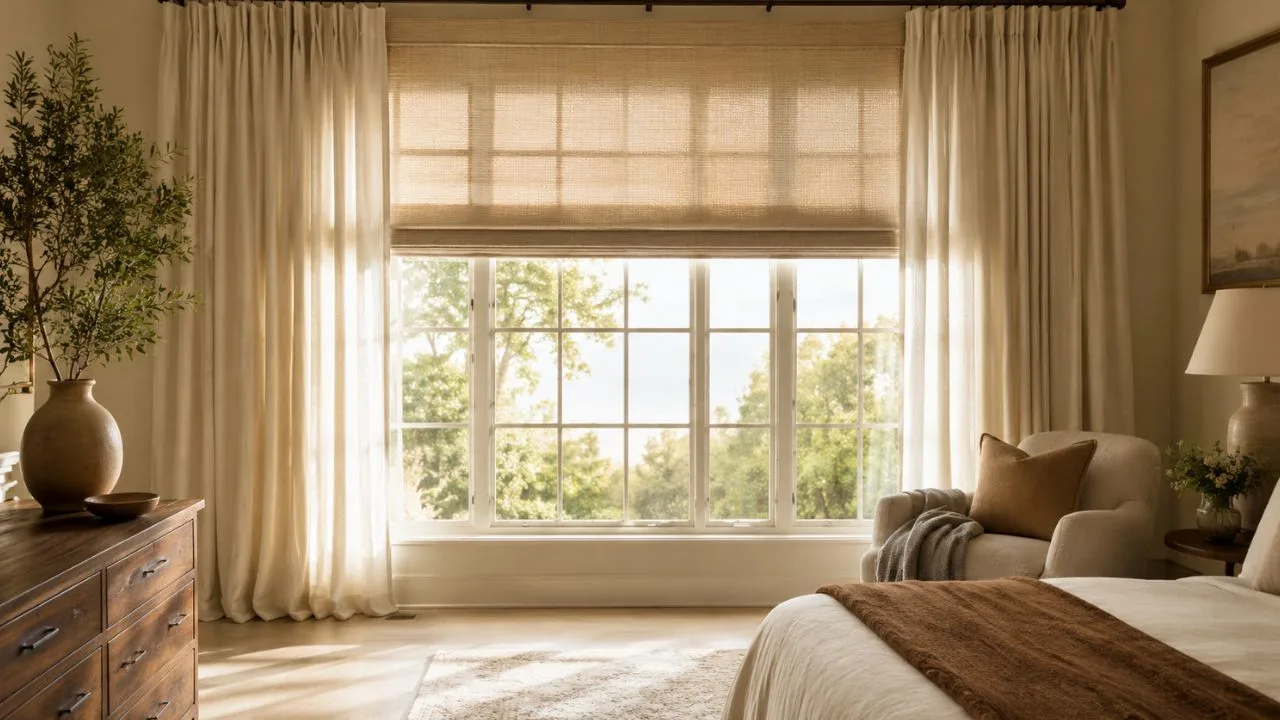
Many homes use two window coverings together. A roller shade may provide privacy and light control, while curtain panels frame the window and complete the room’s design. Layering treatments can offer more flexibility than relying on one decorative or functional product alone.
The terms “window treatment,” “window covering,” and “window dressing” are often used interchangeably in everyday conversation. However, window treatment usually refers to the complete design solution, including coverings, decorative fabric, rods, tracks, hardware, and sometimes exterior shading.
Why Window Treatments Matter
Privacy is one of the most practical reasons for covering a window. Street-facing rooms, ground-floor bedrooms, bathrooms, and homes positioned close to neighbouring buildings may require stronger coverage than upper-floor spaces overlooking private gardens or open landscapes.
Window treatments also control natural light. Sheer curtains soften bright sunlight without completely blocking it, while blackout curtains or opaque shades create darker conditions. Adjustable blinds and shutters allow occupants to redirect light throughout the day without fully covering the glass.
A well-chosen treatment can change the visual proportions of a room. Curtains mounted close to the ceiling can make walls appear taller, while wide panels can make a narrow window look more substantial. Texture and pattern can also connect the window with rugs, furniture, artwork, and other design details.
Window coverings may improve comfort by reducing glare, limiting unwanted solar heat, and creating an additional layer between the room and the glass. Their performance depends on the product, fit, material, climate, window direction, and how consistently occupants open or close them.
Types of Window Treatments
The main types of window treatments are curtains, drapes, blinds, shades, and shutters. Curtains and drapes use hanging fabric panels, blinds contain movable slats, shades use a continuous piece of material, and shutters are more permanent frames containing adjustable louvres or solid panels.
Decorative treatments include valances, swags, cornices, and stationary side panels. These options may conceal hardware or add shape and colour above a window, but they normally provide limited privacy or light control unless combined with another covering.
Specialised options include café curtains, solar shades, panel-track blinds, woven wood shades, cellular shades, exterior awnings, window film, and motorised systems. Each product addresses a different balance of design, privacy, glare control, insulation, maintenance, and operating convenience.
There is no single best treatment for every home. The most suitable choice is the one that solves the room’s practical problems while supporting its interior style. A moisture-resistant blind may suit a bathroom, while a layered curtain-and-shade arrangement may work better in a formal living room.
Curtains and Drapes
Curtains are fabric panels that usually hang from a rod or track. They are available in numerous colours, patterns, materials, and lengths, making them one of the most flexible choices for bedrooms, living rooms, dining areas, nurseries, and casual family spaces.
Drapes are similar to curtains but are commonly heavier, lined, pleated, and more formal. Their lining may improve light reduction, privacy, shape, and insulation. People often use the words curtains and drapes interchangeably, although designers may distinguish them according to construction and fabric weight.
Sheer curtains allow daylight to pass through while softening the appearance of the window. They provide limited privacy at night when indoor lights are switched on, so they are often combined with opaque panels, shades, blinds, or shutters in rooms requiring complete coverage.
When selecting fabric panels, consider how frequently they will be opened and closed. Decorative stationary curtains can be mounted on simple rods, while functional full-width panels may perform better on smooth tracks, rings, or traverse rods that allow easier daily movement.
Window Blinds
Blinds are made from separate slats that can usually be tilted to control light and privacy. Horizontal blinds are commonly used on standard windows, while vertical blinds are often selected for sliding doors, wide windows, and openings that require side-to-side movement.
Available materials include aluminium, wood, faux wood, vinyl, and composite products. Real wood can add warmth and natural character, while faux wood may be easier to maintain in kitchens, laundry rooms, and other spaces exposed to occasional moisture.
The main advantage of blinds is precise light control. Tilting the slats can block direct views while allowing daylight to enter. Raising the entire blind provides a clear view, although the stacked slats and headrail remain visible at the top of the window.
Blinds create a structured, streamlined look that suits modern, transitional, and practical interiors. They can be used alone or softened with curtains. When choosing blinds, compare slat width, operating mechanism, material durability, cleaning needs, and the amount of light that enters around their edges.
Window Shades
Window shades are generally made from one continuous piece of fabric or flexible material that raises, folds, rolls, or gathers. Unlike blinds, they do not normally contain separate tilting slats. Light control depends on the shade’s material, opacity, position, and operating design.
Roller shades create a simple, compact appearance and can be produced with sheer, light-filtering, solar, room-darkening, or blackout materials. Roman shades form soft horizontal folds when raised, making them suitable for homeowners who want the warmth of fabric with a more tailored appearance.
Cellular shades contain honeycomb-shaped air pockets that can improve the window’s insulating performance. The U.S. Department of Energy reports that well-fitted cellular shades can trap air, reduce drafts, limit unwanted heat gain, and perform better than basic vinyl blinds under tested conditions.
Woven wood shades use bamboo, grasses, reeds, or similar natural-looking materials. They add texture and warmth but may require a privacy or blackout liner. Because natural weaving can contain small gaps, an unlined shade may not fully block views or strong sunlight.
Interior Shutters
Interior shutters are solid frames fitted with adjustable louvres or panels. They are usually attached directly to the window opening and remain part of the room rather than hanging from removable rods. This construction gives them a clean, architectural appearance.
Full-height shutters cover most or all of the window, while café-style shutters cover only the lower section. Tier-on-tier designs divide the upper and lower panels, allowing each part to open independently. This flexibility can preserve daylight while improving privacy at street level.
Shutters can be manufactured from wood, composite materials, vinyl, or other moisture-resistant products. Their rigid surfaces are generally easier to wipe than textured fabric, although cleaning individual louvres may require more time than maintaining a simple roller shade.
Because shutters are made to fit the opening closely, they often cost more than ready-made curtains or blinds. Their structured appearance can suit traditional, coastal, farmhouse, transitional, and contemporary rooms, but careful measuring and professional installation may be required for a balanced result.
Valances and Cornices
A valance is a short fabric treatment placed across the top of a window. It may hide curtain hardware, soften the upper edge of a blind, or introduce pattern without covering the entire window. Valances can be tailored, pleated, gathered, scalloped, or softly draped.
A cornice performs a similar decorative role but normally has a firm structure. It may be made from wood or an upholstered board and installed above curtains, blinds, or shades. Its straight, defined shape can create a more architectural or formal appearance.
Swags use fabric arranged in decorative curves across the top of a window. They offer limited practical coverage and are normally combined with curtains, blinds, shades, or shutters when privacy and light management are required.
These decorative top treatments are useful when you need to disguise tracks, headrails, uneven trim, or mounting hardware. Keep their scale appropriate to the room, because a deep or heavily patterned valance can make a small window feel shorter and visually crowded.
Café Curtains
Café curtains cover only the lower portion of a window. They allow light to enter through the uncovered upper glass while limiting direct views from outside. This makes them useful in kitchens, breakfast rooms, bathrooms, and street-facing spaces requiring daytime privacy.
The panels are usually attached to a slim rod positioned across the middle or lower section of the frame. They may be plain and tailored or softly gathered, depending on the desired style. Lightweight washable fabric is practical in kitchens where cooking residue can collect.
Café curtains create a relaxed, welcoming look and pair naturally with cottage, farmhouse, vintage, and traditional interiors. More minimal fabrics and hardware can also make them suitable for modern homes, especially when the surrounding design uses clean lines and neutral colours.
Because they leave the top section exposed, café curtains are not ideal when complete darkness or full nighttime privacy is necessary. They can be combined with an upper shade, shutter, or full-length curtain when the room requires greater control after sunset.
Curtains vs Blinds vs Shades
Curtains are best for adding softness, height, movement, colour, and pattern. They can visually frame a window and improve the overall sense of comfort in a room. However, wide fabric panels may require more wall space and regular washing or vacuuming.
Blinds offer precise control because their slats can be tilted without raising the entire covering. They suit rooms where occupants want to redirect sunlight or maintain a partial outside view. Their hard surfaces are practical but can collect dust across multiple individual slats.
Shades create a cleaner and often more compact appearance. They are available in materials ranging from translucent solar mesh to opaque blackout fabric. However, many shades must be raised significantly to reveal the outside view because their material cannot be tilted like blind slats.
Choosing between curtains, blinds, and shades depends on your priority. Use curtains for decorative softness, blinds for adjustable light, and shades for streamlined coverage. Layer two treatments when you need strong functionality alongside a more finished interior design.
Window Treatments for Living Rooms
Living rooms often benefit from flexible window treatments because their lighting needs change throughout the day. Daytime privacy, television glare, evening coverage, and visual warmth may all matter in the same space, making layered solutions particularly practical.
A light-filtering shade with full-length curtain panels provides a balanced arrangement. The shade manages brightness and privacy, while the fabric adds colour and frames the window. The curtains can remain decorative or close fully when greater coverage is needed.
In smaller living rooms, choose a treatment that does not overwhelm the wall. Curtains close to the wall colour can create a continuous appearance, while a compact Roman or roller shade can preserve floor space and prevent fabric from competing with nearby furniture.
For large living-room windows, divide the treatment according to how the window operates. Separate shades may be easier to raise than one extremely wide covering, while a continuous ceiling-mounted curtain track can visually connect several adjoining windows.
Bedroom Window Treatments
Bedroom window treatments should support privacy, comfort, and sleep. Blackout curtains, room-darkening roller shades, cellular shades, and lined Roman shades are common options when early sunlight, exterior lighting, or changing work schedules make darkness important.
A product labelled “blackout” can still allow light around its edges. Outside-mounted shades, wider curtain panels, wraparound rods, pelmets, and layered treatments can reduce these gaps more effectively than a narrow covering fitted only inside the glass opening.
Bedrooms also benefit from easy operation. A treatment should open smoothly each morning and close completely at night. Motorised shades may be helpful for high, wide, or difficult-to-reach windows, although they add cost and may require batteries, wiring, or smart-home integration.
Choose washable or easy-care materials for children’s rooms, guest bedrooms, and allergy-sensitive spaces. Avoid long operating cords where children may be present, and position furniture away from windows so children cannot easily reach covering mechanisms.
Kitchen and Bathroom Treatments
Kitchens need window coverings that can tolerate moisture, cooking residue, frequent handling, and regular cleaning. Faux wood blinds, vinyl shutters, washable roller shades, and short café curtains can be more practical than heavy, absorbent fabric placed close to food preparation areas.
Avoid positioning loose curtains near burners, open flames, or surfaces where fabric could become stained. A fitted treatment mounted within the frame may create a cleaner working area while preserving access to handles, taps, shelves, and countertops.
Bathrooms require both privacy and moisture resistance. Frosted film, faux wood blinds, vinyl shutters, moisture-resistant roller shades, and café-style coverings can work well. Fabric should dry quickly and remain far enough from showers or baths to avoid constant dampness.
Consider the difference between daytime and nighttime privacy. Frosted glass and sheer materials may conceal details during daylight but become more revealing when the bathroom is illuminated after dark. Test the treatment from outside before relying on it as the only covering.
Home Office Window Treatments
A home office needs effective glare control without removing all natural light. Direct sunlight on a monitor can cause reflections and make the screen difficult to read, while a completely dark workspace may require more artificial lighting during the day.
Solar shades reduce glare while preserving some outside visibility. Their openness factor affects how much light and view remain, so denser materials generally provide greater control. However, many solar shades offer limited privacy at night when interior lights are brighter than the outdoor environment.
Adjustable blinds are another practical choice because their slats can redirect sunlight away from the screen. Cellular or light-filtering shades can soften overall brightness, while curtains may improve acoustics and make the workspace feel more connected with the rest of the home.
Place the desk before finalising the window treatment. A product that works well beside a monitor may be less effective when the screen directly faces the glass. The room orientation and time of strongest sunlight should guide the material and mounting position.
Privacy and Light Control
Window-treatment fabrics are commonly described as sheer, light filtering, room darkening, or blackout. Sheer materials allow substantial light and provide only limited privacy. Light-filtering options soften daylight while obscuring clearer views through the glass.
Room-darkening materials reduce more light but may not create complete darkness. Blackout material is designed to block light through the fabric itself, although light can still enter around the sides, top, and bottom when the covering does not overlap the frame.
Top-down, bottom-up shades offer flexible privacy by allowing the upper section of the window to remain open while the lower section stays covered. This arrangement can be useful in bathrooms, bedrooms, home offices, and street-facing living spaces where daylight is still desirable.
Before ordering, identify when privacy matters most. A treatment that works during daylight may not perform equally well after dark. Stand outside the home at night with the interior lights on to understand how much movement, colour, and detail remain visible.
Energy-Efficient Window Treatments
Windows can gain and lose heat, affecting comfort near the glass and the amount of work required from heating or cooling equipment. Window treatments do not replace efficient windows or proper insulation, but selected products can provide an additional layer of thermal control.
Cellular shades are among the most recognised energy-efficient interior options because their honeycomb pockets trap air. Performance is strongest when the shade fits closely and is used consistently. Double-cell and insulated designs may provide more resistance than thin, single-layer products.
In cold weather, opening coverings on sunny windows may allow useful heat to enter, while closing them after sunset can reduce nighttime heat loss. During hot weather, closing suitable shades or blinds before strong sunlight reaches the glass can help limit unwanted indoor heat.
Exterior shading can stop some solar heat before it passes through the window. Awnings, exterior shades, shutters, and solar screens may therefore be valuable on strongly exposed windows. Their suitability depends on local weather, building design, maintenance requirements, and community restrictions.
How to Measure for Window Treatments
Begin by deciding whether the product will sit inside the window frame or cover it from outside. This choice affects every measurement, so do not order a blind or shade until you have confirmed the mounting method and checked the manufacturer’s measuring instructions.
For an inside mount, measure the internal width at the top, middle, and bottom. Then measure the height on the left, centre, and right. Window openings are not always perfectly square, so record every measurement rather than assuming one dimension represents the complete frame.
For an outside mount, measure the area you want the treatment to cover. Add enough width and height to reduce light gaps, provide privacy, and create the desired proportions. Check for handles, radiators, shelving, wall switches, or furniture that may interfere with operation.
Use a metal tape measure and record dimensions consistently. Many custom suppliers request measurements in a particular order and may apply their own deductions for inside-mounted products. Review the ordering policy carefully because custom-sized window treatments may not be returnable after production.
Inside vs Outside Mount
An inside-mounted blind or shade fits within the window recess. It creates a neat, built-in appearance and keeps surrounding trim visible. This method requires enough frame depth for the headrail, brackets, fabric roll, or operating mechanism.
An outside-mounted treatment is attached to the wall, trim, or ceiling beyond the opening. It can make a small window appear wider, conceal unattractive frames, and reduce edge light by overlapping the window. Outside mounting may also work when the recess is too shallow.
Inside mounting usually leaves small gaps around the material because the treatment needs space to operate. These gaps may be acceptable in living areas but disappointing in bedrooms requiring strong darkness. An outside-mounted blackout shade may provide better coverage when properly sized.
Curtains are commonly mounted beyond the window width so the panels can stack beside the glass when open. Mounting the rod higher can increase the sense of height, but the hardware must remain proportionate and be securely fixed into suitable wall supports.
Materials and Maintenance
Fabric window treatments may be made from cotton, linen, polyester, velvet, silk, or blended textiles. Natural materials can add texture and character, while synthetic blends may offer greater resistance to wrinkles, fading, moisture, or frequent cleaning.
Wood blinds and shutters create warmth but may require protection from prolonged humidity. Faux wood and vinyl products can be practical in bathrooms and kitchens, although quality varies. Metal blinds are lightweight and functional but may bend when handled roughly.
Consider dust before selecting highly textured fabric, layered pleats, or numerous narrow slats. Roller shades and simple panels have relatively broad surfaces, while shutters, Venetian blinds, and detailed valances contain more edges that need individual attention.
Check the care label before purchasing. Some curtains are machine washable, while lined drapes, silk fabrics, and custom Roman shades may require professional cleaning. A beautiful treatment becomes impractical when its maintenance requirements do not suit the household.
Modern Window Treatment Ideas
Modern window treatments tend to combine clean shapes with practical light control. Roller shades, wave-fold curtains, cellular shades, simple Roman blinds, and streamlined shutters can support contemporary interiors without adding unnecessary visual clutter.
Layered drapery is also being used to create flexible, atmospheric rooms. Designers may pair a sheer curtain with a heavier outer panel or combine woven shades with full-length drapes. This approach allows daylight, privacy, and decorative softness to be adjusted separately.
Natural textures can make minimal spaces feel warmer. Woven wood shades, linen-look curtains, wooden blinds, and neutral Roman shades add depth without relying on bold patterns. Darker fabrics or coloured shutters can instead create a deliberate focal point.
Motorised blinds and shades offer a cleaner appearance because they can reduce visible operating cords. They are especially useful for tall windows, skylights, wide glass walls, and grouped openings that would be inconvenient to adjust individually.
Treatments for Large Windows
Large windows need treatments that remain easy to operate despite their size and weight. Vertical blinds, panel-track shades, ceiling-mounted curtains, motorised rollers, and several coordinated shades can be more manageable than one oversized manual product.
Sliding doors require coverings that move in the same direction as the door or stack fully away from the opening. Vertical blinds and panel tracks travel sideways, while curtains can be drawn to one side or divided into two panels.
For a wall containing several windows, you can treat each opening separately or connect them visually. Matching shades preserve individual control, while one continuous curtain track creates a unified appearance and can make the complete wall feel larger.
Check the maximum width supported by the product. Extremely wide shades may bow, operate unevenly, or require stronger hardware. Dividing the opening into smaller sections can improve reliability while allowing occupants to uncover only the portion they need.
Custom vs Ready-Made Treatments
Ready-made curtains, blinds, and shades cost less and are available quickly. They work best when the window is close to a standard size and the homeowner can accept limited choices in colour, length, material, lining, and operating mechanism.
Custom window treatments are manufactured for specific dimensions and design requirements. They may provide a closer fit, broader fabric selection, specialised hardware, motorisation, unusual shapes, and professional installation. Their higher cost reflects both materials and individual production.
A mixed approach can control the budget. Use custom treatments for unusually shaped, highly visible, or functionally demanding windows, then choose ready-made products for secondary bedrooms, utility rooms, or standard openings.
Before comparing prices, include hardware, lining, measuring, delivery, installation, electrical work, and ongoing maintenance. An inexpensive product may become costly when it needs replacement quickly, while an expensive custom option may be unnecessary for a simple temporary space.
Window Covering Safety
Operating cords can present a strangulation hazard to infants and young children. The U.S. Consumer Product Safety Commission advises choosing cordless window coverings, particularly in homes, childcare spaces, and other locations where young children live or visit.
Cordless products may be raised by hand, adjusted with a wand, or controlled through a motorised system. “Cordless” should refer to the operating design rather than merely hiding a long loop behind furniture or fastening it temporarily to the wall.
Keep beds, cots, changing tables, sofas, desks, toys, and climbable furniture away from windows and covering cords. Children can reach higher than expected when furniture provides access, and cord incidents may occur quickly and silently.
Inspect existing blinds and shades for exposed loops, damaged parts, or missing cord stops. Retrofit devices may reduce certain risks, but they do not make every older product completely safe. Replacing old corded treatments with suitable cordless options offers stronger protection.
Common Buying Mistakes
Choosing a treatment before identifying the room’s needs is a common mistake. A beautiful sheer curtain may fail in a bedroom requiring darkness, while a heavy blackout shade may make a bright living room feel unnecessarily closed and uninviting.
Incorrect measurements can leave gaps, obstruct handles, or prevent installation. Measure several points, check frame depth, and confirm the supplier’s instructions. Do not assume that two windows appearing identical have exactly the same dimensions.
Another mistake is ignoring how the treatment looks from outside. Street-facing windows appear more coordinated when visible linings, shades, or shutters have a consistent exterior colour, even when the room-facing fabrics differ from one space to another.
Avoid selecting style without considering operation and maintenance. A treatment opened every morning should move smoothly, a kitchen covering should clean easily, and a child’s room should use a safe cordless design. Good window treatment ideas make daily life easier as well as improving appearance.
Conclusion: Choose Function Before Style
What is a window treatment? It is any covering or decorative system used to improve a window’s privacy, light control, comfort, safety, or appearance. Curtains, blinds, shades, shutters, valances, and layered combinations all belong within this broad category.
Begin by identifying the problem you need to solve. Decide whether your priority is privacy, blackout performance, glare reduction, insulation, moisture resistance, decoration, or easy operation. This step will narrow the options more effectively than choosing by colour alone.
Next, measure carefully and compare materials, mounting styles, maintenance needs, and safety features. Use blinds for adjustable slat control, shades for streamlined coverage, curtains for softness, and shutters for a fitted architectural appearance.
The best window treatment should suit both the room and the people using it. When function, scale, fabric, hardware, and installation work together, the finished window can improve the complete space without looking overdecorated or becoming difficult to maintain.
Frequently Asked Questions
What is a window treatment in simple terms?
A window treatment is any covering or decorative feature added to a window. Examples include curtains, drapes, blinds, shades, shutters, valances, and privacy film.
Are curtains considered window treatments?
Yes. Curtains are one of the most common window treatments. The broader term also includes products such as blinds, shades, shutters, cornices, and exterior coverings.
What is the difference between blinds and shades?
Blinds contain separate slats that can be tilted to control light. Shades use a continuous piece of material that raises, rolls, or folds but normally does not tilt.
Which window treatment is best for privacy?
Blackout shades, lined curtains, shutters, and close-fitting blinds provide strong privacy. Top-down, bottom-up shades are useful when you want lower-window privacy while keeping daylight above.
What window treatments are best for bedrooms?
Blackout curtains, room-darkening roller shades, lined Roman shades, and cellular shades are practical choices. Layering a shade with curtains can reduce light gaps and improve privacy.