

Solid Matter: Properties, Examples & How It Behaves
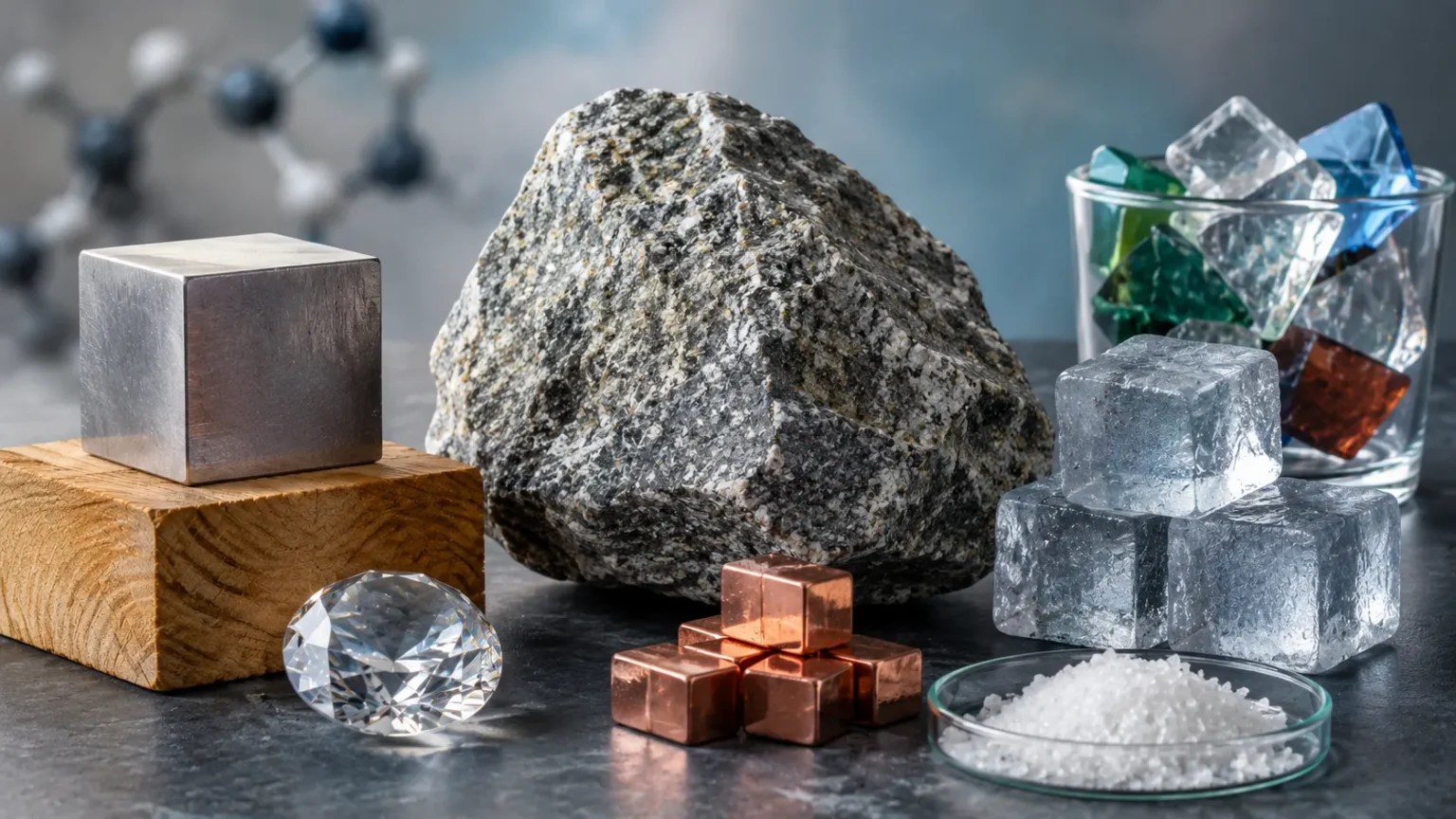
Solid matter is one of the most familiar states of matter because nearly everything we touch in daily life includes some type of solid material. Tables, phones, rocks, buildings, ice, metals, plastics, glass, and even the bones in the human body are examples of solids. Unlike liquids and gases, solids generally maintain a definite shape and a definite volume under ordinary conditions. This happens because their particles are packed closely together and experience strong forces that limit free movement. However, not all solids behave exactly the same way, and their properties can vary dramatically. Some are hard and rigid, while others are flexible, brittle, elastic, soft, conductive, transparent, or highly resistant to heat.
Understanding solid matter is important in physics, chemistry, engineering, construction, electronics, materials science, and many other areas of modern technology. Scientists study how atoms, molecules, and ions are arranged within solids to explain characteristics such as strength, melting point, electrical conductivity, and hardness. Engineers use this knowledge when selecting materials for bridges, aircraft, computer chips, batteries, medical equipment, and everyday products. The behavior of a solid can also change when temperature, pressure, or mechanical force is applied. This guide explains what solid matter is, how its particles behave, its major physical properties, different types of solids, common examples, and what happens when solids experience heat, pressure, or changes of state.
What Is Solid Matter?
Solid matter is a state of matter that normally has a definite shape and a definite volume. A solid does not automatically take the shape of its container in the way a liquid does, and it does not expand to fill an available space like a gas. Instead, its particles remain arranged closely enough that the material maintains its overall form. These particles can be atoms, molecules, or ions depending on the type of substance involved. Strong attractive forces hold the particles near relatively stable positions within the material. This closely packed structure explains many familiar properties of solids, including rigidity, density, and resistance to compression.
Although solids maintain their shape, the particles inside them are not completely motionless. At ordinary temperatures, particles vibrate around fixed or relatively stable positions because they still possess thermal energy. As the temperature rises, these vibrations generally become stronger and the solid may expand slightly. If enough thermal energy is added, the forces holding the structure together can eventually be overcome and the solid may melt. This particle-level behavior helps explain why heating changes the dimensions and properties of many materials. The idea that solids contain moving particles may seem surprising because the material itself appears stationary, but microscopic motion is continuously occurring inside almost every solid.
The structure of a solid can range from highly ordered to relatively disordered. In crystalline solids, particles are arranged in repeating patterns that extend throughout large portions of the material. Salt, many metals, quartz, and numerous minerals are familiar examples of materials with crystalline structures. Amorphous solids, by comparison, lack the same long-range repeating arrangement even though their particles remain closely packed. Glass and many plastics are common examples of amorphous materials. These structural differences influence melting behavior, strength, transparency, brittleness, and other characteristics, which is why the microscopic arrangement of particles is an important part of understanding solid-state properties.
A solid’s shape can still be changed when sufficient force is applied. Clay can be molded, metal can be bent, rubber can stretch, and glass can break even though all of these substances are solids. Having a definite shape therefore does not mean that a solid can never be deformed. It means the material tends to maintain its shape when no significant external force is acting on it. Different solids resist deformation to very different degrees depending on their bonding and internal structure. Steel may require substantial force to bend, while a soft polymer can be reshaped much more easily. Mechanical behavior therefore provides another important way to classify solid materials.
Solids also vary greatly in density, color, texture, electrical conductivity, thermal conductivity, hardness, and chemical stability. Copper conducts electricity efficiently, rubber is a strong electrical insulator, diamond is extremely hard, and graphite is comparatively soft despite both diamond and graphite being forms of carbon. These differences arise because the properties of a solid depend on much more than whether its particles are close together. The identity of the particles, the forces between them, and their arrangement all influence the final behavior of the material. Solid matter is therefore not a single uniform category. It includes an enormous range of substances whose microscopic structures produce very different macroscopic properties.
How Do Particles Behave in a Solid?
Particles in a solid are usually much closer together than particles in a gas and generally have less freedom of movement than those in a liquid. Attractive forces between neighboring particles help hold the structure together and prevent the material from flowing freely. This does not mean every solid has identical particle spacing because atomic and molecular structures vary substantially. Some solids contain tightly packed atoms, while others contain more complex molecular networks with small internal spaces. The general principle is that particles cannot easily move past one another under ordinary conditions. This restricted motion is the main reason solids normally preserve both their shape and their volume.
The particles within a solid continuously vibrate because matter contains thermal energy. At lower temperatures, the vibrations are generally smaller, while higher temperatures increase particle motion. Thermal expansion occurs because stronger vibrations can increase the average distance between neighboring particles. This expansion is usually small, but it becomes important when designing bridges, railway tracks, pipelines, buildings, and precision machinery. Engineers often leave expansion joints or other allowances so materials can expand and contract safely as temperatures change. Without these design features, repeated thermal movement can produce stress, cracks, bending, or structural damage. Particle motion therefore has practical consequences even when it cannot be seen directly.
The strength of attraction between particles plays a major role in determining a solid’s physical behavior. Strong bonding can contribute to high melting temperatures, considerable strength, or resistance to deformation, although the exact relationship depends on the type of bonding and structure. Ionic solids contain positively and negatively charged ions held together by electrostatic attraction. Metallic solids contain metal atoms whose electrons can move relatively freely through the structure, helping explain electrical conductivity. Covalent network solids contain extensive networks of strong covalent bonds. Molecular solids are held together by intermolecular forces that are often weaker than the bonds found in network structures, resulting in different melting and mechanical properties.
Particle arrangement can also explain why some solids break cleanly while others bend before failing. In many crystalline materials, atoms are organized into planes or repeating structural patterns. Under an applied force, these layers may shift, dislocations may move, or cracks may develop along particular directions. Metals can often deform without immediately breaking because their atomic structures allow certain types of internal movement while metallic bonding remains intact. Brittle materials such as many ceramics have less ability to accommodate this deformation before cracks spread. Engineers study these microscopic mechanisms because understanding particle movement helps them predict whether a material will bend, stretch, fracture, or permanently deform under load.
Pressure can also influence the particle arrangement of solid matter. Solids are difficult to compress because their particles are already positioned relatively close together compared with gases. However, extremely high pressure can still change atomic spacing, crystal structures, and physical properties. Deep inside planets, for example, enormous pressures can create forms of matter that behave differently from the same substances at Earth’s surface. Laboratory equipment can also subject materials to extreme pressure to study these structural changes. Under ordinary conditions, however, solids show relatively little compression. Their resistance to compression is one of the major characteristics that distinguishes them from gases, whose widely separated particles allow their volume to change much more easily.
Main Properties of Solid Matter
A definite shape is one of the most recognizable properties of a solid. When a metal block is placed inside a larger container, the block maintains its own shape instead of spreading across the bottom. A liquid behaves differently because it flows and adopts the shape of the portion of the container it occupies. The ability of a solid to preserve shape comes from strong interactions between its particles and their limited freedom to move around one another. However, some solids are flexible enough to bend significantly without losing their classification as solids. Rubber, thin plastic sheets, and fabrics demonstrate that solid matter does not have to be completely rigid.
Solids also have a relatively fixed volume under normal conditions. A wooden cube placed into different containers continues to occupy approximately the same amount of space regardless of the shape of those containers. Temperature and pressure can change solid volume slightly through thermal expansion or compression, but these changes are usually much smaller than those experienced by gases. This stability makes solids useful for construction, measurement, manufacturing, and storage. Engineers can design components with predictable dimensions because many solids maintain size within defined temperature ranges. Precision applications still account for small changes because even tiny amounts of expansion can matter when tolerances are measured in fractions of a millimeter.
Density describes how much mass is contained within a given volume and is another important property of solids. Many solids have relatively high densities because their particles are packed closely together, although density varies enormously between materials. A block of lead feels considerably heavier than an equal-sized block of wood because lead contains much more mass within the same volume. Density can help identify unknown substances and predict whether materials will float or sink in a particular liquid. It also affects engineering decisions where weight matters, such as aircraft design and vehicle manufacturing. Lightweight solids like aluminum and advanced composites are particularly valuable when strength is needed without excessive mass.
Mechanical properties describe how a solid responds to physical forces. Hardness measures resistance to scratching or indentation, while strength describes a material’s ability to withstand applied stress without failing. Elasticity refers to the ability to return toward an original shape after a deforming force is removed. Plasticity describes permanent deformation that remains after the force disappears, while brittleness describes a tendency to fracture with relatively little deformation. Toughness considers how much energy a material can absorb before breaking. These properties are not interchangeable, which means a very hard material is not necessarily the toughest. Selecting the correct solid for an application requires understanding which mechanical characteristics are most important.
Electrical and thermal properties also vary widely among solid materials. Metals such as copper and aluminum are good electrical conductors because electrons can move relatively freely through their structures. Many plastics, ceramics, and rubber materials are electrical insulators, making them useful for protecting wires and electronic components. Thermal conductivity describes how easily heat moves through a material, with metals generally conducting heat more effectively than wood or plastic. Other important properties include magnetism, optical transparency, melting point, chemical resistance, and heat capacity. The enormous variety of solid-state properties allows scientists and engineers to select or design materials suited to highly specific functions, from cookware and insulation to microprocessors and spacecraft.
Crystalline and Amorphous Solids
Crystalline solids have particles arranged in repeating three-dimensional patterns known as crystal lattices. This regular organization can extend across a large crystal or occur within many small crystalline regions inside a larger material. Common examples include table salt, quartz, sugar crystals, diamonds, and many metals. The repeating structure often causes crystalline materials to show well-defined geometric characteristics at the microscopic level. Their properties can sometimes vary depending on the direction in which they are measured because particle arrangements differ along different crystal axes. Crystallography is the field that studies these structures and provides important information for chemistry, mineralogy, materials science, electronics, and pharmaceutical development.
Crystalline solids generally have relatively well-defined melting temperatures under a given pressure. As enough thermal energy is supplied, the ordered structure becomes unstable and the material transitions into a liquid. Different crystalline substances have different melting points because bonding strength and particle arrangement vary. Ice melts at a much lower temperature than many metals because the interactions and structures involved are very different. High melting points are particularly useful in materials designed for furnaces, engines, industrial equipment, and aerospace applications. However, melting point alone does not determine whether a material is suitable for high temperatures because strength, oxidation resistance, thermal expansion, and chemical stability also matter.
Amorphous solids lack the long-range repeating order found in crystalline materials. Their particles remain close together, but the arrangement is more irregular over larger distances. Glass is one of the best-known examples, while many plastics, gels, and other manufactured materials can also have substantial amorphous character. Instead of melting sharply at one precise temperature, many amorphous materials soften gradually over a range of temperatures. This behavior reflects their disordered internal structure. The transition from rigid to softer behavior can be described using concepts such as the glass transition temperature. These properties make amorphous materials useful in products ranging from windows and packaging to optical fibers and advanced polymers.
Some solid materials contain both crystalline and amorphous regions rather than fitting perfectly into one category. Many polymers are semicrystalline, meaning portions of their molecular chains form ordered structures while other regions remain disorganized. The proportion and arrangement of these regions can significantly affect stiffness, strength, transparency, flexibility, and resistance to chemicals. Manufacturers can change processing conditions such as cooling rate to influence the internal structure of certain materials. This allows two objects made from similar chemical substances to exhibit different properties because their microscopic arrangements developed differently. Materials science therefore focuses not only on chemical composition but also on the way a material was formed and processed.
Crystalline structure is especially important in modern technology because small structural changes can significantly influence material performance. Semiconductor devices rely on carefully controlled crystalline materials such as silicon. Metal strength can be modified by controlling grain size, alloy composition, heating, cooling, and mechanical processing. Pharmaceutical compounds may also exist in different crystalline forms that influence stability or dissolution behavior. Even natural geological processes depend heavily on crystal formation as minerals cool or grow under different conditions. Understanding the difference between crystalline and amorphous solids therefore goes far beyond classroom classification. It provides a foundation for explaining why materials behave differently and how engineers can intentionally create solids with desired characteristics.
Common Examples of Solid Matter
Everyday objects provide some of the easiest examples of solid matter. A wooden table, metal spoon, glass window, ceramic plate, plastic container, pencil, book, and smartphone all contain solid materials that maintain a recognizable form. These objects may combine several different solids within one product. A smartphone, for example, contains glass, metals, semiconductor materials, polymers, ceramics, and numerous other specialized components. Each material was selected because it provides useful properties such as conductivity, transparency, hardness, flexibility, or low weight. Modern products therefore demonstrate how different types of solids can be combined to create functions that no single material could provide efficiently on its own.
Rocks and minerals are natural examples of solid matter found throughout Earth’s crust. Granite contains several minerals, commonly including quartz, feldspar, and mica, while limestone consists largely of calcium carbonate minerals. Different geological conditions create minerals with distinctive crystalline structures, colors, hardness levels, and chemical compositions. Geologists examine these properties to identify rocks and reconstruct the processes that formed them. Pressure, temperature, cooling rate, and chemical environment all influence how solid minerals develop underground or at Earth’s surface. These same principles help explain volcanic rocks, gemstones, ores, and sedimentary materials. Solid matter is therefore central to understanding the structure and history of the planet.
Metals are another major category of solids and play an essential role in construction, transportation, electronics, and manufacturing. Iron and steel are widely used because they can provide considerable strength, while aluminum is valued for its relatively low density and corrosion resistance. Copper is important in electrical wiring because of its excellent electrical conductivity. Metals can often be shaped by rolling, forging, drawing, casting, or machining without immediately breaking. Alloying combines metals or adds other elements to modify properties such as hardness, corrosion resistance, strength, or temperature performance. Stainless steel, bronze, brass, and many aerospace alloys demonstrate how carefully changing solid composition can produce materials suited to specific applications.
Polymers include many familiar solid plastics, rubbers, fibers, and engineered materials. Their properties depend heavily on the structure and arrangement of long molecular chains. Some polymers are rigid enough for pipes, helmets, or machine parts, while others are flexible enough for packaging films and elastic products. Heating behavior also differs, with some plastics softening repeatedly when heated and others forming networks that do not simply melt again after curing. Manufacturers can add reinforcing fibers, pigments, fillers, flame retardants, or other ingredients to modify performance. Polymer science has therefore made it possible to produce lightweight solid materials with combinations of durability, flexibility, chemical resistance, and low manufacturing cost.
Ice is a particularly useful example because it demonstrates how the same substance can exist in different states of matter. Water becomes a solid when conditions allow its molecules to arrange into an ordered structure associated with ice. Unlike most substances, ordinary ice is less dense than liquid water, which explains why ice cubes float and lakes freeze from the surface downward. Snowflakes are also solid water, with their distinctive patterns reflecting crystal growth under different atmospheric conditions. Dry ice provides another interesting example because it is solid carbon dioxide rather than frozen water. These familiar materials help illustrate how temperature and pressure determine whether a substance exists as a solid, liquid, or gas.
How Solids Respond to Force, Heat and Pressure
When force is applied to a solid, the material experiences stress and may undergo deformation. Small forces may produce only tiny changes in shape that disappear after the force is removed. This reversible behavior is called elastic deformation and is familiar in springs, elastic bands, and many structural materials operating within safe limits. If the applied force becomes greater, some materials begin to deform permanently, producing plastic deformation. Increasing the force further can eventually cause cracking or complete fracture. Engineers study stress-strain behavior to determine how much load materials can tolerate before permanent damage occurs, which is essential when designing buildings, vehicles, bridges, tools, medical implants, and mechanical systems.
Different solids respond to force in dramatically different ways. Steel can bend or stretch substantially under certain conditions before breaking, giving it valuable ductility for structural applications. Glass and many ceramics behave more brittly, often showing relatively little permanent deformation before fracture. Rubber can experience very large elastic deformation and then return close to its original shape. Concrete is strong when compressed but relatively weak when pulled apart, which is why steel reinforcement is often added to structures. These differences demonstrate that describing a material simply as “strong” is incomplete. Engineers need to know whether a solid will face tension, compression, bending, impact, fatigue, or other specific forms of loading.
Heat affects solids primarily by increasing the motion of their particles. Most materials expand as temperature rises because the average spacing between particles becomes slightly larger. Cooling usually causes contraction as particle vibration decreases. This behavior is important in structures and machines exposed to changing temperatures because different materials can expand at different rates. Glass cookware, railway tracks, engine components, electronic circuits, and bridges are all designed with thermal expansion in mind. Rapid or uneven temperature changes can create thermal stress because one region of a solid may expand or contract faster than another. Brittle materials are especially vulnerable to cracking when these temperature differences become severe.
Heat can also alter the mechanical and chemical properties of solid materials without necessarily melting them. Metals may become softer at elevated temperatures, while carefully controlled heating and cooling can change their internal crystal structures and strength. Heat treatment processes such as annealing, quenching, and tempering are widely used in metal manufacturing to create desired properties. Polymers may soften, lose stiffness, or degrade when heated beyond their useful temperature range. Some ceramics maintain useful strength at temperatures that would seriously weaken many metals or plastics. Material selection for hot environments therefore requires considering not only melting point but also how mechanical performance changes well below the actual melting temperature.
Pressure usually produces much smaller volume changes in solids than in gases because solid particles are already closely packed. Nevertheless, high pressure can produce important changes in structure, density, and physical properties. Some materials undergo phase transitions in which atoms rearrange into a different crystalline structure that is more stable under pressure. Diamond provides a famous example of a high-pressure carbon structure, although its natural formation involves complex geological conditions. Pressure also affects rocks deep inside Earth, contributing to mineral transformations that scientists use to understand the planet’s interior. At ordinary everyday pressures, however, most solids remain relatively incompressible, making their volume much more stable than the volume of gases.
How Solid Matter Changes State
Melting is the process in which a solid becomes a liquid after absorbing enough thermal energy under suitable pressure conditions. As temperature increases, particles vibrate more strongly until the ordered or relatively fixed solid structure can no longer be maintained. At that point, particles gain enough freedom to move past one another, creating liquid behavior. The temperature associated with this transition is called the melting point for substances that melt at a defined temperature. Ice melting into liquid water is a familiar example, while metals require much higher temperatures. Melting is a physical change because the chemical identity of a substance can remain the same even though its state changes.
Freezing is essentially the reverse process, occurring when a liquid loses enough thermal energy to form a solid structure. As particle motion decreases, attractive forces become increasingly able to maintain particles in more stable positions. The exact structure formed depends on the substance, pressure, cooling conditions, and other factors. Slow cooling can sometimes encourage larger crystals to develop, while rapid cooling may produce smaller crystals or more disordered structures. These principles are important in metal casting, food processing, geology, glass manufacturing, and materials engineering. Controlling how a liquid becomes solid can dramatically influence the strength, texture, transparency, and other properties of the finished material.
Some solids can change directly into gas without first becoming liquid through a process called sublimation. Dry ice is a familiar example because solid carbon dioxide sublimates under ordinary atmospheric conditions, producing carbon dioxide gas without forming a normal liquid puddle. Iodine and certain other substances can also show noticeable sublimation under appropriate conditions. The reverse process, in which gas changes directly into solid, is called deposition. Frost formation provides a common example when water vapor forms ice on a sufficiently cold surface. These transitions demonstrate that the familiar solid-liquid-gas sequence is not the only possible pathway between states of matter.
Pressure can influence phase changes because the stable state of a substance depends on both temperature and pressure. A material that is solid under one combination of conditions may become liquid or transform into another solid structure when pressure changes. Scientists summarize these relationships using phase diagrams, which show the regions where different phases are stable. Phase diagrams can include solid, liquid, gas, and multiple crystalline forms depending on the substance. Engineers use this information when working with metals, refrigerants, chemicals, and materials exposed to unusual environments. Understanding phase behavior becomes especially important in aerospace engineering, energy systems, industrial manufacturing, geology, and high-pressure scientific research.
Changes of state should not be confused with chemical changes. When ice melts, the molecules remain water molecules, so the process is primarily physical. If wood burns, however, chemical reactions produce new substances such as gases, ash, and other combustion products. Some processes involve both physical and chemical effects, making real-world situations more complex than simple classroom examples. Solids can also dissolve into liquids without technically melting, as happens when salt dissolves in water. Recognizing these distinctions helps explain why different processes require different scientific descriptions. Solid matter can therefore transform through melting, sublimation, dissolution, chemical reaction, deformation, or structural change depending on the conditions acting on the material.
How Solids Differ From Liquids and Gases
Solids differ from liquids primarily in their ability to maintain shape. A solid usually keeps its own shape when moved between containers, while a liquid flows and takes the shape of the region it occupies. Both solids and liquids generally maintain relatively stable volumes compared with gases. Their particles are also much closer together than particles in a typical gas. The key difference is that particles in a liquid can move past neighboring particles more easily, allowing the substance to flow. In a solid, stronger structural constraints keep particles in relatively stable positions. This difference in microscopic movement creates the large-scale behaviors people observe without needing to see individual atoms or molecules.
Gases behave very differently because their particles are generally much farther apart and move freely throughout available space. A gas does not maintain a definite shape or a definite volume and instead expands to fill its container. Because so much empty space exists between gas particles, gases can usually be compressed much more easily than solids or liquids. This property is useful in compressed gas cylinders, pneumatic systems, engines, refrigeration, and many industrial applications. Solids, by comparison, resist compression strongly because their particles are already close together. The contrast between gas and solid behavior provides one of the clearest demonstrations of how microscopic particle arrangement controls macroscopic physical properties.
Diffusion also occurs differently across the three familiar states of matter. Gas particles can mix relatively rapidly because they move freely, while diffusion in liquids generally occurs more slowly. Diffusion can also occur within solids, but it is usually much slower because particles do not move freely through the structure. At high temperatures, however, atomic diffusion in solids can become important enough to influence manufacturing and material performance. Processes involving metal alloys, semiconductor fabrication, surface hardening, and crystal growth may depend on atoms gradually moving through solid structures. This demonstrates that solids are not completely static even when their macroscopic shape appears unchanged for years.
The boundaries between states of matter can also become less straightforward under unusual conditions. Certain materials may behave like solids over short periods but flow slowly over much longer times, while gels and complex soft materials can show properties associated with both solids and liquids. Plasma represents another state of matter in which gases become ionized and contain charged particles. Scientists also study unusual phases that appear at extremely low temperatures, intense pressures, or specialized quantum conditions. These examples demonstrate that the simple solid-liquid-gas classification is an excellent starting point but not a complete description of all matter. Everyday solid matter still follows the familiar characteristics closely enough for the classification to remain highly useful.
The defining behavior of solids can ultimately be traced to how their particles interact. Strong enough structural interactions prevent particles from moving freely past one another, giving the material resistance to shape change. Liquids retain close particle spacing while allowing much more rearrangement, producing flow without easy compression. Gases contain widely separated particles with enough freedom to occupy an entire available volume. Temperature and pressure can shift the balance between these states by changing particle energy and the relative importance of attractive forces. Understanding these basic principles provides a foundation for studying chemistry, physics, engineering, geology, materials science, and many technologies built around controlling how matter behaves.
Frequently Asked Questions
What is solid matter?
Solid matter is a state of matter that generally has a definite shape and a definite volume. Its particles are packed closely together and usually vibrate around relatively stable positions rather than moving freely throughout the material.
What are five examples of solids?
Common examples of solids include wood, metal, glass, ice, and stone. Plastics, ceramics, salt crystals, electronics, and many building materials are also forms of solid matter.
What are the main properties of a solid?
Solids usually have a definite shape, definite volume, closely packed particles, relatively high resistance to compression, and limited particle movement. Individual solids can also differ in hardness, elasticity, density, conductivity, strength, and melting point.
Do particles move in solid matter?
Yes, particles in solids are constantly moving at the microscopic level, mainly by vibrating around relatively stable positions. Their vibrations generally increase as temperature rises.
What happens when a solid is heated?
Heating usually increases particle vibration and causes most solids to expand slightly. If enough heat is added, a solid may eventually melt into a liquid or, in certain substances and conditions, change directly into a gas through sublimation.