
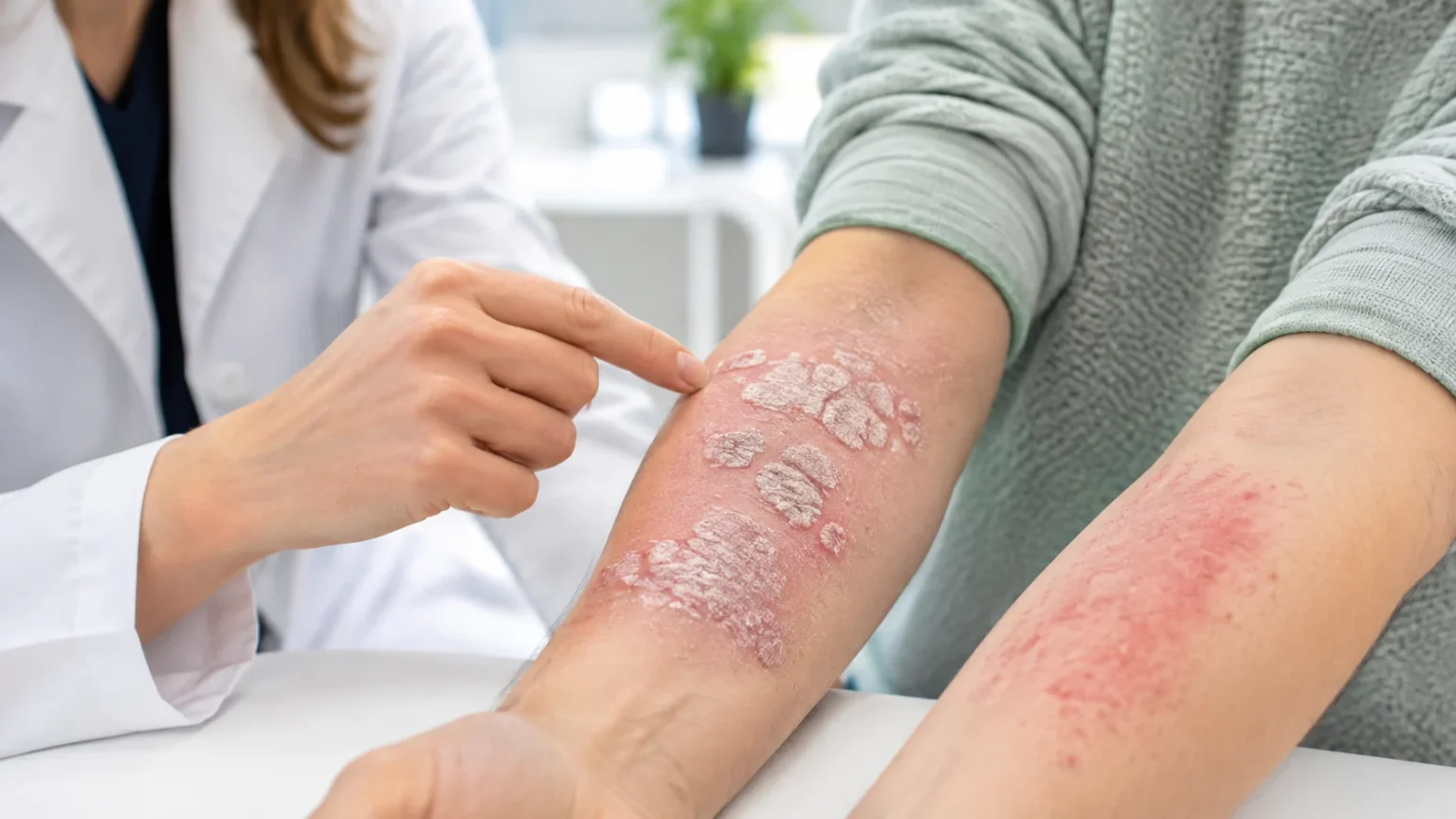

Psoriasis vs Eczema: How to Tell the Difference
Psoriasis and eczema can both cause an itchy, inflamed rash, so confusing one for the other is understandable. Either condition may leave skin dry, scaly, discolored, cracked or uncomfortable, and both can improve only to flare again later. Yet they are not the same disease, and the treatment that helps one rash may be ineffective or unsuitable for another. Looking at the texture, borders, location and behavior of the affected skin can provide useful clues, but those clues work best when considered together rather than separately.
The simplest distinction is that psoriasis is an immune-mediated disease that speeds up the production of skin cells, while eczema is a group of inflammatory skin conditions often involving a weakened skin barrier. Atopic dermatitis is the most common form of eczema and the main type discussed in this comparison. Psoriasis often creates thicker, more clearly outlined plaques, whereas atopic eczema frequently causes intensely itchy, dry or weeping areas. These are common patterns, not rules, because either condition can look different on the face, hands, scalp or skin folds.
Skin tone also influences what a flare looks like. In lighter skin, inflammation may appear pink or red, while in darker skin it may look violet, purple, gray, deep brown or simply darker than the surrounding area. Scale can appear silvery, white or ashy, and discoloration may remain after active inflammation settles. Images showing only one complexion can therefore be misleading. A people-first comparison of psoriasis vs eczema must consider symptoms such as itch and pain alongside color, thickness, distribution and changes over time.
Neither condition is contagious, and neither results from poor hygiene. Both are long-term inflammatory disorders shaped by a mixture of immune activity, genetic susceptibility and environmental triggers. Some people experience limited patches that are easy to manage, while others have extensive disease that disrupts sleep, work, exercise or confidence. A visible rash can carry an emotional burden as well as physical discomfort, so seeking care is reasonable even when the affected area seems small. Quality of life matters when treatment decisions are made.
This guide explains how to recognize the usual differences between psoriasis and eczema, which triggers may cause flare-ups and how dermatologists approach diagnosis and treatment. It cannot confirm the cause of an individual rash, especially when infection, contact dermatitis, ringworm or another skin disorder could be involved. If symptoms are new, worsening, painful or resistant to basic skin care, a medical assessment is safer than repeated trial and error. An accurate diagnosis creates a clearer route toward calmer skin and fewer avoidable complications.
Psoriasis and Eczema Begin with Different Changes in the Skin
Psoriasis develops when immune signals accelerate the skin-cell growth cycle and sustain inflammation. Cells accumulate at the surface faster than the body can shed them, helping form raised areas called plaques. Plaque psoriasis is the most common type, although guttate, inverse, pustular and erythrodermic forms can look quite different. The condition may affect the scalp, nails and joints as well as the skin. This broader immune involvement helps explain why joint pain, swollen fingers or morning stiffness can be important clues rather than unrelated complaints.
Atopic eczema involves both immune-system dysregulation and difficulty maintaining an effective skin barrier. When the barrier loses moisture too easily, skin becomes dry and more vulnerable to irritants, allergens and microbes. That can start an itch-scratch cycle: inflammation causes itching, scratching damages the barrier, and the additional damage fuels more inflammation. Eczema is an umbrella term that also includes contact dermatitis, dyshidrotic eczema and other conditions. Consequently, not every eczema rash shares the causes or treatment plan associated with atopic dermatitis.
Both diseases tend to follow a relapsing pattern, meaning symptoms can become active and later improve. A psoriasis plaque may persist for weeks or months before flattening, while atopic eczema can shift from dry, itchy skin to an oozing flare and then settle again. Quiet periods do not necessarily mean the underlying tendency has disappeared. Maintenance care may still be needed between flares, particularly for eczema-prone skin. For psoriasis, continuing a prescribed long-term plan can reduce recurrence and help control inflammation beyond the most visible plaques.
Family history can increase the likelihood of either condition, but it does not make a diagnosis certain. Atopic dermatitis often occurs in people or families with asthma, hay fever or food allergy, a pattern sometimes described as atopy. Psoriasis also tends to run in families and can be influenced by several genes interacting with environmental events. A person can develop either disorder without knowing any affected relative. Genetics shapes susceptibility, while infections, climate, stress, injuries and exposures may help determine when symptoms first appear or return.
These biological differences matter because they guide therapy. Moisturizing can support both conditions, but psoriasis treatment often focuses on slowing excess skin-cell production and modifying specific immune pathways. Eczema care emphasizes restoring the barrier, calming inflammation, reducing itch and preventing infection. Modern medicines can target particular immune signals in either disease, yet they are not interchangeable. Borrowing another person’s prescription or assuming every scaly rash needs the same steroid can delay diagnosis, aggravate an infection or expose delicate skin to an unnecessarily strong product.
Compare the Rash: Borders, Scale, Itch and Other Symptoms
Classic plaque psoriasis produces raised, thickened patches with relatively sharp borders. The surface may carry dry white or silvery scale, and plaques can crack or bleed, especially over moving joints or very dry skin. Some people feel itching, burning, soreness or tightness rather than itch alone. Scale may be less obvious in moist folds or on recently treated skin. On the scalp, psoriasis can extend beyond the hairline and form thicker buildup, but mild disease may resemble dandruff or seborrheic dermatitis and remain difficult to identify without an examination.
Atopic eczema often looks less sharply outlined and feels dry, rough or sensitive. During an active flare, areas may become swollen, bumpy, raw, crusted or wet with clear fluid. Repeated rubbing can eventually make the skin thicker and more deeply lined, a change called lichenification. This chronic thickening can resemble a psoriasis plaque at first glance. Eczema can also create painful cracks, particularly on hands and feet. The combination of severe itch, dryness and evidence of scratching frequently points toward eczema, although it does not prove the diagnosis.
Itch is usually the dominant symptom of atopic dermatitis and can be intense enough to interrupt sleep or concentration. Psoriasis also commonly itches, and for some people that itching is severe, so a simple “itchy or not” test is unreliable. The timing offers more context: eczema may itch before a rash is fully visible, and scratching often rapidly worsens it. Psoriasis may feel itchy, sore or burning within an established plaque. Asking how the skin feels is as useful as describing how it looks, particularly when color changes are subtle.
Fluid and crusting deserve careful attention. Eczema can weep during a strong flare, but yellow or honey-colored crust, pus, warmth, increasing tenderness or a bad smell may indicate bacterial infection. Groups of painful blisters, punched-out sores, fever or sudden illness can signal a serious viral infection in eczema-prone skin and require urgent assessment. Psoriasis is usually dry, but certain uncommon types produce pus-filled bumps or widespread redness. New blisters should not be diagnosed from an online comparison because their causes and urgency vary considerably.
Psoriasis is more likely to produce distinctive nail changes, including pits, lifting, thickening, crumbling or yellow-brown discoloration. Nail fungus can cause similar changes, so testing may still be necessary. Joint swelling, heel pain, a swollen entire finger or toe, and stiffness after rest raise concern for psoriatic arthritis. Eczema around the nails can irritate the surrounding skin and alter nail growth, but it does not typically cause inflammatory arthritis. Looking beyond the rash can therefore uncover clues that change both the diagnosis and the need for timely treatment.
Where the Rash Appears Can Offer Helpful Clues
Plaque psoriasis commonly affects the outer elbows and knees, scalp and lower back. Patches may also develop around the navel, behind the ears, between the buttocks or on the palms and soles. This preference for extensor surfaces—the outside of a joint—is a familiar clue, but psoriasis can occur almost anywhere. Inverse psoriasis favors body folds such as the armpits, groin or beneath the breasts, where it may appear smooth and shiny rather than scaly. Location narrows the possibilities, yet the type of psoriasis changes what is visible.
Atopic eczema often affects flexural areas, especially the creases of the elbows and behind the knees in older children and adults. The neck, wrists, ankles, eyelids, face and hands are also common sites. In babies, eczema frequently begins on the cheeks, forehead or scalp and may spread to the trunk and limbs. Age changes the distribution, so an infant’s pattern cannot be applied directly to an adult. In addition, eczema in darker skin may be more noticeable on extensor surfaces, reinforcing why location should guide rather than dictate a conclusion.
Hand rashes are especially difficult to separate. Eczema can result from atopic dermatitis, repeated wet work, harsh cleansers, occupational irritants or an allergic reaction to something touching the skin. Psoriasis on the palms can create well-defined thick scale and deep fissures, but it may resemble chronic hand eczema. Tiny, intensely itchy blisters along the fingers suggest dyshidrotic eczema, while a rash with a ring-shaped advancing edge may be fungal. Because daily exposures affect the hands so strongly, a detailed work and product history is often essential.
On the face and skin folds, the usual visual rules become less dependable. Facial psoriasis may be thinner and less scaly than plaques elsewhere, while eyelid eczema can appear swollen, flaky and discolored. Inverse psoriasis can be smooth because moisture limits scale, and intertrigo, yeast or contact dermatitis may mimic it. Genital skin also requires a careful examination because symptoms overlap and the area absorbs topical medicines more readily. Strong treatments that are suitable for an elbow plaque may be inappropriate near the eyes, groin or other sensitive sites.
The pattern across the body often matters more than one isolated spot. Symmetrical plaques on both elbows with scalp scale and nail pits support psoriasis, while widespread dryness with intensely itchy elbow creases and a history of hay fever supports atopic dermatitis. Real cases are not always so tidy, and a person may have more than one skin condition at once. Photographs taken during a flare can help if the rash improves before an appointment. Include several body sites and note when each area began rather than relying only on a close-up image.
Triggers and Flare Patterns: What Makes Each Condition Worse?
A trigger is an event or exposure associated with a flare, not necessarily the root cause of the disease. Psoriasis and eczema can both worsen during stress, dry weather or skin irritation, which is one reason they seem similar. Triggers also vary from person to person and may change over time. One flare after a new product does not automatically prove an allergy, just as stress does not mean symptoms are imaginary. A useful trigger assessment looks for repeatable patterns while accounting for prescribed treatments, infections, climate and everyday skin care.
Psoriasis may flare after an infection, particularly a streptococcal throat infection in some people with guttate psoriasis. Cuts, burns, tattoos, sunburn or repeated friction can sometimes prompt lesions at injured sites, a response known as the Koebner phenomenon. Cold, dry weather, smoking, heavy alcohol use and stress are also recognized contributors. Certain medicines can worsen psoriasis in susceptible individuals, but prescribed drugs should never be stopped abruptly. A clinician or pharmacist can review timing and alternatives without creating risks from an unsupervised medication change.
Eczema flares are often linked to barrier stress and direct exposure. Fragranced products, harsh soaps, detergents, solvents, wool, sweat, overheating and frequent handwashing can all aggravate sensitive skin. Airborne allergens or seasonal changes may contribute for some people, while allergic contact dermatitis can coexist with atopic eczema. Food allergy is not the usual explanation for every flare. Eliminating major food groups without a confirmed reason can cause nutritional harm, especially in children, and rarely replaces appropriate topical care or medical treatment.
Heat and sweat commonly intensify eczema itch, whereas very dry winter air can worsen either condition. Moderate sunlight may appear to help some psoriasis symptoms, but sunburn can trigger a flare and ultraviolet exposure increases skin-cancer risk. Medical phototherapy uses controlled doses and is not the same as deliberate tanning. Stress-management practices can support a treatment plan because stress can amplify itch, scratching and inflammation, but they do not replace medicine when disease is active. The goal is to reduce avoidable triggers without making daily life unnecessarily restrictive.
A brief symptom diary can reveal more than memory alone. Record the date, body areas affected, itch or pain severity, sleep disruption, new products, illnesses, medication changes and treatments used. Photos taken in consistent lighting can document progression, particularly when discoloration looks different from day to day. Avoid changing several products simultaneously, because improvement will be hard to attribute to one action. If a pattern repeatedly follows workplace exposure, jewelry, cosmetics or personal-care products, ask whether patch testing for allergic contact dermatitis would be appropriate.
How Dermatologists Diagnose Psoriasis and Eczema
Diagnosis usually begins with a conversation and a head-to-toe skin examination rather than a single laboratory test. A dermatologist considers the shape, thickness, scale, borders and distribution of the rash, then checks the scalp and nails for less obvious signs. Questions about itch, pain, onset, family history, childhood eczema, asthma, allergies, recent infections and joint symptoms add essential context. Bring a complete list of prescription drugs, supplements and over-the-counter treatments, because medication effects and partially treated rashes can alter the appearance.
The course of symptoms can help separate the conditions. Psoriasis plaques may remain in the same locations and show persistent sharp borders, while eczema often cycles through itching, scratching, weeping and thickening. However, scratching can thicken any rash, topical steroids can temporarily reduce redness, and moisturizers can hide scale. Skin tone, body site and disease subtype further complicate pattern recognition. Clinicians therefore combine several clues instead of using a single checklist. A confident diagnosis may be possible at the first visit, but uncertainty is not unusual.
When the appearance is atypical, a small skin biopsy may be examined under a microscope. Scraping or other testing can look for fungal infection, which is important because steroid treatment may disguise or worsen ringworm. Patch testing can identify delayed allergic reactions to substances such as preservatives, fragrances, rubber chemicals or metals when contact dermatitis is suspected. Blood testing does not routinely distinguish ordinary psoriasis from atopic eczema. Allergy tests should be ordered for a specific clinical question, not as broad screening for every person with itchy skin.
Several common conditions can imitate psoriasis or eczema. Seborrheic dermatitis often affects oily areas of the scalp and face; contact dermatitis appears where an irritant or allergen touches skin; and tinea, or ringworm, can form scaly patches with clearer centers. Scabies usually causes intense nighttime itch and can spread among close contacts. Less common inflammatory, infectious or medication-related rashes may also overlap. A rash that changes rapidly, affects household members or worsens with treatment is a good reason to reconsider the working diagnosis rather than simply applying more cream.
Accurate identification matters because treatment strength, location and duration must be matched carefully. A thick psoriasis plaque on an elbow may need an approach that would be too potent for eyelid eczema. An antifungal will not control immune-driven psoriasis, and an antibiotic will not treat an uninfected eczema flare. If therapy is not working, clinicians may first reassess adherence, technique, exposures and diagnosis before escalating medicine. Asking what the treatment is supposed to accomplish—and how soon improvement should appear—makes follow-up more productive and helps prevent uncontrolled self-treatment.
Psoriasis vs Eczema Treatment: Similar Tools, Different Plans
Treatment for either condition is individualized according to severity, body location, age, medical history and impact on daily life. Mild disease may respond to topical care, while widespread or persistent inflammation may require phototherapy or medicines that work throughout the body. The target is more than temporary cosmetic improvement: good treatment reduces itch or pain, protects sleep and movement, limits complications and supports long-term control. Because both diseases can relapse, a plan often includes one strategy for active flares and another for maintenance after skin becomes calmer.
For limited psoriasis, clinicians may prescribe topical corticosteroids, vitamin D–related medicines, retinoids or other anti-inflammatory products. Salicylic acid can loosen scale, and some people use coal-tar preparations, although irritation and staining can limit their appeal. Potency and formulation matter: an ointment may suit a thick dry plaque, while a solution or foam can be easier on the scalp. Sensitive areas often need different choices. Following the recommended amount, schedule and rest periods reduces the risk of skin thinning and other local side effects.
Moderate-to-severe psoriasis may be treated with supervised phototherapy, oral medicines or injected biologic drugs that target specific immune pathways. The expanding range of targeted therapy allows treatment to be matched more closely to skin severity, joint involvement and other health conditions. Screening and ongoing monitoring may be needed because immune-modifying medicines can carry infection or organ-specific risks. People with psoriatic arthritis need a plan that protects joints as well as clears skin. Treatment should be reviewed when benefits fade, side effects emerge or life circumstances change.
Eczema treatment begins with regular barrier repair using a fragrance-free cream or ointment, combined with anti-inflammatory therapy when a flare occurs. Options can include topical corticosteroids, calcineurin inhibitors, a topical phosphodiesterase inhibitor or a topical JAK inhibitor, depending on age, site and local approval. Wet-wrap therapy may help selected severe flares when taught by a healthcare professional. More extensive atopic dermatitis may require phototherapy, injectable biologics or oral immune-targeting medicines. Itch often improves when inflammation is controlled, even when antihistamines provide little direct relief.
Topical steroids are used for both psoriasis and eczema, but that overlap should not encourage self-diagnosis. The correct strength for the scalp may be unsafe on an eyelid, and long-term uncontrolled use can thin skin or produce other complications. “Natural” products can also irritate, cause allergic contact dermatitis or interact with prescribed care. Discuss pregnancy, breastfeeding, infection risk and other medicines before starting systemic treatment. If cost, texture, application time or fear of side effects makes a plan unrealistic, tell the clinician; an effective alternative must also be practical enough to use.
Daily Skin Care That Supports Fewer and Gentler Flares
Gentle skin care can reduce background irritation in both conditions, although it does not replace prescribed treatment. Bathe or shower in lukewarm rather than hot water and keep washing time reasonable. Use a mild fragrance-free cleanser only where needed, then pat rather than rub the skin dry. Apply a thick moisturizer while skin remains slightly damp to trap water. Creams and ointments usually protect dry skin longer than thin lotions. If a product stings consistently or seems to worsen redness, stop using it and review the ingredients.
Choose products based on function rather than marketing claims. “Unscented” can still contain masking fragrance, while “natural” does not guarantee low allergy risk. A short ingredient list and a fragrance-free label are sensible starting points for reactive skin. Introduce one new product at a time and test it on a small unaffected area when appropriate. Scalp products, adhesives, cosmetics and laundry additives can be overlooked sources of irritation. For psoriasis scale, use keratolytic products only as directed because excessive application can inflame skin or increase absorption of other medicines.
Keeping nails short and smooth can lessen injury from scratching. At night, a cool room, breathable clothing and a consistent treatment routine may reduce eczema-related sleep disruption. Instead of telling a child simply not to scratch, address the itch with the treatment plan and use gentle distraction or covered sleepwear when advised. For psoriasis, protect skin from cuts, burns and sunburn, and avoid picking scale. Scratching is not a personal failure; it is a biological response that becomes easier to control when inflammation and dryness are properly treated.
Clothing and work routines can make a noticeable difference. Soft, breathable fabrics may be better tolerated than rough wool or tight garments, and changing out of sweaty clothes can reduce irritation. Gloves can protect hands from wet work or cleaning chemicals, but moisture trapped inside can also aggravate eczema; cotton liners may help in some situations. Apply moisturizer after washing and carry a small container if frequent cleansing is unavoidable. Occupational rashes deserve assessment because modifying exposure may be as important as adding another topical medicine.
Consistency usually matters more than an elaborate routine. Place treatments where they are easy to remember, clarify which product goes on which area and follow the agreed maintenance schedule. Do not judge progress by color alone, because post-inflammatory discoloration can remain after active itching, scale and thickening improve. Balanced nutrition, adequate sleep, movement and smoking cessation support overall health, but no detox or supplement reliably cures either disease. A sustainable plan respects medical needs, cultural practices, budget, time and the person’s own priorities.
When an Itchy or Scaly Rash Needs Medical Help
Arrange a routine appointment when a rash persists despite gentle care, repeatedly returns, spreads, or interferes with sleep, school, work or relationships. An early evaluation is also useful when the diagnosis is unclear, the face or genitals are affected, or over-the-counter products have been used for weeks without a plan. Children with significant itch or sleep loss deserve prompt attention even if the visible area seems modest. Bring photos, symptom notes and product containers so the clinician can assess both the skin and the exposures surrounding it.
Seek urgent medical advice for possible infection: rapidly increasing redness, warmth, swelling, pain, pus, honey-colored crust, fever or red streaks extending from the rash. In someone with eczema, a sudden crop of painful blisters or round open sores—especially with fever, tiredness or involvement near the eyes—can indicate eczema herpeticum and needs same-day care. Do not apply leftover antibiotics or strong steroids to an undiagnosed infection. Treatment depends on whether bacteria, viruses or fungi are responsible, and delays can allow the problem to spread.
Widespread redness, peeling or pus-filled bumps accompanied by fever, chills, dehydration, weakness or a rapid decline can represent a severe psoriasis complication or another serious illness. These symptoms require emergency assessment rather than a standard dermatology appointment. Eye swelling, difficulty breathing or swelling of the lips or tongue also warrants emergency help because it may reflect a severe allergic reaction. A rash should never be assessed in isolation when the person feels acutely unwell. General symptoms can change an ordinary skin concern into an urgent situation.
People with psoriasis should report persistent joint pain, swelling, heel pain, morning stiffness or a whole swollen finger or toe. Psoriatic arthritis can cause lasting joint damage, and skin severity does not always predict who develops it. Early assessment by an appropriate clinician can shorten the path to treatment. Nail pitting or lifting alongside joint symptoms provides another reason to speak up. Do not assume aches are simply part of aging or exercise when they repeatedly accompany psoriasis, especially if stiffness improves after moving around.
Finally, ask for support when the emotional impact feels heavy. Visible disease, relentless itch, pain and poor sleep can contribute to anxiety, low mood and social withdrawal. Effective dermatologic treatment often improves more than the rash, and counseling or mental-health care can be part of a complete plan. If symptoms suddenly change or a previously reliable treatment stops working, schedule a review instead of blaming yourself. Psoriasis and eczema are manageable medical conditions, and needing an adjusted plan is a normal part of long-term care.
Is psoriasis more serious than eczema?
Neither condition is automatically more serious. Severity depends on the extent, symptoms, infections, sleep disruption and other effects; psoriasis can also involve the joints, while severe eczema can substantially damage skin and quality of life.
Can eczema turn into psoriasis?
Eczema does not transform into psoriasis because they are distinct inflammatory conditions. Their appearance can overlap, however, and an earlier diagnosis may be revised when new signs such as plaques, nail changes or joint symptoms emerge.
Can a person have psoriasis and eczema at the same time?
Yes, although it is not the most common situation. A dermatologist may need to examine several areas—or occasionally perform testing—because each condition may require a different treatment strategy.
Which condition usually itches more, psoriasis or eczema?
Atopic eczema is especially known for intense itch and an itch-scratch cycle, but psoriasis can itch severely too. Texture, borders, body location, nail findings and symptom history are needed alongside itch intensity.
Do psoriasis and eczema ever go away permanently?
Both can enter long symptom-free periods, and childhood eczema may improve markedly with age. Psoriasis usually remains a lifelong tendency, while either condition may need maintenance care and treatment adjustments to prevent or shorten flares.