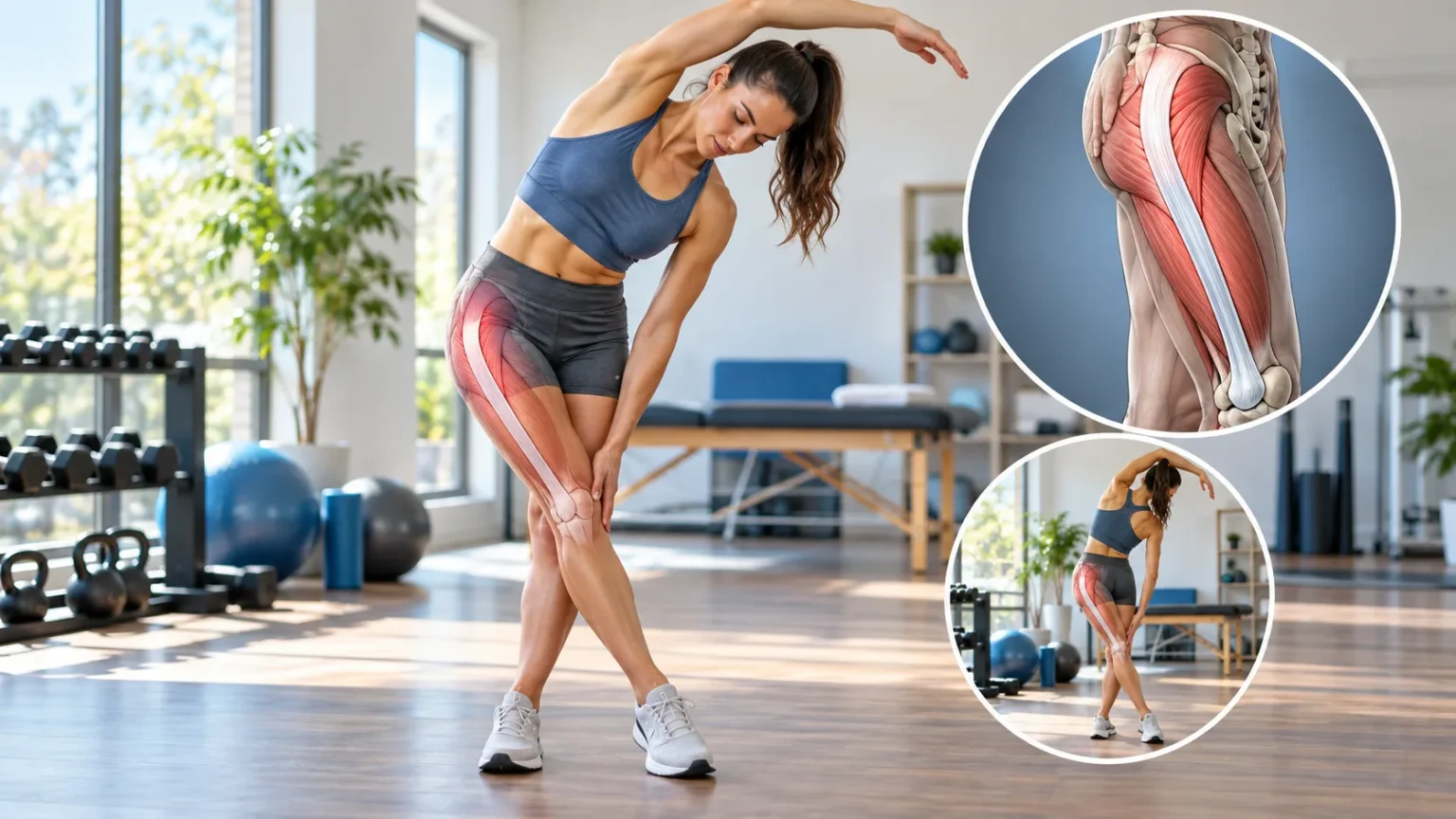

IT band exercises are often recommended when the outside of the thigh or knee feels tight, irritated, or uncomfortable during running, walking, cycling, or other repetitive activities. The iliotibial band itself is a thick strip of connective tissue rather than a muscle, so effective exercise usually focuses on the surrounding muscles that influence hip, knee, and leg mechanics.
A well-designed routine can improve hip strength, movement control, and tolerance to activity without aggressively trying to stretch the IT band. The key is choosing appropriate exercises, performing them with control, and increasing difficulty gradually. Understanding what the IT band does can also help you avoid common mistakes that may aggravate symptoms instead of improving them.
What Is the IT Band?
The iliotibial band, commonly called the IT band, is a strong band of connective tissue running along the outside of the thigh. It extends from structures near the hip down toward the outer portion of the knee. Unlike a muscle, it does not actively contract, but it works closely with several muscles to support movement and stability.
The IT band interacts with the gluteus maximus and tensor fasciae latae, or TFL, around the hip. These muscles contribute to hip movement and help control the position of the leg during walking, running, climbing stairs, and single-leg activities. Problems around the IT band are therefore often influenced by strength, training load, and overall lower-body mechanics.
Because the IT band is naturally dense and strong, trying to physically lengthen it through aggressive stretching is unlikely to create major structural changes. Instead, many useful exercises strengthen the hips, glutes, thighs, and surrounding muscles. This approach can improve movement capacity while reducing excessive strain around the outside of the knee.
Why IT Band Exercises Can Be Helpful
IT band exercises can improve the strength of the muscles responsible for controlling the pelvis, hip, and knee. When these areas are better conditioned, they may handle repetitive activity more efficiently. This is particularly useful for runners, cyclists, hikers, and athletes who regularly perform thousands of similar lower-body movements during training.
Exercises may also help rebuild activity tolerance after a period of irritation. Pain can sometimes lead people to avoid movement completely, causing muscles to lose strength and endurance. Gradually reintroducing controlled loading allows the body to adapt without suddenly exposing sensitive tissues to the same activity levels that originally triggered discomfort.
Another benefit is improved awareness of lower-body movement. Exercises such as step-downs, bridges, and single-leg movements encourage you to control the position of the hip, knee, and foot. Better control does not require perfect alignment, but it can help make demanding movements feel more stable and efficient.
Glute Bridges for Hip and Glute Strength
Begin a glute bridge by lying on your back with your knees bent and feet flat on the floor. Keep the feet about hip-width apart and allow your arms to rest comfortably beside you. Gently tighten your abdominal muscles without holding your breath or forcing your lower back against the floor.
Press through your feet and lift your hips until your body forms a comfortable line from the shoulders toward the knees. Focus on squeezing the glutes rather than excessively arching the lower back. Pause briefly at the top before lowering your hips slowly back toward the floor with control.
Start with two or three sets of eight to fifteen repetitions depending on your current ability. As the exercise becomes easier, you can progress to single-leg bridges or add resistance around the thighs. Increase difficulty gradually rather than immediately choosing the hardest variation available.
Side-Lying Leg Raises
Side-lying leg raises strengthen muscles around the outer hip, including the gluteus medius. Lie on your side with the lower leg slightly bent for support and the top leg straight. Keep your hips stacked rather than allowing the upper hip to roll backward during the movement.
Slowly lift the top leg several inches while keeping the toes pointing mostly forward. Raising the leg extremely high is unnecessary because excessive height can change which muscles are doing most of the work. Pause briefly before lowering the leg slowly to the starting position.
Perform around ten to fifteen controlled repetitions on each side, depending on comfort and strength. A resistance band around the thighs or ankles can increase difficulty when bodyweight repetitions become easy. Prioritize smooth movement and muscle control instead of trying to complete repetitions as quickly as possible.
Clamshell Exercises
Clamshells are another popular exercise for strengthening muscles that support the hip. Lie on your side with your hips and knees bent while keeping your feet together. Your head can rest comfortably on your lower arm or a pillow while your torso remains stable.
Keeping the feet together, slowly raise the top knee without allowing your pelvis to rotate backward. The movement does not need to be large to challenge the hip muscles effectively. Pause at the top and then lower the knee with control until it returns to the starting position.
Begin with one to three sets of ten to fifteen repetitions on each side. Once the movement becomes easy, a small resistance band placed above the knees can make it more challenging. Avoid using heavy resistance if it causes you to twist the body or lose control of the movement.
Lateral Band Walks
Lateral band walks strengthen the glutes and other muscles that help control side-to-side movement. Place a resistance band above the knees or around the ankles, depending on your strength level. Bend the knees slightly and keep your body in a comfortable athletic position without dropping into a deep squat.
Take small controlled steps sideways while maintaining tension in the band. Avoid allowing your feet to snap back together after each step, because maintaining consistent resistance increases muscular demand. Keep your knees comfortably aligned and your torso relatively steady as you move across the floor.
Travel several steps in one direction before returning the opposite way. You might begin with two or three rounds of eight to twelve steps per side. As strength improves, use a stronger resistance band or increase the number of steps while maintaining good technique.
Step-Down Exercises
Step-downs are useful for developing hip and knee control during movements similar to descending stairs or running. Stand on a low step with one foot near the edge while the other foot hangs freely. Keep your standing foot firmly planted and maintain a stable, upright torso.
Slowly bend the standing knee and lower the opposite heel toward the floor. The movement should remain controlled rather than allowing your body to drop quickly. Once the heel lightly approaches or touches the ground, press through the standing leg to return to the starting position.
Begin with a low step because greater height increases the difficulty considerably. Perform approximately eight to twelve repetitions on each side and increase the step height only when you can control the movement comfortably. Holding onto a stable surface can provide additional balance while learning the exercise.
Single-Leg Balance and Hip Control
Single-leg balance can help improve coordination around the foot, knee, hip, and pelvis. Stand near a wall or sturdy surface in case you need support. Slowly lift one foot from the ground and maintain your balance on the standing leg without gripping excessively through the toes.
Try to remain steady while keeping a slight bend in the standing knee. Hold for fifteen to thirty seconds before switching sides. If the exercise is too easy, gentle arm movements, head turns, or standing on a slightly less stable surface can increase the challenge.
More advanced versions can include single-leg reaching or a controlled single-leg squat. These exercises combine strength and balance while placing greater demand on the hip muscles. Progress carefully, particularly if lateral knee discomfort appears during deeper movements or longer periods of single-leg loading.
Hip Flexor and TFL Mobility Exercises
The tensor fasciae latae and hip flexor region can sometimes feel tight when someone has been sitting for long periods or performing repetitive exercise. A gentle half-kneeling hip flexor stretch can provide temporary relief. Place one knee on a padded surface and shift your body slightly forward while maintaining a comfortable trunk position.
You may feel a stretch around the front of the hip on the kneeling side. Avoid forcing the pelvis forward aggressively because a small movement is usually enough. Hold the position for approximately twenty to thirty seconds while breathing normally and remaining within a comfortable range.
Mobility exercises can complement strengthening, but they should not replace it entirely. Stretching may temporarily change how an area feels, while strengthening improves the muscles’ ability to manage physical load. Combining both approaches can create a more balanced exercise routine for people managing outer hip or knee discomfort.
Should You Foam Roll the IT Band?
Foam rolling the outside of the thigh may temporarily make some people feel less stiff or sore. Place the roller underneath the outer thigh and use your arms and opposite leg to control how much body weight is applied. Roll slowly rather than aggressively pressing into painful areas.
Foam rolling does not physically break up or permanently lengthen the IT band. The tissue is extremely strong, so any immediate improvement is more likely related to temporary changes in sensation. This means foam rolling should be viewed as an optional comfort strategy rather than the primary treatment for IT band problems.
If rolling directly over the outer thigh feels excessively painful, reduce the pressure or work around nearby muscles instead. You can focus on the glutes, quadriceps, and upper hip region without aggressively pressing the sensitive lateral knee. More discomfort does not necessarily produce a better result.
IT Band Pain vs Other Causes of Leg Pain
Pain on the outside of the knee is commonly associated with IT band syndrome, particularly in runners and cyclists. However, not every episode of lateral knee or thigh pain comes from the IT band. Joint problems, muscle strains, tendon irritation, or other structures around the knee and hip can create similar symptoms.
Symptoms traveling from the lower back into the buttock or leg may suggest a different problem. Nerve-related pain can involve burning, tingling, numbness, or shooting sensations rather than only localized tenderness. People experiencing these symptoms may benefit from learning about appropriate sciatica therapy separately rather than assuming every leg symptom requires IT band exercises.
Persistent or unusual symptoms should be assessed if the cause remains unclear. Exercise selection depends heavily on which structure is involved and what activities trigger the discomfort. A routine that helps one type of lateral leg pain may not be suitable for another condition with similar symptoms.
Common Mistakes With IT Band Exercises
One common mistake is focusing entirely on stretching the IT band while ignoring hip and leg strength. Because the IT band itself is dense connective tissue, strengthening surrounding muscles often provides a more practical way to improve movement capacity. Mobility work can still be useful, but it should generally support rather than replace progressive strengthening.
Another mistake is doing too much exercise too quickly. Adding multiple new exercises, heavy resistance, and high repetition numbers at once can overload an already sensitive area. Begin with a manageable amount of training and increase one variable at a time as your strength and symptom tolerance improve.
Ignoring pain patterns can also slow progress. Mild muscular effort is expected during strengthening, but sharp or steadily worsening knee pain deserves attention. If symptoms consistently increase after each exercise session and remain elevated for extended periods, reduce the load and reassess your exercise choices.
How Often Should You Do IT Band Exercises?
Strengthening exercises are commonly performed two to four times per week depending on your training schedule and recovery. The muscles need enough repetition to adapt while still receiving adequate recovery between demanding sessions. Beginners may benefit from starting with fewer sessions and increasing frequency only when the routine feels manageable.
Mobility movements can often be performed more frequently because they typically involve lower physical demand. Short sessions after sitting, running, or cycling may help the hips and legs feel more comfortable. However, there is no requirement to stretch constantly if mobility exercises do not noticeably improve how you feel or move.
Your overall activity level should also influence exercise frequency. Someone running several days each week may need less additional lower-body training than someone with a largely sedentary routine. A balanced schedule should improve strength and resilience without creating excessive fatigue that interferes with sports, work, or everyday activities.
Tips for Doing IT Band Exercises Correctly
Move slowly enough to maintain control throughout each exercise. Fast repetitions may allow momentum to reduce the amount of work performed by the target muscles. A controlled pace also makes it easier to notice whether your pelvis, knee, and foot remain comfortable as the exercise becomes more demanding.
Progress exercises only when the current version feels manageable. You can increase repetitions, add resistance, use a more difficult variation, or increase the range of movement. Changing one factor at a time usually makes it easier to identify whether the progression is helpful or unnecessarily aggravating symptoms.
Consistency matters more than finding one perfect IT band exercise. A routine combining hip strengthening, lower-body control, mobility, and gradual return to activity is often more useful than repeatedly performing a single stretch. Choose exercises that fit your needs and can realistically become part of your weekly routine.
When to Seek Professional Help
Consider professional assessment if outer knee or thigh pain persists despite reducing aggravating activity and following a gradual strengthening plan. A clinician or physical therapist can examine the hip, knee, back, and surrounding muscles to determine whether the IT band is actually the likely source of symptoms.
Seek evaluation sooner if pain follows a significant injury or is accompanied by severe swelling, inability to bear weight, joint locking, or noticeable weakness. These symptoms may indicate a problem that requires more specific assessment. Continuing to exercise aggressively through significant symptoms can potentially delay appropriate treatment.
Numbness, persistent tingling, unexplained weakness, fever, redness, or symptoms that progressively worsen should also not be dismissed as ordinary IT band tightness. Most exercise-related lateral knee problems are manageable, but recognizing unusual warning signs helps ensure that more serious or unrelated conditions receive appropriate attention.
Conclusion
IT band exercises work best when they focus on the muscles surrounding the hip, thigh, and knee rather than attempting to stretch the iliotibial band itself aggressively. Glute bridges, side-leg raises, clamshells, lateral band walks, step-downs, and balance exercises can all contribute to stronger lower-body movement.
Correct technique and gradual progression are essential. Begin with exercises you can control comfortably and increase resistance or complexity only when your current routine becomes easy. Combining strengthening with appropriate mobility work and sensible training changes can help improve tolerance to walking, running, cycling, and other repetitive activities.
Persistent pain should not automatically be treated as IT band syndrome. Other knee, hip, muscle, or nerve-related problems can produce similar symptoms and may require different management. Paying attention to how symptoms behave and seeking assessment when needed can help you choose the right exercises and return to activity more confidently.
FAQs
What is the best exercise for IT band pain?
There is no single best exercise for everyone. Glute bridges, side-lying leg raises, clamshells, lateral band walks, and step-downs are commonly used to strengthen muscles that influence hip and knee control.
Can you actually stretch the IT band?
The IT band is dense connective tissue and does not stretch significantly like a muscle. Mobility exercises mainly affect surrounding muscles and may temporarily improve comfort rather than permanently lengthening the IT band.
Is walking good for IT band pain?
Comfortable walking can often be continued if it does not significantly increase symptoms. If walking causes progressively worsening lateral knee pain or limping, reducing distance temporarily may allow the irritated area to settle.
How long does IT band pain take to improve?
Recovery time depends on symptom severity, training load, and how long the problem has been present. Mild cases may improve within weeks, while longer-lasting symptoms can require a more gradual strengthening and activity progression.
Should I stop running with IT band pain?
You may need to temporarily reduce running volume or intensity if running repeatedly aggravates symptoms. A gradual return is usually more practical than immediately returning to the same distance, speed, or hill training.