
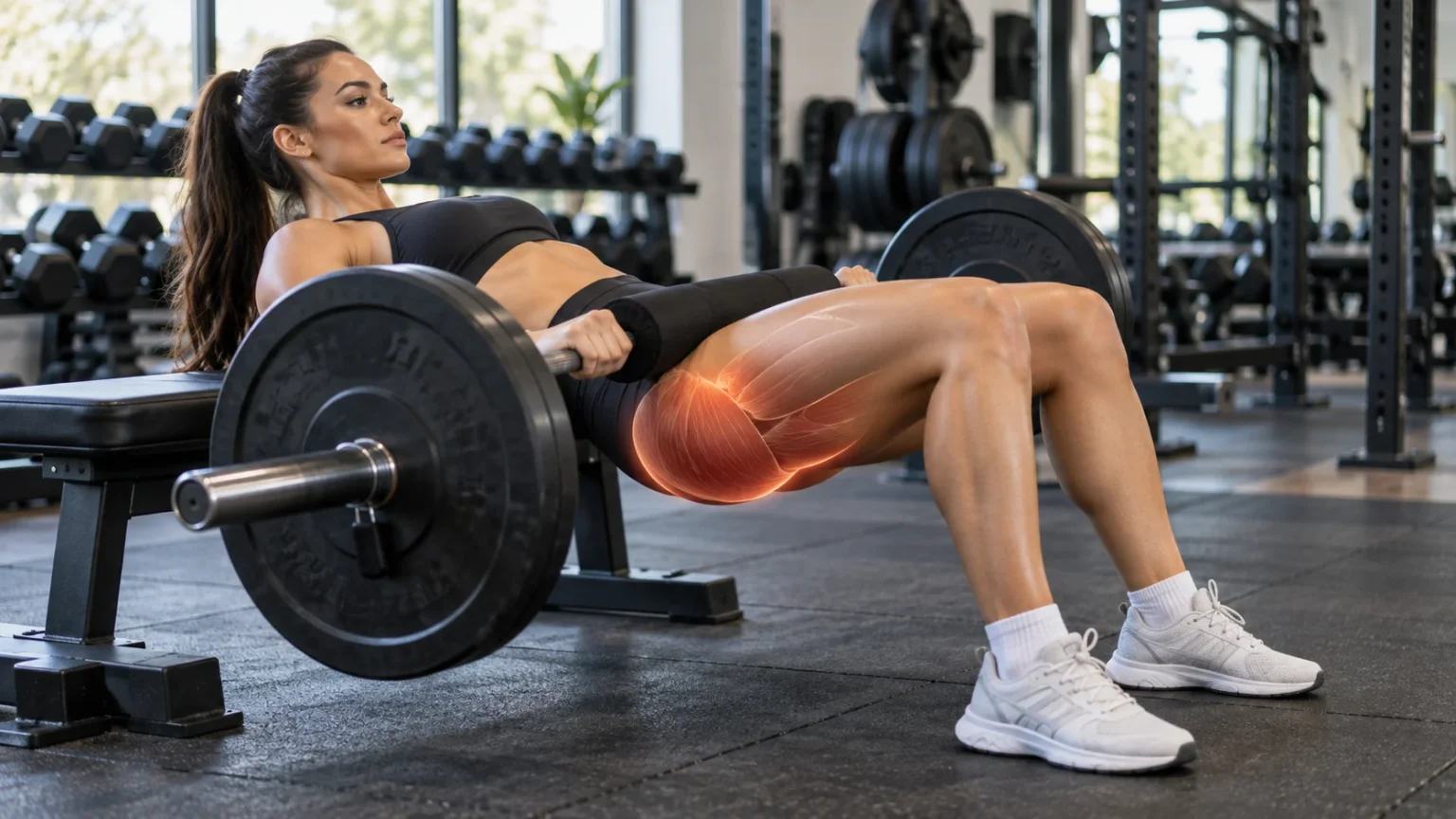

Hip thrusts are one of the most effective lower-body exercises for building strength through the hips and glutes. The movement focuses heavily on hip extension, making it popular among people who want stronger glutes, better athletic performance, and improved lower-body power. When performed correctly, hip thrusts can also involve the hamstrings, core, and surrounding stabilizing muscles.
Although the exercise looks simple, small technique mistakes can reduce its effectiveness or shift too much stress toward the lower back. Foot position, bench height, range of motion, and pelvic control all matter. Understanding which muscles hip thrusts work and how to perform them properly can help you get more value from every repetition.
What Are Hip Thrusts?
A hip thrust is a resistance exercise in which your upper back rests against a bench while your feet stay planted on the floor. From this position, you drive your hips upward until your torso and thighs form a relatively straight line. The movement is powered mainly by the muscles responsible for extending the hips.
Hip thrusts can be performed using body weight, dumbbells, resistance bands, barbells, or dedicated machines. Beginners often start without additional weight to learn the movement pattern. More experienced lifters can gradually increase resistance as strength and control improve, allowing the exercise to become a challenging part of lower-body training.
The hip thrust differs from many traditional leg exercises because the greatest challenge occurs near the top of the movement when the hips are fully extended. This makes it especially effective for training the glutes in a shortened position. It can complement exercises such as squats, lunges, and Romanian deadlifts, which challenge the hips differently.
What Muscles Do Hip Thrusts Work?
The gluteus maximus is the primary muscle worked during hip thrusts. It is the largest muscle in the buttocks and plays a major role in extending the hip. Every time you rise from the bottom position and push your hips upward, the gluteus maximus contracts strongly to create that movement.
The gluteus medius and gluteus minimus also contribute by helping stabilize the pelvis and maintain proper leg alignment. They are especially important when resistance increases or when single-leg variations are performed. Strong hip stabilizers can improve control during walking, running, climbing stairs, and other lower-body movements.
The hamstrings, quadriceps, adductors, and core muscles also assist during hip thrusts. These muscles help control knee position, stabilize the trunk, and support the pelvis throughout the exercise. The hip thrust is therefore not an isolated glute exercise, although the glutes usually receive the greatest training stimulus.
Why Hip Thrusts Are Effective for Glute Strength
Hip thrusts place the glutes under significant tension as the hips approach full extension. This position is important because the glutes are responsible for driving the hips forward and straightening the body. Compared with some other lower-body exercises, hip thrusts allow lifters to challenge this end range with substantial resistance.
Another advantage is that the exercise can be loaded progressively. Once bodyweight hip thrusts become easy, resistance can be increased with a dumbbell, barbell, or machine. Progressive overload encourages the muscles to adapt over time, helping improve strength and muscle development when training is combined with adequate recovery.
Hip thrusts also make it relatively easy to focus on glute contraction because the movement is straightforward. When technique is controlled, many people can clearly feel the glutes working at the top of each repetition. However, squeezing harder is not a substitute for proper form, appropriate resistance, and consistent training progression.
How to Do a Hip Thrust Correctly
Sit on the floor with your upper back positioned against the edge of a sturdy bench. Bend your knees and place your feet flat on the floor around hip-width apart. The bench should support the lower portion of your shoulder blades rather than your neck, allowing the upper body to pivot comfortably during the movement.
Brace your core and drive through your feet as you lift your hips upward. Continue until your hips are extended and your torso is approximately parallel with the floor. Keep your chin slightly tucked and avoid throwing your head backward, which can encourage excessive arching through the spine.
Pause briefly at the top and contract your glutes before lowering your hips under control. Do not allow the lower back to overextend in an attempt to lift higher. The movement should come mainly from the hips, with the ribs and pelvis remaining controlled throughout each repetition.
How Foot Position Changes the Hip Thrust
Foot placement has a major effect on how the hip thrust feels. If your feet are too close to your hips, you may feel more work through the quadriceps. If they are too far away, the hamstrings may become more dominant and you may struggle to reach full hip extension comfortably.
A useful starting point is to position your feet so that your shins are close to vertical at the top of the movement. This position often allows the glutes to work effectively without excessive pressure through the knees or hamstrings. Small adjustments can then be made based on comfort and individual body proportions.
Your feet should remain fully planted throughout the exercise. Avoid rising onto your toes or allowing the heels to lift because this can reduce stability. Keep the knees tracking roughly in line with the toes rather than collapsing inward, especially when using heavier resistance.
Common Hip Thrust Mistakes to Avoid
One common mistake is overextending the lower back at the top of the movement. People sometimes continue lifting after the hips have already reached full extension, causing the rib cage to flare and the spine to arch. This can reduce glute tension and place unnecessary stress on the lower back.
Another mistake is using too much weight before mastering the movement. Heavy resistance can encourage bouncing, shortening the range of motion, or losing control. Reducing the load usually makes it easier to maintain proper pelvic position and ensure that the glutes remain the primary muscles driving the exercise.
Poor bench setup can also create problems. If the bench is too high or unstable, you may struggle to position the upper back comfortably. Use a secure bench and take time to find the right contact point before adding heavy resistance, especially when performing barbell hip thrusts.
Hip Thrusts vs Glute Bridges
Hip thrusts and glute bridges look similar, but they are performed from different starting positions. During a glute bridge, the upper back remains on the floor. During a hip thrust, the upper back is elevated on a bench, which increases the available range of motion through the hips.
The greater range of motion makes hip thrusts easier to load heavily and can create a stronger training stimulus for the glutes. Glute bridges are often more beginner-friendly because they require less setup and can be performed almost anywhere. They are also useful during warm-ups or lower-intensity training sessions.
Both exercises can be valuable depending on your goals. Beginners may start with bridges before progressing to hip thrusts, while experienced lifters may use both within the same program. The most effective choice is the one that allows you to train the hips comfortably with consistent technique.
Hip Thrusts vs Squats
Squats and hip thrusts both train the glutes, but they emphasize different parts of the movement. Squats challenge the hips, knees, and thighs through a larger total range of motion. They also involve the quadriceps significantly and require more whole-body coordination and trunk control.
Hip thrusts place more focused tension on the glutes near full hip extension. This makes them especially useful when someone wants to add extra glute-specific volume without performing another demanding squat variation. They may also feel easier on the knees for some individuals, although this depends on technique and personal mobility.
There is no need to choose between squats and hip thrusts. Combining both exercises can create a more complete lower-body program because they challenge the muscles differently. Squats build broad leg strength, while hip thrusts provide a focused opportunity to train powerful hip extension.
How Many Hip Thrusts Should You Do?
Beginners can start with two or three sets of 8 to 12 repetitions using body weight or light resistance. The final repetitions should feel challenging without causing technique to break down. If every repetition feels extremely easy, resistance can gradually be increased.
People training primarily for muscle growth may use moderate repetition ranges with enough weight to create muscular fatigue. Strength-focused lifters may perform fewer repetitions with heavier resistance, while endurance-oriented routines may use higher repetitions. The exact number matters less than maintaining good form and applying gradual progression.
Two or three hip thrust sessions per week can work well for many people, depending on total lower-body training volume. The glutes also work during squats, lunges, deadlifts, and other exercises, so recovery should be considered. More training is not automatically better if soreness and fatigue prevent quality movement.
Best Hip Thrust Variations
The bodyweight hip thrust is the best starting point for many beginners. It allows you to learn the movement without worrying about equipment or load placement. Once you can perform controlled repetitions and feel the glutes working effectively, you can progress to weighted variations.
A dumbbell hip thrust provides an easy next step. Place a dumbbell across the hips and hold it securely while completing the same movement. This setup works well for home or gym training and requires less preparation than loading a barbell with plates.
More advanced options include barbell hip thrusts, banded hip thrusts, single-leg hip thrusts, and machine variations. Each changes the challenge slightly. Single-leg versions demand greater balance and hip stability, while bands can increase tension around the knees and encourage stronger engagement of the hip abductors.
Can Hip Thrusts Help With Athletic Performance?
Strong hip extension is important for sprinting, jumping, changing direction, and accelerating. Because the glutes are major hip extensors, strengthening them may support athletic movements that depend on forceful lower-body power. Hip thrusts are therefore commonly used in strength and conditioning programs.
The exercise can also improve the ability to produce force in a horizontal direction. This can be useful for sprinting and acceleration, where athletes drive the body forward. However, performance improvements depend on a complete training program rather than one exercise performed in isolation.
Athletes should combine hip thrusts with squats, jumps, sprints, single-leg exercises, and sport-specific practice. Strength is most useful when it transfers into actual movement. Hip thrusts provide one valuable piece of that training by improving the capacity of the glutes to generate force.
Can Hip Thrusts Affect the Lower or Middle Back?
Hip thrusts should primarily be felt through the glutes, but poor technique can create unnecessary stress through the spine. Excessive back arching, poorly positioned benches, or loads that are too heavy can make the lower or middle back work harder than intended. Proper pelvic control helps keep the movement focused on the hips.
If you already experience middle back pain, begin with lighter resistance and make sure the bench position feels comfortable. The upper back should be supported without forcing the spine into an awkward position. Stop if the exercise clearly increases pain or produces unusual symptoms.
Persistent back pain should not automatically be treated with hip strengthening alone. Back discomfort can have many causes, including muscle strain, joint irritation, and nerve-related problems. A physical therapist or healthcare professional can help determine whether hip thrusts are appropriate when pain is ongoing or unexplained.
How to Progress Hip Thrusts Safely
Progressive overload is important for building strength, but it should happen gradually. Once you can perform your planned repetitions with consistent technique, increase the resistance slightly. There is no need to make large weight jumps if smaller increases continue to challenge the muscles effectively.
You can also progress by adding repetitions, increasing the pause at the top, slowing the lowering phase, or trying a more difficult variation. These methods can increase training difficulty without immediately adding more weight. They are particularly useful when equipment is limited or heavier loads cause technique problems.
Keep track of your sets, repetitions, and resistance so you can see whether your performance is improving. Progress may be gradual from week to week. The goal is to become stronger while maintaining the same movement quality rather than sacrificing form simply to move heavier weight.
Who Should Modify or Avoid Hip Thrusts?
People recovering from hip, pelvic, abdominal, or spinal surgery should get medical clearance before performing loaded hip thrusts. The exercise creates pressure through the trunk and hips, which may not be suitable during early recovery. Rehabilitation timelines vary greatly depending on the procedure and individual circumstances.
People with active hip or back pain may also need modifications. A glute bridge, lighter resistance, smaller range of motion, or different exercise may feel more comfortable. Pain should not be ignored simply because hip thrusts are generally considered a safe strength exercise.
Pregnant individuals or people with certain pelvic floor concerns may benefit from individualized guidance. Exercise can often continue with appropriate modifications, but comfort, breathing, and pressure management become important. A qualified healthcare or fitness professional can help determine whether the exercise suits your specific needs.
Tips to Get More From Hip Thrusts
Focus on controlling the movement rather than simply moving the weight from one position to another. Drive through the feet, keep the knees stable, and pause briefly at full hip extension. A controlled repetition generally provides a better training stimulus than bouncing through the bottom and top positions.
Use padding when performing barbell hip thrusts to make the setup more comfortable. A bar pad or folded mat can reduce pressure across the front of the hips. Discomfort from the bar should not become the main factor limiting the exercise when the muscles could otherwise continue working.
Finally, train the glutes through more than one movement pattern. Combine hip thrusts with squats, lunges, Romanian deadlifts, step-ups, or other lower-body exercises. A varied program helps build strength through different ranges of motion and creates more balanced development than relying entirely on one exercise.
Conclusion
Hip thrusts primarily work the gluteus maximus, while the gluteus medius, hamstrings, quadriceps, core, and other stabilizing muscles also contribute. The exercise is especially effective for training strong hip extension. This makes it valuable for general strength, muscle development, and athletic performance.
Proper technique is essential for getting the most from the movement. Keep your feet stable, control your pelvis, avoid overextending your lower back, and use a bench that allows comfortable positioning. Start with manageable resistance and increase the challenge only when your technique remains consistent.
Hip thrusts work best as part of a balanced lower-body program rather than as a replacement for every other exercise. Combine them with squats, hinges, lunges, and single-leg movements to build complete strength. With regular practice and sensible progression, hip thrusts can become one of the most useful exercises in your training routine.
FAQs
What muscles do hip thrusts work the most?
Hip thrusts primarily target the gluteus maximus. The hamstrings, gluteus medius, quadriceps, core, and hip stabilizers also assist throughout the movement.
Are hip thrusts better than squats for glutes?
Hip thrusts emphasize the glutes strongly near full hip extension, while squats train the glutes through a different range. Using both exercises can provide more complete lower-body development.
How many hip thrusts should a beginner do?
Beginners can start with two or three sets of 8 to 12 repetitions. Begin with body weight or light resistance and increase the load gradually as technique and strength improve.
Should hip thrusts hurt your lower back?
No. You should mainly feel the exercise in your glutes. Lower-back pain may indicate excessive arching, poor setup, too much weight, or another condition requiring assessment.
How often should I do hip thrusts?
Two or three sessions per week can work well for many people. Your ideal frequency depends on training volume, exercise intensity, recovery, and how many other glute exercises you perform.