
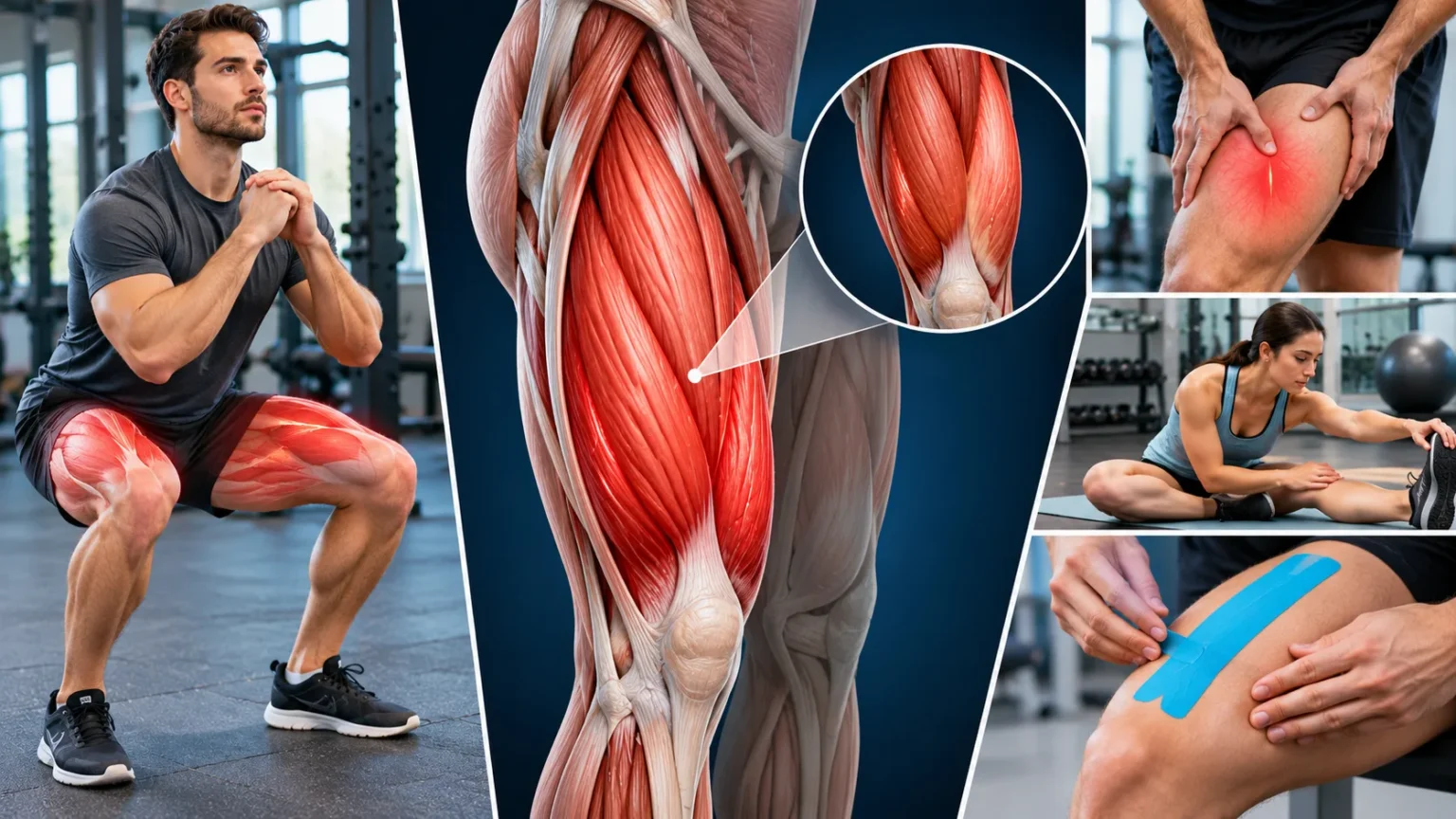

The quads muscles are among the largest and most important muscle groups in the human body. Located at the front of your thighs, they help you walk, run, climb stairs, stand up, and maintain balance during everyday movements. These muscles also support your knees and contribute to lower-body strength and stability.
Understanding how the quadriceps muscles work can help you improve movement, recognize common injuries, and maintain healthy legs. Whether you exercise regularly or simply want to learn more about human anatomy, knowing their location and function is useful. This guide explains quadriceps anatomy, common problems, strengthening exercises, and practical recovery tips.
What Are the Quads Muscles?
The quads muscles, officially called the quadriceps femoris, are a group of four major muscles located at the front of the thigh. Their primary function is to straighten the knee by extending the lower leg. They also help stabilize the knee joint during movement. Because they support many everyday activities, healthy quadriceps are essential for comfortable mobility.
The term quadriceps comes from Latin words meaning four heads, referring to the four muscles that form the group. These muscles work together to generate force during walking, climbing, standing, and other movements. Each muscle has a slightly different anatomical position and contribution. Together, they create a powerful system that supports movement throughout the lower body.
Strong and properly functioning quadriceps help you perform daily activities with greater control and stability. However, these muscles can become sore, strained, or weak because of injuries, prolonged inactivity, or certain health conditions. Understanding their structure and functions makes it easier to recognize possible problems. It also helps you choose appropriate exercises and recovery strategies.
Where Are the Quads Muscles Located?
The quadriceps muscles are located along the front and sides of the upper leg, extending between the hip region and the knee. Most of their muscle mass surrounds the femur, commonly called the thigh bone. You can usually feel these muscles becoming firm when you straighten your knee. Their position allows them to control several important lower-body movements.
The quadriceps group covers much of the anterior thigh, which is the medical term for the front of the thigh. Different portions of the group lie toward the inner, outer, and central regions of the leg. One muscle also crosses the hip joint, while the others primarily act at the knee. This arrangement allows the group to contribute to both movement and stability.
Near the knee, the quadriceps muscles connect through the quadriceps tendon, which attaches to the patella or kneecap. The patellar ligament continues from the kneecap to the tibia, or shinbone. Together, these structures help transfer muscular force to straighten the leg. Understanding this connection explains why quadriceps injuries sometimes cause discomfort around the knee.
The Four Quadriceps Muscles Explained
The quadriceps group consists of the rectus femoris, vastus lateralis, vastus medialis, and vastus intermedius. Although these muscles share responsibility for knee extension, their anatomical locations are different. Each contributes force to the movement while helping the leg function as a coordinated system. Understanding their individual roles provides a clearer picture of quadriceps anatomy.
The rectus femoris runs along the front of the thigh and crosses both the hip and knee joints. It helps straighten the knee while also assisting with hip flexion, such as raising your thigh. The vastus lateralis lies along the outer thigh and contributes substantial force during knee extension. It is one of the largest components of the quadriceps group.
The vastus medialis occupies the inner portion of the thigh and contributes to knee extension and kneecap control. The vastus intermedius sits deeper beneath the rectus femoris, directly along the front of the femur. Both muscles work with the other quadriceps to extend the knee. Their coordinated action supports controlled movement during everyday activities.
What Do the Quads Muscles Do?
The primary function of the quadriceps muscles is knee extension, which means straightening the leg at the knee joint. This movement is necessary when standing up from a chair, climbing stairs, and kicking a ball. The quadriceps also help control knee bending by producing force while lengthening. This makes them important during both upward and downward movements.
During walking and running, the quads help manage forces passing through the knee. They contribute to stability when your foot contacts the ground and your body weight shifts forward. When walking downstairs or lowering yourself into a chair, they help control the movement against gravity. Without adequate quadriceps function, these activities may become more difficult.
The rectus femoris also assists with hip flexion because it crosses the hip joint. This action contributes when lifting the thigh, stepping forward, or performing certain athletic movements. However, other muscles, including the iliopsoas, play major roles in hip flexion. The quadriceps therefore work as part of a larger muscular system rather than functioning independently.
How the Quads Support the Knee and Hip
The quadriceps muscles play an important role in knee stability by controlling extension and helping manage movement-related forces. Their tendons connect the muscles to the kneecap and lower leg, allowing muscular contractions to move the joint. This mechanism supports activities such as stepping, squatting, and changing direction. Healthy muscle function can improve control during these movements.
The vastus medialis contributes to kneecap control alongside the other quadriceps muscles and surrounding soft tissues. However, knee stability depends on more than one muscle or isolated strengthening exercise. Ligaments, tendons, hip muscles, and overall movement patterns also influence joint function. Balanced rehabilitation therefore usually considers the entire lower limb instead of focusing only on the quadriceps.
At the hip, the rectus femoris helps lift the thigh toward the torso. This action becomes important during walking, running, and movements requiring coordinated hip and knee activity. Excessive tightness or discomfort in this muscle may affect how certain movements feel. Maintaining comfortable mobility and appropriate strength can support normal joint function.
Common Quadriceps Muscle Injuries
Quadriceps strains are among the common injuries affecting the front of the thigh. A strain occurs when muscle fibers are overstretched or damaged, often during sudden acceleration, kicking, or forceful movements. Symptoms may include localized pain, tenderness, swelling, and difficulty contracting the affected muscle. The severity can range from mild discomfort to a substantial muscle tear.
Quadriceps contusions are another type of injury, usually resulting from a direct impact to the thigh. They commonly occur during contact sports, falls, or accidental collisions. A contusion may cause soreness, bruising, swelling, and temporary difficulty bending the knee. More significant injuries can restrict movement and require medical evaluation before returning to normal activities.
Severe quadriceps injuries may involve extensive muscle damage or disruption of the tendon. These injuries can produce sudden pain, marked weakness, and difficulty straightening the knee. Trying to continue strenuous activity can aggravate the problem. Prompt medical assessment is important when symptoms are severe, movement is significantly limited, or an injury causes noticeable loss of function.
Quadriceps Tendon Pain and Knee Problems
The quadriceps tendon connects the quadriceps muscles to the upper part of the kneecap. Repeated loading or sudden excessive force can contribute to irritation or injury in this structure. Quadriceps tendinopathy may cause discomfort just above the kneecap, particularly during activities involving repeated knee bending and straightening. Symptoms can develop gradually or follow changes in physical activity.
Not every case of pain around the kneecap comes from the quadriceps tendon. Patellofemoral pain, patellar tendinopathy, joint problems, and other conditions may produce similar symptoms. Pain location, recent activity, and physical examination findings help distinguish these possibilities. Accurate identification matters because different knee problems may require different treatment and rehabilitation approaches.
A quadriceps tendon rupture is a more serious injury that can prevent normal knee extension. Someone with a complete rupture may be unable to straighten the leg actively or lift it while keeping the knee straight. This injury requires urgent medical assessment and may need surgical treatment. Severe knee weakness after a sudden injury should never be ignored.
Why Your Quads Feel Tight, Sore, or Weak
Quadriceps tightness can develop after prolonged sitting, unfamiliar exercise, or extended periods in certain positions. Some people describe this sensation as stiffness or resistance when bending the knee or moving the hip. However, feeling tight does not always mean the muscle is physically shortened. Pain sensitivity, fatigue, and reduced movement tolerance can also influence the sensation.
Soreness after unfamiliar physical activity is often associated with delayed-onset muscle soreness, commonly called DOMS. It usually develops several hours after exercise and may be most noticeable during the following days. Mild soreness generally improves as the muscles recover. Sharp pain, substantial swelling, or difficulty bearing weight may indicate something other than ordinary post-exercise soreness.
Quadriceps weakness may occur after injury, prolonged inactivity, surgery, or certain neurological conditions. Weak muscles can make activities such as climbing stairs and standing from a chair more challenging. However, weakness should not automatically be attributed to poor fitness. Persistent, unexplained, or worsening weakness deserves medical evaluation to identify the underlying cause.
Best Exercises to Strengthen the Quads Muscles
Quadriceps strengthening exercises can improve your ability to straighten the knee and control everyday movements. Chair sit-to-stands are a practical starting option because they resemble an activity performed throughout the day. Begin from a stable chair, stand using comfortable control, and sit down slowly. Use your hands for assistance if needed and avoid movements that cause sharp pain.
Supported mini squats are another way to engage the quadriceps while practicing controlled knee bending. Stand near a sturdy surface, bend your knees slightly, and return to a comfortable upright position. Keep the movement within a range that feels manageable. A shallow movement can be useful when deeper bending causes discomfort or when you are beginning a strengthening routine.
Step-ups and straight-leg raises may also help strengthen the muscles surrounding the knee. A low step provides a way to practice controlled movement during step-ups, while straight-leg raises can activate the quadriceps with limited knee bending. Exercise selection should match your current abilities and symptoms. Gradual progression and adequate recovery are more important than forcing difficult movements.
How to Stretch Your Quad Muscles Safely
Gentle quadriceps stretching may improve comfort and movement tolerance when the front of your thighs feels stiff. A common standing stretch involves bending one knee and bringing the heel toward the buttock. Hold a stable surface for balance and keep the movement comfortable. Avoid pulling forcefully on your ankle or arching your lower back excessively.
A side-lying quadriceps stretch can be useful if balancing on one leg feels difficult. Lie comfortably on your side and gently bend your upper knee, bringing your foot toward your body. Use a strap or towel if reaching your ankle is uncomfortable. The stretch should produce a mild pulling sensation rather than sharp pain around the knee or thigh.
Stretching is not always necessary for every quadriceps problem, particularly when a muscle or tendon is acutely injured. Forceful stretching of a painful strain may aggravate symptoms. Gentle mobility and appropriate strengthening are often useful components of a broader movement routine. If discomfort persists or worsens, seek guidance before continuing with more demanding stretches.
Recovery and Prevention Tips for Healthy Quads
Recovering from quadriceps discomfort depends on the cause and severity of the problem. Mild muscle soreness may improve with comfortable movement, adequate rest, and temporary adjustments to demanding activities. A more significant strain or tendon injury may require structured rehabilitation. Avoid returning to high-intensity exercise simply because symptoms briefly improve during rest.
Gradually increasing physical activity can help your quadriceps adapt to new demands. Large, sudden increases in running, jumping, or resistance exercise may place excessive stress on muscles and tendons. Comfortable warm-up movements can prepare your body for activity, while suitable recovery periods allow tissues to adapt. Consistency is generally more useful than repeatedly making dramatic changes to exercise intensity.
Maintaining overall lower-body strength can also support quadriceps function. Hip muscles, hamstrings, calves, and core muscles contribute to movement control and should not be overlooked. Regular physical activity, sufficient sleep, and balanced nutrition support general muscle health. When returning after an injury, follow individualized rehabilitation advice rather than relying on a fixed recovery timeline.
When to Seek Medical Help for Quad Pain
Mild quadriceps soreness after unfamiliar activity often settles without intensive treatment. However, pain that persists, repeatedly returns, or interferes with ordinary movement should be assessed by a healthcare professional. A clinician can examine the thigh and knee, review symptoms, and identify potential injuries. Proper diagnosis helps determine whether rest, rehabilitation, or additional treatment is necessary.
Seek urgent medical attention after a significant injury if you cannot straighten your knee, bear weight, or walk normally. Rapid swelling, severe pain, or an obvious change in the shape of the thigh or knee also requires prompt assessment. These findings can indicate a substantial injury. Avoid testing the injured leg repeatedly or attempting strenuous exercise before receiving appropriate advice.
Unexpected quadriceps weakness, persistent numbness, or symptoms affecting several parts of the leg may involve nerves or other medical conditions. A hot, swollen, painful leg, particularly without a clear injury, also needs prompt evaluation. Leg swelling with chest pain or sudden breathlessness is a medical emergency. Recognizing these warning signs helps distinguish ordinary muscle discomfort from problems requiring urgent care.
Conclusion
The quads muscles are essential for knee extension, lower-body movement, and everyday stability. Located along the front of the thigh, the quadriceps group includes four muscles that work together to generate force and control movement. They support activities such as walking, climbing stairs, standing, and running. Understanding their anatomy makes it easier to recognize their importance.
Quadriceps strains, tendon problems, weakness, and stiffness can affect comfort and mobility. Appropriate strengthening exercises, gentle mobility work, and gradual activity progression may help maintain healthy muscle function. However, the most suitable approach depends on individual symptoms and physical abilities. Persistent or severe discomfort should be evaluated rather than managed through exercise alone.
Taking care of your quadriceps involves maintaining regular movement, allowing adequate recovery, and recognizing possible signs of injury. Balanced lower-body conditioning can support both your knees and hips during everyday activities. Avoid pushing through sharp pain or significant weakness. With appropriate care and sensible activity habits, your quadriceps can continue supporting comfortable movement.
Frequently Asked Questions
Where Are the Quads Muscles Located?
The quads muscles are located along the front and sides of your thighs, between the hip region and knee. They surround the femur and connect to the kneecap through the quadriceps tendon.
What Are the Four Quadriceps Muscles?
The four quadriceps muscles are the rectus femoris, vastus lateralis, vastus medialis, and vastus intermedius. They work together to straighten the knee, while the rectus femoris also helps flex the hip.
What Is the Main Function of the Quads Muscles?
The primary function of the quads muscles is knee extension, which means straightening the leg. They also help control knee bending and support everyday movements such as walking, climbing stairs, and standing.
What Causes Pain in the Quadriceps Muscles?
Quadriceps pain may result from muscle strains, direct injuries, unfamiliar exercise, or tendon problems. Persistent symptoms, significant swelling, or difficulty moving the leg should be evaluated by a healthcare professional.
How Can You Strengthen Weak Quad Muscles?
Chair sit-to-stands, supported mini squats, step-ups, and straight-leg raises can help strengthen the quadriceps. Start with comfortable movements, progress gradually, and seek professional advice if weakness follows an injury or continues without explanation.