
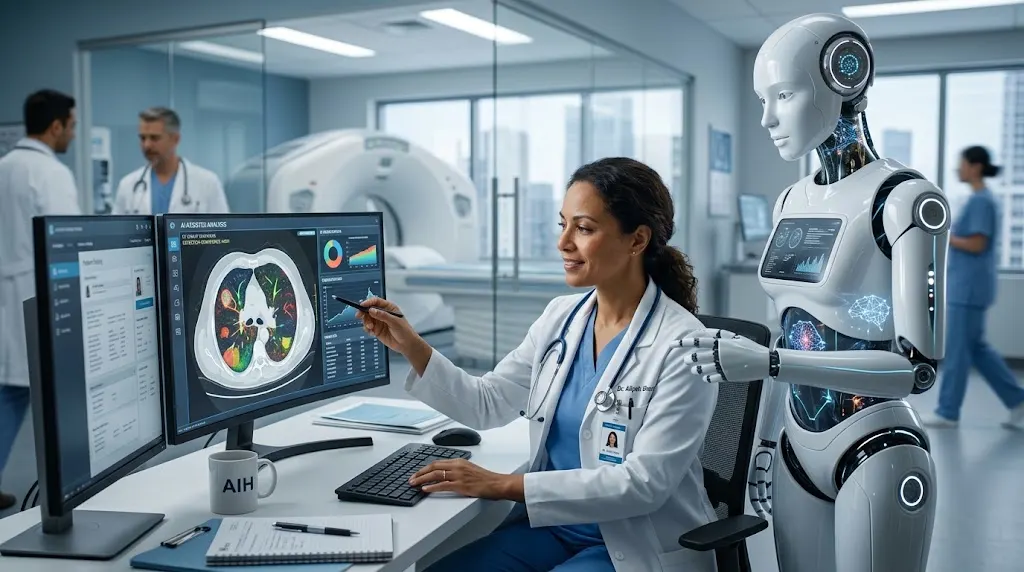

What Is AI in Healthcare?
Artificial intelligence in healthcare refers to the use of computer systems that can analyze information, recognize patterns, support decisions, and automate certain clinical or administrative tasks. These technologies can work with medical images, health records, laboratory data, patient messages, and other forms of healthcare information. Their purpose is generally to help professionals work more efficiently and make better-informed decisions.
Healthcare AI includes machine learning, natural language processing, computer vision, predictive analytics, and generative AI. Different tools are designed for different jobs, such as identifying abnormalities in scans, summarizing medical notes, forecasting patient risks, or helping staff manage repetitive documentation. Some systems assist directly with clinical care, while others focus on operational efficiency.
AI does not replace the need for qualified healthcare professionals. Doctors, nurses, therapists, pharmacists, and other experts still provide the judgment, empathy, responsibility, and context required for safe patient care. The most practical role for AI is supporting professionals with information and automation while humans remain responsible for important medical decisions.
How AI Is Changing Medical Diagnosis
AI can help healthcare professionals identify patterns in medical data that may be difficult or time-consuming to detect manually. Machine learning models can analyze imaging studies, laboratory results, and patient information to highlight findings that deserve closer attention. This can help clinicians prioritize cases or consider possibilities they may want to investigate further.
Medical imaging is one of the most visible applications. AI systems can assist with analyzing X-rays, CT scans, MRIs, mammograms, and other images by identifying suspicious areas or unusual patterns. These systems are generally used as decision-support tools rather than independent diagnosticians, allowing radiologists and other specialists to review AI findings alongside their own clinical expertise.
Accuracy remains essential because medical information can be complex and individual patients may present differently. An AI system trained on limited or unrepresentative data may perform poorly in certain populations or clinical settings. Healthcare organizations therefore need careful validation, monitoring, and human review before relying on automated diagnostic support in real-world patient care.
AI and Personalized Patient Care
Artificial intelligence can help make healthcare more personalized by analyzing larger amounts of patient information than clinicians could easily review at once. A system may consider medical history, laboratory results, medications, lifestyle information, and previous treatments to identify patterns. These insights can support more individualized care planning when combined with professional medical judgment.
Personalization may be especially useful when several treatment options are available. AI can help clinicians compare patient characteristics with patterns found in previous cases or clinical data. This does not mean the system chooses the treatment independently, but it can provide additional information that helps professionals evaluate which approaches may deserve consideration.
Patient preferences and personal circumstances still matter greatly. Two people with similar medical conditions may have different goals, risks, lifestyles, or responses to treatment. Effective personalized care therefore requires combining data-driven insights with conversations between patients and healthcare professionals rather than treating an algorithmic recommendation as the complete answer.
AI in Medical Imaging
Medical imaging generates enormous amounts of visual information, making it a natural area for artificial intelligence. Computer vision systems can analyze images and identify patterns associated with particular conditions or abnormalities. These tools may help radiologists review cases more efficiently by highlighting regions that appear unusual and deserve closer examination.
AI can also assist with workflow prioritization. If a system detects features that may indicate an urgent problem, the case can potentially be moved higher in the review queue. This can help medical teams focus attention quickly where it may be most needed, particularly in environments where specialists handle large numbers of images every day.
However, imaging AI should not be treated as infallible. Poor image quality, unusual anatomy, rare conditions, or differences between training data and real patients can affect performance. Radiologists and clinicians must interpret findings within the patient’s broader medical context and confirm whether AI-generated observations are clinically meaningful before decisions are made.
How AI Helps Doctors With Medical Records
Healthcare professionals often spend substantial time documenting visits, reviewing records, and organizing patient information. AI can help summarize clinical notes, identify important details, structure unorganized text, and reduce repetitive administrative work. This may allow doctors and nurses to spend less time navigating documentation and more time communicating directly with patients.
Natural language processing is particularly useful because medical records contain large amounts of written information. AI systems can analyze notes, discharge summaries, medication lists, and other documents to surface relevant details. Generative AI may also assist with drafting documentation based on conversations, although the finished record still requires careful professional review for accuracy.
Documentation errors can have serious consequences, so automated summaries should never be accepted without checking important details. AI may misunderstand terminology, omit context, or generate incorrect information. Healthcare organizations need clear review processes to ensure that time savings do not come at the expense of accurate medical records or patient safety.
AI in Remote Patient Monitoring
Remote patient monitoring allows healthcare teams to track certain health information while patients are outside traditional clinical settings. Connected devices can collect measurements such as heart rate, activity, blood pressure, glucose readings, or other relevant data. AI can help analyze these streams and identify patterns that may indicate a meaningful change requiring attention.
Instead of clinicians manually reviewing every individual measurement, an AI system can highlight unusual trends or changes based on predefined criteria and learned patterns. This may support earlier intervention for certain patients, particularly those managing chronic conditions. It can also help healthcare teams prioritize which patients need follow-up most urgently.
Remote monitoring still requires thoughtful clinical oversight because not every unusual reading represents an emergency. Devices may produce incorrect measurements, and personal circumstances can affect data interpretation. AI should help organize and prioritize information while qualified professionals determine whether a change is clinically important and what action, if any, should follow.
How AI Is Improving Healthcare Administration
Not every important use of artificial intelligence happens directly during medical treatment. Hospitals and clinics also manage scheduling, billing, staffing, insurance processes, documentation, supply coordination, and many other administrative responsibilities. AI can automate portions of these workflows, reducing repetitive tasks that consume time without requiring advanced clinical expertise.
For example, automated systems can help organize appointment requests, classify incoming messages, summarize administrative documents, or route information to appropriate departments. More advanced systems may coordinate several actions across software platforms. Understanding agentic AI can be useful because agent-based systems are increasingly designed to manage multi-step digital workflows rather than simply generate individual responses.
Administrative automation can benefit patients as well as staff. Faster scheduling, better information routing, and fewer repetitive processes may reduce waiting and improve communication. However, healthcare organizations must design these workflows carefully because administrative decisions can still affect access, privacy, billing, and the overall patient experience.
AI in Drug Discovery and Medical Research
Developing new medicines traditionally requires extensive research, testing, and analysis. AI can help researchers examine large scientific datasets, identify promising molecular patterns, and prioritize possibilities for further investigation. This may reduce the time spent evaluating certain early-stage options while allowing scientists to focus resources on candidates that appear more promising.
Artificial intelligence can also support medical research by analyzing complex relationships across large datasets. Researchers may use machine learning to identify patterns involving diseases, biomarkers, treatment responses, or patient populations. These discoveries can generate hypotheses that require further testing through laboratory research, clinical studies, and other established scientific methods.
AI does not eliminate the need for rigorous medical research. A computational prediction is not the same as proven clinical effectiveness or safety. New treatments must still undergo appropriate testing, validation, regulatory review, and professional evaluation before they become part of standard patient care, regardless of how promising an AI-generated discovery appears initially.
Benefits of AI in Healthcare
One major benefit of healthcare AI is its ability to process large amounts of information quickly. Clinicians often work with medical histories, tests, images, medications, and changing patient conditions simultaneously. AI can help organize this information and highlight relevant patterns, reducing some of the cognitive and administrative workload associated with increasingly complex healthcare environments.
AI can also improve efficiency by handling repetitive tasks. Automated documentation, scheduling assistance, patient message classification, and data analysis may allow healthcare professionals to spend more time on work that requires direct human involvement. Even relatively small time savings can become significant across large hospitals or healthcare networks serving thousands of patients.
Another potential benefit is consistency. Properly designed systems can apply the same analytical process across many cases without fatigue. However, consistency is valuable only when the underlying system is accurate and appropriately validated, which means healthcare organizations still need regular monitoring, quality controls, and human oversight as technology becomes more deeply integrated into care.
Risks and Challenges of AI in Healthcare
AI systems can make mistakes, and healthcare errors can have serious consequences. A model may generate an incorrect summary, miss an important pattern, or produce a recommendation that does not fit a particular patient’s circumstances. Human review is therefore essential whenever AI-generated information could influence diagnosis, treatment, medication, or another significant medical decision.
Bias is another major concern. If an AI model is trained on data that does not adequately represent different patient populations, its performance may vary across groups. Healthcare organizations need to evaluate systems carefully to ensure they work appropriately for the people they serve rather than assuming strong overall accuracy guarantees equally reliable results for every patient.
Privacy and cybersecurity also require careful attention because healthcare information is highly sensitive. AI systems may interact with medical records, diagnostic data, or patient communications, creating additional responsibilities around access and data protection. Organizations should limit permissions, protect information appropriately, and ensure technology vendors meet relevant privacy and security expectations before deploying AI broadly.
The Future of AI in Healthcare
AI is likely to become increasingly integrated into the software healthcare professionals already use. Rather than operating as separate applications, intelligent features may appear directly inside electronic health records, imaging systems, patient communication platforms, and administrative workflows. This could make artificial intelligence feel less like a specialized technology and more like a routine part of healthcare operations.
Multimodal AI may also become increasingly useful because healthcare information exists in many formats. Future systems may analyze text, images, laboratory data, audio, and structured records together to support more complete understanding. Combining different types of information could help clinicians identify relationships that are difficult to see when each data source is reviewed separately.
The success of healthcare AI will depend on more than technical capability. Trust, clinical validation, transparency, privacy, regulation, and responsible implementation will remain important. The most useful systems will likely be those that support healthcare professionals without obscuring how decisions are made or reducing the human connection that remains central to quality patient care.
Conclusion
AI in healthcare is changing how medical professionals diagnose conditions, analyze images, manage records, monitor patients, conduct research, and handle administrative work. The technology can process large amounts of information quickly and identify patterns that support decision-making. These capabilities have the potential to make many healthcare workflows more efficient and responsive.
At the same time, artificial intelligence introduces important challenges involving accuracy, bias, privacy, security, and accountability. Medical decisions are often complicated and highly personal, so automated recommendations cannot simply replace professional judgment. Healthcare organizations need careful validation and human oversight whenever AI outputs could meaningfully affect a patient’s care or wellbeing.
The future of healthcare will likely involve closer collaboration between people and intelligent systems. AI can organize information, automate routine tasks, and provide useful analytical support, while healthcare professionals contribute experience, empathy, context, and responsibility. Used carefully, this combination can improve efficiency without losing the human expertise patients depend on.
FAQs
How is AI being used in healthcare?
AI is used for medical imaging, documentation, patient monitoring, predictive analytics, research, scheduling, and administrative automation. Most applications support healthcare professionals rather than independently making final medical decisions.
Can AI replace doctors?
AI can assist doctors with information, analysis, documentation, and repetitive tasks, but it cannot replace the full clinical judgment, accountability, communication, empathy, and patient-specific understanding required from qualified healthcare professionals.
What are the main benefits of AI in healthcare?
Key benefits include faster data analysis, reduced administrative work, improved workflow efficiency, earlier identification of certain patterns, and better organization of complex patient information for healthcare professionals.
What are the risks of AI in healthcare?
Important risks include inaccurate outputs, biased models, privacy concerns, cybersecurity threats, and excessive reliance on automated recommendations. Careful validation and human oversight are essential for safe implementation.
Will AI improve patient care in the future?
AI has the potential to improve care by supporting earlier analysis, personalized decisions, remote monitoring, and more efficient healthcare operations. Its impact will depend on reliable technology, responsible implementation, and continued clinical oversight.