
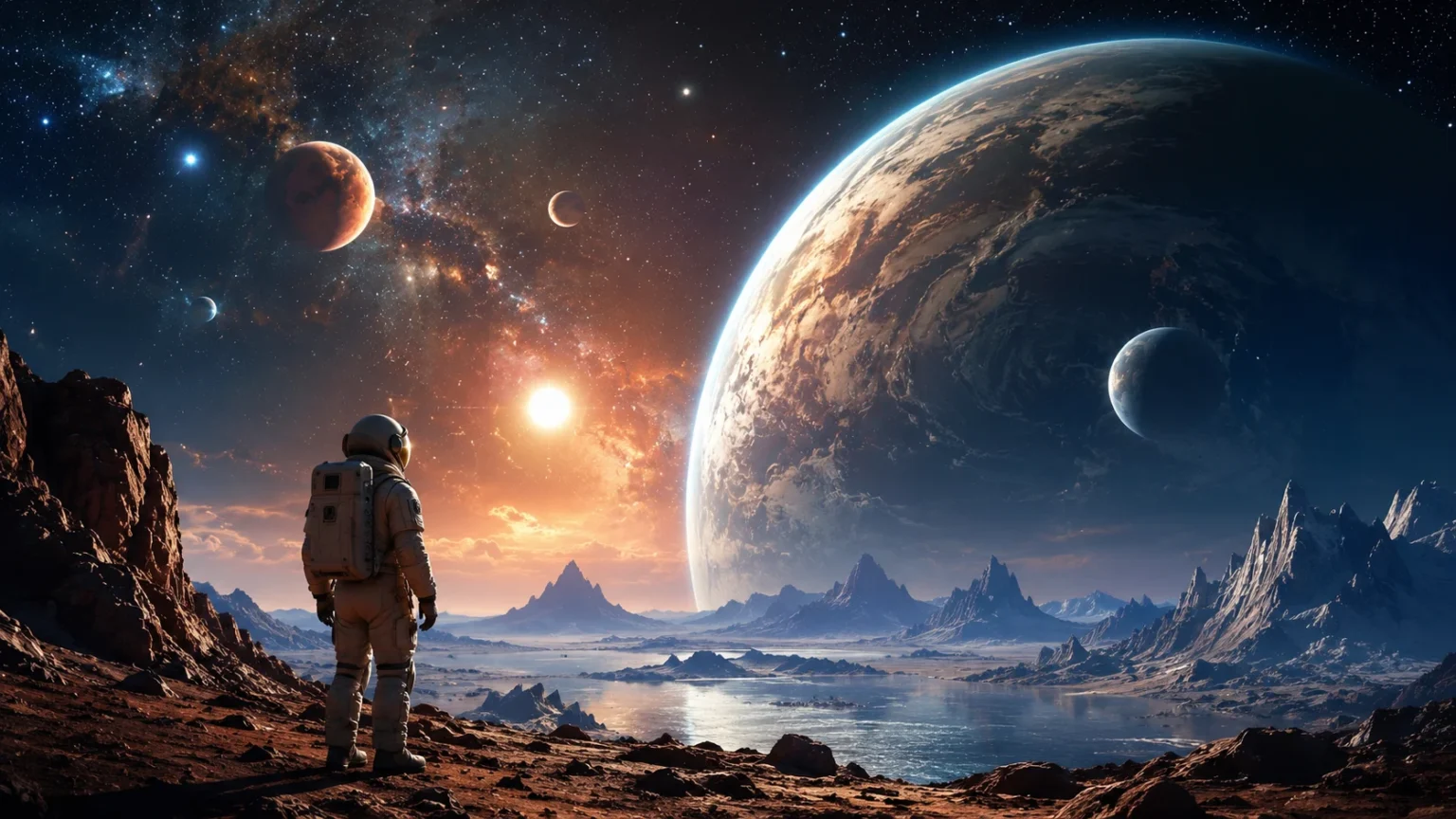

Is There Life on Other Planets?
For centuries, people have looked into the night sky and wondered whether Earth is the only place where life exists. That question has moved from philosophy and imagination into serious scientific investigation as telescopes, planetary missions, and laboratory research have become more powerful. Scientists can now study the atmospheres of distant worlds, explore the surface of Mars, investigate hidden oceans beneath icy moons, and search for chemical clues associated with biology. Yet despite extraordinary progress, no life beyond Earth has been scientifically confirmed.
The possibility of life on other planets appears increasingly worth investigating because planets themselves are clearly not rare. NASA has confirmed more than 6,000 exoplanets beyond our solar system, with many additional candidates awaiting confirmation. These worlds vary dramatically in size, temperature, composition, and orbit, showing that planetary systems are remarkably diverse. Discovering so many worlds has transformed the question from whether planets exist around other stars to whether some of them provide environments where life could develop.
Scientists are not necessarily expecting to discover intelligent civilizations first. In astrobiology, even evidence of simple microorganisms would be revolutionary because it would demonstrate that biology originated independently somewhere beyond Earth. Researchers therefore search for liquid water, useful chemical elements, energy sources, organic molecules, and atmospheric patterns that could indicate biological activity. These clues are known broadly as indicators of habitability and, in stronger cases, potential biosignatures.
The search now extends from nearby Mars to ocean-covered moons and planets orbiting distant stars. Each environment presents different possibilities and scientific challenges, and no individual observation is likely to provide an easy answer. This guide explores what scientists currently know, where life might exist, how astronomers search for it, and why possible signs of biology must be interpreted cautiously. The evidence is becoming more interesting, but the difference between a potentially habitable environment and confirmed extraterrestrial life remains extremely important.
What Do Scientists Mean by Life Beyond Earth?
When people hear the phrase extraterrestrial life, they often imagine advanced civilizations, spacecraft, or intelligent beings. Scientists usually begin with a much broader and simpler definition. Life elsewhere could consist of microorganisms comparable to bacteria or other microscopic organisms on Earth. Because microbial life has existed on our planet for an enormous portion of its biological history, many researchers consider simple life a reasonable first target when exploring potentially habitable environments.
Earth demonstrates that life can occupy environments once considered extremely hostile. Organisms survive in deep oceans, hot environments, acidic conditions, frozen regions, underground ecosystems, and locations receiving little or no sunlight. These organisms have expanded scientific thinking about where biology might survive. A planet or moon does not necessarily need forests, oceans open to the sky, or Earth-like weather to provide an environment suitable for some form of life.
Scientists therefore investigate basic requirements associated with life as we understand it. Liquid water is particularly important because every known form of terrestrial life depends on it. Useful chemical ingredients and accessible sources of energy are also necessary for biological processes. These requirements guide scientists toward environments such as ancient Martian lakes, subsurface oceans, and rocky planets occupying temperature ranges where liquid water could potentially exist.
However, scientists must be careful about assuming extraterrestrial biology would operate exactly like life on Earth. Earth is the only example of a living world currently available for study, so researchers naturally use terrestrial biology as their starting point. Other forms of life might differ in ways we have not imagined. For now, searching for environments compatible with known chemistry provides the most practical scientific method.
Has Life on Another Planet Ever Been Found?
Despite decades of planetary exploration and increasingly powerful telescopes, scientists have not confirmed life on another planet, moon, or other celestial body. NASA states that no life beyond Earth has been found and that there is no scientifically supported evidence that extraterrestrial life has visited Earth. This distinction is important because intriguing discoveries are sometimes reported publicly as though scientists have already found aliens when the actual evidence is much more limited.
Researchers have discovered many environments that might have been habitable and several chemical clues that make particular worlds scientifically interesting. Mars contains evidence of ancient water and organic chemistry, while Europa and Enceladus appear to contain enormous subsurface oceans. Astronomers have also identified thousands of planets orbiting other stars, some located in regions where temperatures might permit liquid water under suitable atmospheric conditions.
None of these observations proves that organisms exist or ever existed there. Organic molecules, for example, are important because carbon chemistry is central to life on Earth, but organic compounds can also form without biology. Liquid water makes an environment more interesting for astrobiology, yet water alone does not demonstrate that life developed. Scientists therefore need multiple independent lines of evidence before making an extraordinary biological claim.
This cautious standard can sometimes make scientific progress appear slower than it really is. In reality, discovering environments with water, complex chemistry, and potentially usable energy represents enormous progress toward understanding whether life might be possible elsewhere. The unanswered question is whether any of those ingredients actually came together to produce biology. That remains one of the biggest mysteries in modern science.
Why Scientists Think Life Elsewhere Is Possible
One reason scientists take extraterrestrial life seriously is the enormous number of planets now known to exist. NASA’s confirmed exoplanet count has passed 6,000, and these discoveries represent only a portion of the planets believed to exist throughout the Milky Way. Planet formation appears to be a common outcome around stars, meaning Earth is not unusual simply because it is a planet orbiting a star.
Some of those exoplanets are rocky, while others have sizes or orbital locations that make them interesting targets for atmospheric study. Astronomers are particularly interested in planets located within a star’s habitable zone, commonly described as the region where conditions could allow liquid water on a planetary surface if other factors are suitable. Being in that zone does not guarantee habitability, but it helps researchers narrow an enormous list of possible worlds.
Our own solar system has also taught scientists that potentially habitable environments can exist in unexpected places. Europa and Enceladus are far from the Sun and have frozen surfaces, yet evidence indicates both contain liquid water beneath their ice. This means a world does not necessarily need to resemble modern Earth on the surface to contain environments where chemistry associated with life might occur.
The discovery of potentially habitable settings does not tell researchers how easily life begins. Life might emerge whenever suitable conditions persist, or its origin might depend on an extremely rare sequence of events. Because Earth provides only one known example, scientists cannot yet calculate the probability confidently. Discovering even one independent example of extraterrestrial life would fundamentally change that uncertainty.
Could There Be Life on Mars?
Mars remains one of the most important places in the search for extraterrestrial life because evidence shows that the planet was very different billions of years ago. Its surface preserves geological features connected with ancient rivers, lakes, groundwater, and other watery environments. Mars is cold and dry today, but its past may have provided conditions much more favorable to microbial life.
NASA’s Curiosity rover has found increasingly interesting organic chemistry in Martian rocks. In 2025, researchers reported the largest organic molecules then detected on Mars, and further analysis announced in April 2026 identified the most diverse collection of organic molecules yet found in a Martian sample, including seven carbon-containing molecules not previously identified there. Organic molecules are important to prebiotic chemistry, but their presence is not proof that organisms created them.
Mars exploration has also produced observations described as potential biosignatures rather than confirmed evidence of life. Scientists use that wording deliberately because unusual chemistry or rock features may have biological explanations while still being producible through nonbiological processes. Testing competing explanations is essential before any observation can be interpreted as evidence that organisms once inhabited Mars.
If life ever existed on Mars, scientists may be searching mainly for traces of ancient microorganisms preserved in rock rather than living organisms visible on the surface today. Another possibility is that potential habitats could exist underground, where conditions are better protected from radiation and severe surface conditions. For that reason, Mars remains scientifically compelling even after decades of missions without confirmed biology.
Could Life Exist Beneath Europa’s Ice?
Europa, one of Jupiter’s largest moons, has become one of the most exciting destinations in astrobiology. Scientists believe a global saltwater ocean lies beneath its frozen shell, and NASA notes that Europa’s ocean may contain roughly twice as much water as all of Earth’s oceans combined. Water, chemistry, and internal energy make the moon an especially interesting place for investigating whether an ocean world could support life.
Unlike Earth, Europa receives relatively little warmth from the Sun, but gravitational interactions with Jupiter and neighboring moons can flex its interior and generate heat. This process may help maintain liquid water beneath the ice. Scientists are particularly interested in possible interactions between the rocky seafloor and ocean because chemical reactions there could provide useful energy and materials for potential biological processes.
NASA’s Europa Clipper mission launched in October 2024 and is traveling toward the Jupiter system, where it is expected to arrive in 2030. The spacecraft is designed to make 49 close flybys of Europa and investigate its ice shell, composition, geology, and interior. The mission is not designed to directly detect life; its primary objective is determining whether locations beneath Europa’s surface could provide conditions suitable for life.
Recent research continues to improve scientists’ understanding of the moon before Clipper arrives. In January 2026, analysis of data from NASA’s Juno mission indicated an average ice-shell thickness of about 29 kilometers in the region measured during a 2022 Europa flyby.
Why Enceladus Is Another Major Candidate for Life
Saturn’s moon Enceladus looks small and frozen, yet it has become one of the most compelling Astro biological targets in the solar system. NASA’s Cassini mission revealed that a global ocean of salty liquid water lies beneath the moon’s icy surface. Even more remarkably, material from that ocean escapes through enormous plumes near the moon’s south polar region, allowing spacecraft to sample material originating from the hidden ocean without drilling through the ice.
Cassini observations found water, salts, organic compounds, and evidence consistent with hydrothermal activity. These findings matter because hydrothermal environments on Earth involve interactions between water and rock that can provide chemical energy. Scientists are therefore interested in whether Enceladus has several of the major ingredients considered important for habitability in one accessible environment.
The evidence became even more interesting in 2025 when scientists reported previously undetected organic compounds in fresh ice grains ejected from Enceladus’ ocean. Because the particles had been expelled only minutes before being analyzed during Cassini’s mission, researchers could study compounds less altered by Saturn’s intense radiation environment. The new chemistry strengthens the scientific case for investigating Enceladus, but organic molecules still do not demonstrate that biology is present.
Enceladus illustrates why the search for extraterrestrial life has expanded beyond planets. A frozen moon far from the traditional habitable zone can still contain liquid water and potentially useful chemistry because internal energy maintains a subsurface ocean. If life were ever detected there, it would dramatically broaden our understanding of where habitable environments can exist throughout planetary systems.
What Are Exoplanets?
Exoplanets are planets located outside our solar system, generally orbiting stars other than the Sun. Only a few decades ago, astronomers had very limited observational evidence about planetary systems beyond our own. Today, NASA tracks more than 6,000 confirmed exoplanets, demonstrating that planetary systems are abundant and remarkably diverse.
Some exoplanets are enormous gas giants orbiting extremely close to their stars, while others are smaller rocky worlds. Astronomers have also discovered systems containing several planets and worlds unlike anything found in our solar system. This diversity has taught scientists not to assume that other planetary systems will resemble the arrangement of planets around the Sun.
For astrobiology, the most interesting exoplanets are often worlds whose size, composition, temperature, and atmosphere might allow environments compatible with life. Distance from the host star matters because it influences temperature, but atmospheric pressure, greenhouse gases, stellar radiation, magnetic environments, geology, and many other factors can affect actual habitability. A planet cannot therefore be labeled Earth-like simply because its orbital distance looks promising.
Scientists cannot currently travel to these worlds because even the nearest exoplanets are extraordinarily distant. Instead, astronomers analyze starlight, planetary transits, atmospheric spectra, orbital behavior, and other indirect signals. This turns the search for extraterrestrial life into an extraordinarily precise form of remote investigation where tiny changes in light can reveal information about distant planets.
What Is the Habitable Zone?
The habitable zone, sometimes called the Goldilocks zone, is the range of distances from a star where temperatures could allow liquid water to exist on a planet’s surface under appropriate atmospheric conditions. A planet too close to its star may become extremely hot, while one too far away may remain frozen. The habitable-zone concept helps scientists identify promising targets without claiming that every planet found there actually supports life.
Earth lies within the Sun’s habitable zone and maintains oceans across much of its surface, which makes liquid water a natural reference point for astrobiology. Scientists search for planets in comparable orbital environments because water acts as the medium for known terrestrial biology. However, orbital position represents only one part of a much more complicated habitability equation.
Atmospheric composition can radically influence planetary temperature. A thick greenhouse atmosphere can make a planet much warmer than its orbital distance alone suggests, while a thin atmosphere may fail to retain enough heat. Stellar activity is another factor because intense radiation and repeated flares could affect atmospheric stability or surface conditions, particularly around certain smaller stars.
What Are Biosignatures?
A biosignature is an observable characteristic that could provide evidence of past or present life. Depending on the environment, potential biosignatures might include unusual atmospheric gases, chemical combinations, organic structures, minerals, isotopic patterns, or physical features associated with biological activity. Scientists searching distant planets are particularly interested in atmospheric chemistry because atmospheric signals can sometimes be measured through telescopes.
On Earth, life changes the atmosphere substantially. Oxygen produced by photosynthesis is an obvious example, while methane can also be influenced by biological processes. However, neither gas automatically proves life exists because geological and chemical processes can sometimes produce similar substances. Researchers therefore study combinations of signals and the overall planetary environment rather than relying on one molecule.
This is one reason scientists are cautious about dramatic claims involving potential biosignatures. An observation becomes stronger when independent measurements support it and when researchers can rule out plausible nonbiological explanations. NASA emphasizes that exoplanet biosignature investigations may require hundreds of hours of observing time for a single planet and still demand extensive follow-up before conclusions become convincing.
How the James Webb Space Telescope Searches for Clues
The James Webb Space Telescope has opened a powerful new chapter in exoplanet research because it can study the chemical composition of some planetary atmospheres. When a planet passes in front of its star, a small portion of starlight can travel through the planet’s atmosphere. Different molecules absorb particular wavelengths, allowing astronomers to use spectroscopy to investigate atmospheric chemistry.
Webb has already studied a broad range of exoplanets and can detect molecules relevant to habitability investigations, including water vapor, methane, and carbon dioxide in suitable targets. These observations help scientists understand how planetary atmospheres form and evolve while identifying worlds worthy of deeper study. The telescope was not built as a straightforward alien detector, however, and interpreting atmospheric signals remains difficult.
One widely discussed planet is K2-18 b, where Webb observations identified methane and carbon dioxide in the atmosphere. Scientists have explored models suggesting the planet could potentially possess a hydrogen-rich atmosphere and an ocean-covered surface, although its actual nature remains debated and observations do not demonstrate that life exists there.
Webb demonstrates both the power and limitations of current technology. Scientists can analyze atmospheric chemistry on worlds located many light-years away, something that would have seemed extraordinary not long ago. At the same time, NASA stresses that determining whether an atmospheric feature represents a genuine biosignature requires extensive observations and multiple lines of evidence.
Could Intelligent Alien Life Exist?
The question of intelligent extraterrestrial life is much harder to investigate than the search for microbial organisms. Intelligence appeared relatively late in Earth’s history, while simple life existed much earlier. Even if microbial biology is common throughout the universe, technologically advanced civilizations could still be rare. Scientists currently lack enough examples to calculate how frequently intelligence evolves.
Researchers interested in technological civilizations sometimes search for technosignatures, meaning evidence that could potentially result from technology rather than ordinary natural processes. Radio transmissions are the best-known example, although scientists have proposed searching for unusual optical signals, atmospheric pollution patterns, large engineered structures, or other detectable consequences of advanced technology.
Finding such a signal would require extraordinary verification because natural astronomical sources, human technology, satellites, equipment problems, and data-processing errors could all create misleading results. Scientists would need repeated observations and independent confirmation before identifying a signal as artificial and extraterrestrial. The absence of confirmed evidence so far does not prove civilizations are absent; it simply means none has been scientifically demonstrated.
Distance creates another major challenge. The Milky Way is enormous, and civilizations could exist thousands of light-years apart or during completely different periods. A civilization may disappear before its signals reach another inhabited world. Even if technological life exists elsewhere, the practical difficulties of discovering and communicating with it may be far greater than popular fiction suggests.
Why Haven’t We Found Aliens Yet?
The apparent contradiction between the enormous universe and the absence of confirmed extraterrestrial civilizations is often associated with the Fermi paradox. If planets are extremely common and some are potentially habitable, people naturally ask why there is no clear evidence of advanced life. The question is fascinating because many possible explanations remain consistent with what scientists currently know.
One possibility is that the origin of life itself is extremely rare. Earth may have experienced an unusual combination of chemistry, environmental stability, geology, and chance events that seldom occurs elsewhere. Alternatively, microbial life could be common while complex organisms or technological intelligence require much more difficult evolutionary transitions.
Another possibility is that technological civilizations exist but are difficult to detect. Our own civilization has produced easily detectable radio technology for only a tiny fraction of Earth’s history. Other societies might use communication methods we are not searching for, produce weak signals, or exist at distances where their technology remains beyond the sensitivity of our instruments.
It is also possible that our search has barely begun. Humanity has examined only a small number of planetary systems and only narrow portions of the possible signal space. The discovery of thousands of exoplanets and improved atmospheric observations has greatly expanded the search, but astronomers are still in the early stages of learning how to investigate potentially inhabited worlds.
Could Alien Life Be Completely Different From Earth Life?
Most searches for extraterrestrial biology focus on carbon chemistry and liquid water because these ingredients are central to every known organism. Carbon can form extraordinarily complex molecules, while liquid water supports many chemical reactions necessary for terrestrial biology. Using known life as a guide gives scientists a practical framework for designing experiments and choosing destinations.
However, researchers recognize that unfamiliar environments could potentially support biological systems that differ significantly from terrestrial organisms. Scientists have considered alternative solvents, unusual metabolic chemistry, and environments with temperatures or pressures very different from Earth’s surface. These possibilities remain speculative because no alternative biochemistry has been observed naturally.
This uncertainty creates an important scientific challenge. If researchers design instruments only to detect biology exactly like Earth’s, they could overlook something fundamentally different. Astrobiology therefore often combines targeted searches for familiar biosignatures with broader investigations of chemical complexity, environmental disequilibrium, and unusual patterns that might warrant further study.
At the same time, scientists need testable hypotheses. Searching for every imaginable form of life would make experiments impossible to design. Water, carbon chemistry, energy, and Earth-like biological signatures remain logical priorities precisely because scientists understand them well enough to recognize meaningful evidence.
How Scientists Search for Life Without Visiting a Planet
Most potentially habitable exoplanets are far too distant for spacecraft to visit with existing technology. NASA notes that even traveling to nearby stars would require timescales far beyond practical human missions using current or planned propulsion systems. Scientists therefore depend primarily on remote observations for the search beyond our solar system.
One major technique involves observing transits, when a planet passes across the face of its star from our perspective. The dip in starlight reveals information about planetary size and orbit. If some starlight passes through an atmosphere, spectroscopy can potentially reveal molecules present there. Repeating these observations improves confidence in the measurements.
Researchers also study stars themselves because a planet’s environment cannot be understood independently of its host star. Stellar radiation, age, magnetic activity, and flare behavior can influence atmospheric loss and surface conditions. A planet receiving an apparently suitable amount of energy could still be inhospitable if its star repeatedly exposes it to extreme radiation.
Future observatories are expected to expand these capabilities by studying smaller rocky worlds and separating their faint light more effectively from surrounding stars. The long-term objective is not simply finding more planets but learning which ones have environments most worthy of detailed investigation for habitability and potential biosignatures.
Why Discovering Microbial Life Would Change Science
Finding even a single extraterrestrial microorganism would answer one of humanity’s oldest questions: life is not unique to Earth. If that organism originated independently rather than sharing ancestry with terrestrial biology, scientists would have two examples of life’s origin instead of one. This would dramatically improve our ability to understand how easily biology emerges under suitable conditions.
A second origin of life could also reveal which biological properties are universal and which are accidents of Earth’s evolutionary history. Researchers could compare basic chemistry, genetic systems, cellular structures, metabolism, and adaptation. Similarities might indicate that certain solutions naturally emerge from chemistry, while dramatic differences could expand our definition of what living systems can be.
Such a discovery would reshape planetary science as well. Worlds currently classified primarily through geology and chemistry would also need to be studied as biological environments. Missions could increasingly focus on understanding ecosystems, evolutionary history, and potential interactions between planetary processes and organisms.
The cultural impact would be equally profound. Finding simple microbes would not prove that intelligent civilizations exist, but it would demonstrate that nature produced biology at least twice. That alone would fundamentally change how humanity views Earth’s place in the universe and make the possibility of life on countless other worlds much harder to dismiss.
What Could the Next Major Discovery Be?
Mars remains capable of producing major discoveries because ongoing missions continue analyzing environments that once contained water and preserved organic chemistry. The increasingly complex organic molecules identified by Curiosity demonstrate that Martian rocks can preserve important carbon chemistry over enormous periods. Future investigations may clarify whether any Martian features represent biological activity or purely geological chemistry.
Europa represents another major frontier. Europa Clipper is currently traveling toward Jupiter and is expected to begin its investigation after arriving in 2030. Its measurements should dramatically improve scientific understanding of Europa’s ocean, ice shell, chemistry, and potential habitability, even though the spacecraft itself is not intended to announce whether organisms are present.
Enceladus also remains exceptionally promising because its ocean material naturally sprays into space. Continued analysis of Cassini data has already revealed new organic compounds years after the mission ended, demonstrating how valuable archived measurements can remain. A future mission specifically designed to analyze Enceladus’ plume with modern life-detection instruments could provide much more detailed information about its chemistry.
Beyond the solar system, atmospheric observations will continue becoming more precise. Webb and future telescopes can progressively identify promising planets and chemical patterns requiring follow-up. The first persuasive evidence of extraterrestrial life could therefore come from a Martian rock, an icy moon’s ocean, or the atmosphere of a planet many light-years away. Science does not yet know which path will provide the breakthrough.
Final Thoughts
So, is there life on other planets? The scientifically accurate answer is that we do not know yet. No extraterrestrial organism has been confirmed, and no observation currently provides universally accepted proof of life beyond Earth. At the same time, modern astronomy has revealed thousands of planets, ancient habitable environments on Mars, and ocean worlds containing water and complex chemistry.
The search has therefore become much more concrete than it was a generation ago. Scientists are no longer asking whether planets around other stars are common; thousands have already been confirmed. They are now studying which worlds have atmospheres, appropriate temperatures, water, useful chemistry, and other characteristics that could make biology possible.
Mars, Europa, and Enceladus provide especially exciting opportunities close to home. Mars preserves evidence of ancient watery environments and increasingly complex organic molecules, while Europa and Enceladus contain enormous subsurface oceans. None has produced confirmed biological evidence, but all help scientists understand where and how life might survive beyond Earth.
Frequently Asked Questions
Has life been found on another planet?
No confirmed life has been discovered beyond Earth. Scientists have found potentially habitable environments and intriguing chemical clues, but none currently provides definitive proof of extraterrestrial organisms.
Which planet is most likely to have life?
Mars remains an important target because it once had wetter environments, although scientists also consider moons such as Europa and Enceladus highly promising because they contain subsurface oceans.
How many potentially habitable planets have scientists found?
Thousands of exoplanets are known, but determining which are truly habitable is much harder than identifying their orbits. A planet’s atmosphere, star, temperature, composition, and ability to maintain liquid water all matter.
Could humans ever meet intelligent aliens?
It is theoretically possible, but there is currently no confirmed evidence of an extraterrestrial civilization. Enormous distances between stars also make physical travel and communication extremely challenging with present technology.
What would count as proof of extraterrestrial life?
Scientists would look for multiple independent lines of evidence that strongly favor biology over nonliving chemistry or geology. A single organic molecule or potentially habitable environment would not be enough to confirm life.