
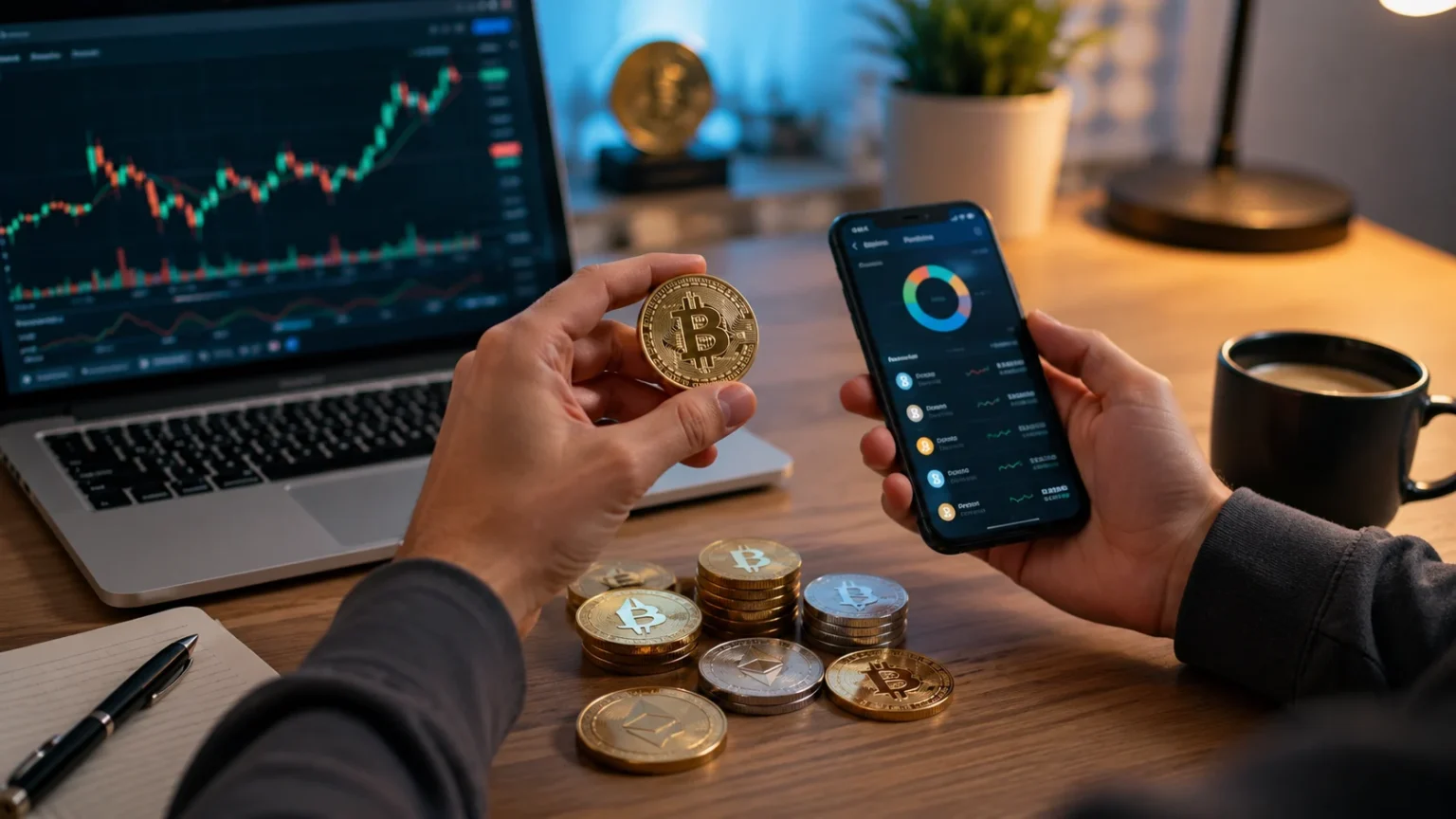

Cryptocurrency for Beginners: A Simple Guide to Get Started
Cryptocurrency can seem confusing when you first encounter terms such as Bitcoin, blockchain, wallets, private keys, exchanges, and stablecoins. Behind all that terminology, however, the basic idea is easier to understand: cryptocurrency is a form of digital asset that can be transferred and recorded using blockchain or similar distributed-ledger technology.
For beginners, the biggest mistake is trying to understand everything at once. You do not need to become a blockchain developer or professional trader before learning how cryptocurrencies work. Understanding the fundamental concepts ownership, transactions, wallets, security, volatility, and risk is a much better starting point.
It is equally important to approach crypto realistically. Digital assets can experience dramatic price changes, scams are common, transactions may be difficult or impossible to reverse, and different cryptocurrencies have very different purposes and risks. Buying something simply because its price is rising is not a reliable strategy.
This cryptocurrency for beginners guide explains the topic step by step without unnecessary technical language. You will learn what cryptocurrency is, how blockchain works, what Bitcoin and altcoins are, how crypto wallets function, how people buy digital assets, and which mistakes new users should avoid.
What Is Cryptocurrency?
Cryptocurrency is a type of digital asset that uses cryptography and computer networks to record and verify transactions. Unlike physical cash, cryptocurrencies usually exist entirely in digital form and can be transferred electronically between compatible addresses.
Many cryptocurrencies operate on decentralized blockchain networks rather than relying on one company to maintain every transaction record. A distributed network of computers follows agreed rules to update and verify the shared record of activity.
Bitcoin is the best-known example, but thousands of other digital assets have been created for different purposes. Some are designed primarily for transferring value, while others support smart contracts, decentralized applications, digital ownership, or specific online ecosystems.
The word cryptocurrency is often used broadly, although not every crypto asset functions exactly like traditional currency. Some behave more like utility tokens, governance assets, digital commodities, or components of blockchain-based applications.
How Does Cryptocurrency Work?
A cryptocurrency network maintains records showing how digital assets move between addresses. When someone submits a transaction, information about that transfer is communicated to the network for verification according to its protocol rules.
Cryptography helps users prove that they are authorized to move assets associated with their cryptocurrency addresses. This typically involves private keys, which are secret cryptographic credentials that allow valid transactions to be authorized.
Once a valid transaction is processed and added to the network’s record, other participants can recognize the updated ownership state. The exact process varies depending on the blockchain and its consensus mechanism.
This allows people to transfer digital assets without every transaction needing to pass through the same traditional payment intermediary. However, exchanges, wallet providers, payment processors, and other businesses may still play important roles in making cryptocurrency easier to access.
What Is Blockchain Technology?
A blockchain is a type of distributed digital ledger used to record information across a network. Transactions are grouped and added to an ordered history that network participants can independently verify according to established protocol rules.
The term “blockchain” comes from the way many networks organize transaction data into blocks that are cryptographically connected. Changing older records becomes difficult because later blocks depend on information associated with earlier ones.
Decentralized blockchains distribute record-keeping across many computers rather than placing the complete authority in one central database administrator. Different networks use different methods to determine how valid transactions are confirmed and added.
Blockchain technology can be used for more than cryptocurrency payments. Networks may support smart contracts, decentralized finance, tokenized assets, digital identity, games, supply-chain applications, and other systems requiring verifiable digital records.
What Is Bitcoin?
Bitcoin is a decentralized digital asset introduced as a peer-to-peer electronic payment system. It operates through a blockchain network where transactions are verified and recorded without one central organization controlling the ledger.
Bitcoin has a predefined maximum supply of 21 million coins under its protocol rules. New bitcoins have historically entered circulation through mining, where participants contribute computing resources to network security and transaction processing.
A bitcoin can also be divided into much smaller units, so beginners do not need to purchase an entire coin. The smallest commonly recognized unit is called a satoshi, representing a tiny fraction of one bitcoin.
Bitcoin’s market price can move substantially in relatively short periods, making it important to separate the technology from investment expectations. Understanding how Bitcoin works does not mean its future price can be predicted reliably.
What Are Altcoins?
The word altcoin generally refers to cryptocurrencies other than Bitcoin. The category is extremely broad and includes major blockchain assets as well as thousands of smaller tokens with very different technologies, purposes, and levels of risk.
Some altcoins operate independent blockchain networks. Others exist as tokens created on top of established blockchains, where smart-contract standards make it possible to issue digital assets without developing an entirely new network.
Altcoins may be designed for payments, decentralized applications, gaming, finance, governance, data storage, privacy, artificial intelligence ecosystems, or countless other purposes. A stated purpose, however, does not guarantee that a project will succeed.
Beginners should be particularly cautious with little-known tokens promoted through social media. Low liquidity, weak development, concentrated ownership, misleading marketing, and market manipulation can make speculative altcoins considerably riskier than they initially appear.
What Is Ethereum?
Ethereum is a blockchain network designed to support digital assets and programmable applications. Its native cryptocurrency, ether or ETH, is used within the network for transactions and interacting with many blockchain-based services.
One major difference between Ethereum and simpler payment-focused networks is the extensive use of smart contracts. These are programs deployed to the blockchain that can execute defined instructions when users interact with them.
Smart contracts have enabled developers to create decentralized exchanges, lending protocols, games, digital collectibles, stablecoins, token systems, and many other applications. Together, these applications form a large blockchain ecosystem.
Like other cryptocurrencies, ETH can fluctuate significantly in market value. Beginners should therefore distinguish between understanding Ethereum as technology and deciding whether owning its native digital asset fits their personal financial situation.
What Are Stablecoins?
Stablecoins are crypto assets designed to maintain a relatively stable value compared with another asset, commonly a national currency such as the U.S. dollar. They are frequently used for transfers, trading, payments, and blockchain-based financial activities.
Different stablecoins attempt to maintain their value in different ways. Some are backed by reserves held by an issuing organization, while others may rely on crypto collateral, automated mechanisms, or combinations of financial structures.
The word “stable” should not be interpreted as “risk-free.” Stablecoins can face risks involving reserves, issuers, liquidity, regulation, smart contracts, operational failures, or the possibility that the token loses its intended price relationship.
Before using one, understand how the stablecoin maintains its value, who controls or issues it, how redemption works, and what could happen if market confidence declines. A familiar dollar-like price does not eliminate underlying risk.
What Is a Cryptocurrency Wallet?
A crypto wallet is software or hardware that helps users interact with cryptocurrency networks and manage the cryptographic credentials associated with their assets. Contrary to the everyday meaning of wallet, the coins themselves are generally recorded on the blockchain rather than physically stored inside the device.
The wallet manages keys that allow transactions to be authorized. Your public address can be shared when receiving compatible cryptocurrency, while the private credentials used to control those assets must remain secret.
Wallets come in several forms, including mobile applications, desktop software, browser-based wallets, and dedicated hardware devices. Each approach provides a different balance between convenience, control, accessibility, and security.
Choosing a wallet should therefore be based on what you intend to do. Someone experimenting with a very small amount of cryptocurrency has different requirements from a long-term holder protecting significant digital assets.
Public Keys vs Private Keys
A private key is secret information used to prove control over cryptocurrency and authorize transactions. Anyone who obtains the private credentials controlling an address may potentially be able to move the associated assets.
A public key or related public address serves a different purpose. It can be used as part of the process for receiving cryptocurrency and does not need the same secrecy as the private key controlling the funds.
A useful beginner analogy is to think of your public address somewhat like information you can provide when someone needs to send something to you. Your private key is closer to the secret authorization needed to control what you received.
This distinction is fundamental to cryptocurrency security. Share receiving addresses when necessary, but never casually share private keys or recovery phrases, regardless of who claims to need them.
What Is a Seed Phrase or Recovery Phrase?
A seed phrase, also called a recovery phrase, is a sequence of words that many self-custody wallets provide when they are created. It can be used to restore access to wallet credentials if the original device is lost or damaged.
That recovery ability also makes the phrase extremely sensitive. Someone who obtains it may be able to restore the wallet elsewhere and gain control of the cryptocurrency associated with it.
Legitimate support representatives should not require you to send them your recovery phrase through a message, form, social media account, or unexpected website. Requests for secret recovery information are a major warning sign.
Store recovery information carefully and follow the security instructions provided by your chosen wallet. Losing access without a valid backup can be devastating, while exposing the backup can be equally dangerous.
Hot Wallet vs Cold Wallet
A hot wallet is generally connected to an internet-enabled device and is designed for convenient access. Mobile and browser-based wallets are common examples, particularly for people who regularly interact with cryptocurrency applications.
A cold-storage approach keeps important signing credentials more isolated from internet-connected environments. Hardware wallets are commonly used for this purpose because they are designed to keep sensitive keys protected while transactions are authorized.
Hot wallets can be convenient for smaller amounts used regularly, while stronger offline or hardware-based storage may appeal to people holding assets for longer periods. Neither choice eliminates the need for good security practices.
Beginners should avoid assuming that buying a hardware wallet automatically guarantees safety. Fake devices, malicious software, compromised recovery phrases, phishing, and user mistakes can still lead to losses if security procedures are ignored.
Custodial vs Non-Custodial Wallets
A custodial wallet involves a third party holding or controlling the private keys on the user’s behalf. Cryptocurrency exchanges commonly provide custodial account infrastructure because it makes buying, selling, and accessing assets convenient.
A non-custodial or self-custody wallet gives the user direct responsibility for the credentials controlling their assets. This provides greater independence but also removes some of the recovery assistance that centralized services may offer.
Custody creates an important tradeoff. Using an external custodian means trusting its security, operations, and withdrawal processes, while self-custody means personally protecting keys, backups, devices, and recovery information.
Neither approach should be chosen casually. Beginners should understand who controls the private keys, how recovery works, what happens if credentials are lost, and which security protections exist before transferring significant assets.
What Is a Cryptocurrency Exchange?
A cryptocurrency exchange is a platform that allows users to buy, sell, or trade supported digital assets. Some exchanges allow customers to deposit traditional currency through bank transfers, payment cards, or other supported methods.
Centralized exchanges usually manage order execution, account balances, custody systems, and user verification through their own infrastructure. They can provide an easier starting point for newcomers unfamiliar with blockchain transactions.
Exchange availability, features, fees, regulatory status, and supported assets vary considerably between countries. Beginners should research platforms carefully rather than selecting one solely because an influencer, advertisement, or social media account recommends it.
Security matters as much as trading features. Look for transparent information about fees, withdrawals, custody, account protection, and company identity before depositing money with any crypto exchange.
How to Buy Cryptocurrency for the First Time
The first step is understanding what you intend to purchase and why. Never begin by choosing a cryptocurrency simply because its price has recently increased or because someone online promises that it will produce enormous returns.
Next, choose a reputable service that is legally available where you live and understand its identity-verification, deposit, fee, and withdrawal requirements. Create your account directly through the official website or application rather than clicking unfamiliar promotional links.
Secure the account before depositing significant funds. Use a strong, unique password and enable the strongest suitable multi-factor authentication available to you instead of relying only on a reusable password.
Once you understand the risks, start conservatively rather than committing money you cannot afford to lose. Buying cryptocurrency for beginners should be treated as a learning process, not a shortcut to immediate wealth.
How Much Cryptocurrency Should a Beginner Buy?
There is no universal amount that every beginner should invest in cryptocurrency. Your financial situation, income stability, savings, debts, goals, time horizon, and ability to tolerate substantial losses all matter.
Cryptocurrency prices can change quickly and unpredictably. Investing money needed for rent, bills, emergencies, education, debt payments, or other essential expenses can turn normal market volatility into a serious personal financial problem.
Starting with a very small amount can help beginners understand how exchanges, wallets, addresses, transaction fees, and price movements work without immediately exposing significant savings to an unfamiliar market.
The most important principle is simple: never invest money solely because you fear missing out. A comfortable investment decision should still make sense when excitement, social media hype, and rapidly rising prices are removed from the picture.
Understanding Cryptocurrency Prices
Cryptocurrency prices are determined by market supply and demand across trading venues. Buyers and sellers continuously place orders, and the resulting transactions contribute to the market price displayed on exchanges and data platforms.
Demand can change because of investor sentiment, technology developments, regulation, macroeconomic conditions, adoption, market liquidity, security incidents, or speculation. This combination helps explain why cryptocurrency markets can move rapidly.
A rising price does not automatically mean the underlying cryptocurrency has become fundamentally more useful. Momentum, leverage, speculation, promotional activity, and market psychology can also contribute to sharp price movements.
Beginners should therefore avoid treating crypto price charts as guaranteed predictions of what happens next. Historical price performance can describe what already happened, but it cannot promise future returns.
What Is Cryptocurrency Market Capitalization?
Cryptocurrency market capitalization, commonly called market cap, is generally calculated by multiplying the current market price of a coin or token by its circulating supply.
For example, a cryptocurrency with 10 million circulating units priced at $5 each would have a market capitalization of approximately $50 million. This provides one way to compare the approximate market value assigned to different digital assets.
Market cap should not be confused with the amount of cash actually invested in a cryptocurrency. Price can move based on marginal trading activity, meaning the relationship between incoming money and market capitalization is not one-to-one.
Market cap can provide useful context, but it is not a complete quality indicator. Liquidity, token distribution, technology, development activity, security, governance, utility, and supply structure should also be considered.
What Are Cryptocurrency Transaction Fees?
Cryptocurrency transactions may require fees to compensate network participants involved in processing or validating activity. The amount can depend on the blockchain, transaction complexity, network demand, and other technical factors.
Some networks use relatively predictable fee structures, while others experience significant variation during periods of heavy activity. A transaction that is inexpensive at one moment may cost considerably more when network demand rises.
Exchanges and wallet providers may also charge separate fees for buying, selling, withdrawing, converting, or transferring cryptocurrencies. These service charges are different from blockchain-level network fees.
Beginners should always review the final transaction details before confirming an action. A small trade can become inefficient when fees represent a large percentage of the amount being transferred.
What Are Gas Fees in Crypto?
The term gas fee is most closely associated with blockchain networks such as Ethereum, where users pay for computational resources required to process transactions or execute smart-contract operations.
Simple transfers may require relatively little computation, while complex interactions with decentralized applications can require more. The final cost can also increase when many users are competing for limited network processing capacity.
Gas is important because blockchain computation is not unlimited or free. Requiring users to pay for network resources helps allocate capacity and discourages certain forms of spam or excessive computation.
Before interacting with a decentralized application, check the estimated transaction cost carefully. Beginners sometimes focus entirely on the amount being exchanged and overlook the additional network fee required to complete the operation.
What Is Crypto Mining?
Cryptocurrency mining is a process used by some blockchain networks to verify transactions, secure the network, and determine who earns the right to add new blocks to the ledger.
Bitcoin uses a proof-of-work system where miners contribute specialized computing power to solve cryptographic challenges. Successful mining helps maintain the network while providing rewards according to the protocol.
Mining has become highly competitive and often requires specialized hardware, significant electricity, technical knowledge, and careful cost calculations. It should not be viewed as effortless passive income simply because a website claims anyone can become profitable immediately.
Not all cryptocurrencies use mining. Some blockchain networks rely on alternative consensus mechanisms, including proof-of-stake systems where network security works differently.
What Is Crypto Staking?
Crypto staking is associated with proof-of-stake blockchain systems. Participants may commit eligible cryptocurrency to network processes related to transaction validation and security, potentially receiving rewards for participating.
The exact mechanism differs between blockchains. Some users operate validators directly, while others participate through staking services, pools, exchanges, or protocols that simplify the technical requirements.
Staking rewards should not be mistaken for guaranteed investment returns. Token prices can fall, services can fail, smart contracts can contain vulnerabilities, and specific networks may impose additional technical risks or restrictions.
Before staking, understand how your assets are controlled, whether withdrawals are restricted, which fees apply, and what could cause losses. High advertised yields deserve additional scrutiny rather than automatic enthusiasm.
What Is DeFi?
Decentralized finance, or DeFi, refers to blockchain-based financial applications that allow users to perform activities such as swapping assets, lending, borrowing, or providing liquidity through smart contracts.
Unlike traditional financial services where a centralized institution manages transactions, many DeFi applications allow users to interact directly with software protocols using compatible cryptocurrency wallets.
This flexibility introduces additional risks. Smart-contract bugs, malicious developers, token volatility, liquidity problems, complicated transaction mechanics, and fraudulent interfaces can all create opportunities for significant losses.
Beginners generally benefit from understanding ordinary wallet transfers before experimenting with DeFi. Learning how approvals, network fees, addresses, and blockchain transactions work first can reduce avoidable mistakes later.
What Are NFTs?
A non-fungible token, or NFT, is a blockchain-based token designed to represent a distinct digital item, identifier, or ownership record rather than a directly interchangeable unit like ordinary cryptocurrency.
NFTs have been used for digital artwork, collectibles, gaming assets, memberships, tickets, certificates, and other forms of blockchain-based ownership or access.
Owning an NFT does not automatically mean owning every copyright or legal right associated with the underlying artwork or media. The rights depend on the terms attached to the specific project or transaction.
NFT markets can also be highly speculative. Beginners should understand what they are purchasing, which blockchain it uses, associated fees, and what rights or benefits actually accompany the token.
Major Risks of Cryptocurrency
Price volatility is one of the most obvious cryptocurrency risks. A digital asset can experience large gains, but it can also lose a substantial portion of its market value within a relatively short time.
Operational risks matter too. Exchanges can experience problems, passwords can be compromised, wallets can be mishandled, and sending funds to an incorrect or incompatible address may lead to permanent loss.
Fraud represents another major danger. Fake investment platforms, impersonation scams, fraudulent token launches, phishing websites, romance scams, pump-and-dump promotions, and fake giveaways regularly target cryptocurrency users.
Technology does not eliminate ordinary financial judgment. Whenever someone guarantees profits, pressures you to act immediately, or promises unusually high returns without meaningful risk, treat the claim with skepticism.
Why Cryptocurrency Is So Volatile
Crypto markets can move rapidly because investor expectations change quickly and some assets have relatively limited liquidity compared with established global financial markets.
News, regulation, technological developments, large trades, leveraged positions, social media sentiment, economic conditions, and market speculation can all influence demand within short periods.
Smaller cryptocurrencies can be even more volatile because comparatively modest buying or selling activity may move their prices significantly. Thin markets can also make manipulation easier.
Beginners should therefore expect crypto volatility rather than treating every decline as unusual. If normal price movements create severe financial or emotional pressure, the amount at risk may be too large.
Common Cryptocurrency Scams
Fake investment platforms often attract victims by displaying impressive-looking account balances or supposed profits. When the user tries to withdraw money, the scammer may demand additional taxes, fees, deposits, or verification payments.
Phishing scams imitate exchanges, wallets, or cryptocurrency projects. Their goal is commonly to steal login credentials, recovery phrases, private keys, or wallet approvals through convincing websites and messages.
Fake giveaways frequently impersonate well-known companies or public figures and claim that sending cryptocurrency to an address will result in receiving a larger amount back. Legitimate investments do not require this type of guaranteed doubling scheme.
Pump-and-dump campaigns encourage people to buy a token rapidly before promoters or insiders sell their holdings. Beginners should avoid making purchases based purely on social media crypto tips, urgency, hype, or sudden price spikes.
How to Keep Cryptocurrency Safe
Begin with account security. Use unique passwords for crypto-related accounts and protect important services with strong multi-factor authentication wherever suitable options are available.
Never share your private key or recovery phrase with anyone. Someone claiming to be technical support, an administrator, an investor, or a helpful stranger does not need these credentials to solve a legitimate account problem.
Verify websites carefully before connecting a wallet or entering credentials. Bookmarking official services can help reduce the chance of visiting imitation websites distributed through phishing messages or misleading advertisements.
For meaningful holdings, create a clear crypto security plan covering backups, wallet recovery, device loss, phishing protection, and safe storage. Security should be planned before a problem occurs rather than after funds disappear.
Always Double-Check Crypto Addresses
Cryptocurrency addresses can be long combinations of letters and numbers, making them difficult to verify visually. Sending assets to the wrong address can be difficult or impossible to reverse.
Always check that the destination supports the cryptocurrency and network you are using. The same asset can sometimes exist on multiple blockchain networks, and selecting an incompatible network may cause serious problems.
When moving an important amount to a new destination, beginners often benefit from sending a small test transaction first. Once it arrives correctly, the remaining transfer can be made with greater confidence.
Do not rely solely on copied information without checking it. Malware can sometimes alter clipboard contents, so comparing the beginning and end of the destination address before confirming a crypto transfer is a useful habit.
How to Research a Cryptocurrency
Start by asking what problem the cryptocurrency or blockchain claims to solve. If you cannot understand its basic purpose after reasonable research, you may not have enough information to risk money on it.
Look at how the asset is created and distributed. Consider its total or maximum supply, circulating supply, token allocation, issuance rules, governance, and whether a small number of holders control a large percentage.
Evaluate the project behind it as well. Development activity, security history, actual users, transparent documentation, technical design, leadership, and ecosystem adoption can provide more useful information than promotional slogans.
Most importantly, separate evidence from marketing. A professional website, large social media following, celebrity promotion, or impressive crypto whitepaper does not guarantee that a project is legitimate, useful, or financially sound.
Cryptocurrency Investing vs Trading
Cryptocurrency investing generally involves buying an asset with the expectation of holding it for an extended period based on a longer-term view of its potential.
Crypto trading typically involves more frequent buying and selling based on price movements, technical analysis, market events, or short-term strategies. The approach can require considerable time, discipline, and risk management.
Trading should not be confused with easy money. Transaction fees, emotional decisions, leverage, volatility, competition, and incorrect predictions can quickly turn frequent activity into significant losses.
Beginners should understand their purpose before opening a position. Mixing long-term investing with impulsive short-term crypto trading can lead to inconsistent decisions and unnecessary risk.
What Is Dollar-Cost Averaging in Crypto?
Dollar-cost averaging involves investing a fixed amount at regular intervals rather than trying to select one perfect time to make an entire purchase.
For example, someone following this approach might invest the same small amount monthly regardless of whether the cryptocurrency’s price has recently risen or fallen.
This can reduce the psychological pressure of attempting to predict short-term market movements. However, it does not guarantee profits or protect investors from losses if the asset declines over the long term.
A strategy such as crypto dollar-cost averaging should still fit within a broader financial plan. Consistently buying a poor-quality or unsuitable asset does not become safe simply because purchases are spread over time.
Beginner Mistakes to Avoid in Cryptocurrency
The first major mistake is buying because of FOMO—the fear of missing out. Rapid price increases can create emotional pressure, leading people to purchase without researching what they are actually buying.
Another mistake is putting too much money into one highly speculative asset. Concentration increases the financial impact if that particular cryptocurrency fails, loses adoption, or experiences severe price declines.
Security mistakes can be equally costly. Storing recovery phrases carelessly, clicking fake links, using weak passwords, or sending cryptocurrency without checking addresses can result in losses unrelated to market prices.
Finally, avoid borrowing money to speculate in crypto or using complex leverage before understanding the consequences. Cryptocurrency for beginners should begin with education and controlled risk, not maximum exposure.
A Simple Cryptocurrency Checklist for Beginners
First, understand the basics of blockchain, wallets, private keys, exchanges, transaction fees, and cryptocurrency volatility before putting meaningful money into the market. Knowledge reduces avoidable mistakes.
Second, decide why you are interested in cryptocurrency. Learning the technology, making payments, exploring blockchain applications, and investing are different goals that require different approaches.
Third, secure everything before buying. Use strong account security, verify wallet applications, protect recovery information, and understand how you would restore access if your device disappeared tomorrow.
Finally, move slowly. Start with amounts you can afford to lose, double-check every transaction, ignore guaranteed-profit claims, and continue learning before exploring advanced areas such as DeFi, leverage, staking, or speculative tokens.
The Future of Cryptocurrency
Cryptocurrency technology continues to evolve as developers experiment with scalability, payments, financial applications, digital ownership, identity, tokenization, and new blockchain infrastructure.
At the same time, governments and regulators around the world continue developing different approaches to digital assets. Rules can vary significantly between jurisdictions and may affect exchanges, taxation, stablecoins, custody, and other activities.
Technology adoption also does not guarantee that every cryptocurrency will succeed. Individual projects can lose users, become technically outdated, suffer security failures, or disappear even while the broader blockchain industry continues developing.
Beginners should therefore avoid treating the future of cryptocurrency as one guaranteed outcome. Blockchain technology can continue evolving while individual coins, businesses, and investment strategies experience very different results.
Final Thoughts
Cryptocurrency for beginners becomes much easier to understand when you separate the subject into a few basic concepts: blockchain networks record activity, wallets manage credentials, private keys control access, and exchanges provide one route for buying and selling digital assets.
The technology creates interesting possibilities, but cryptocurrency also carries substantial financial and security risks. Price volatility, scams, lost credentials, incorrect transfers, project failures, and unreliable platforms can all lead to financial loss.
Your strongest advantage as a beginner is not finding the next coin before everyone else. It is developing enough knowledge to recognize what you understand, what you do not understand, and which risks you are actually taking.
Start slowly, protect your credentials, research before buying, and never let online hype replace independent judgment. A careful approach may feel less exciting, but it provides a much stronger foundation for understanding the rapidly evolving world of cryptocurrency.
Frequently Asked Questions
Is cryptocurrency good for beginners?
Beginners can learn about cryptocurrency, but investing involves substantial risk and volatility. Start by understanding blockchain, wallets, security, fees, and the specific asset before risking meaningful money.
How do I start cryptocurrency as a beginner?
Learn the basics first, research a reputable platform available in your region, secure your account, and start with an amount you can afford to lose. Never buy solely because of social media hype.
Can I buy cryptocurrency with a small amount of money?
Many cryptocurrencies can be purchased in fractional amounts, so owning an entire coin is usually unnecessary. Check the platform’s minimum purchase requirements and fees before buying.
What is the safest way to store cryptocurrency?
The appropriate storage method depends on the amount, frequency of use, and your ability to manage security. Whichever wallet you choose, protect private keys and recovery phrases carefully and never share them.
Can you lose money with cryptocurrency?
Yes. Cryptocurrency prices can fall substantially, and money can also be lost through scams, failed projects, compromised accounts, lost keys, or incorrect transactions. Only risk money you can afford to lose.