
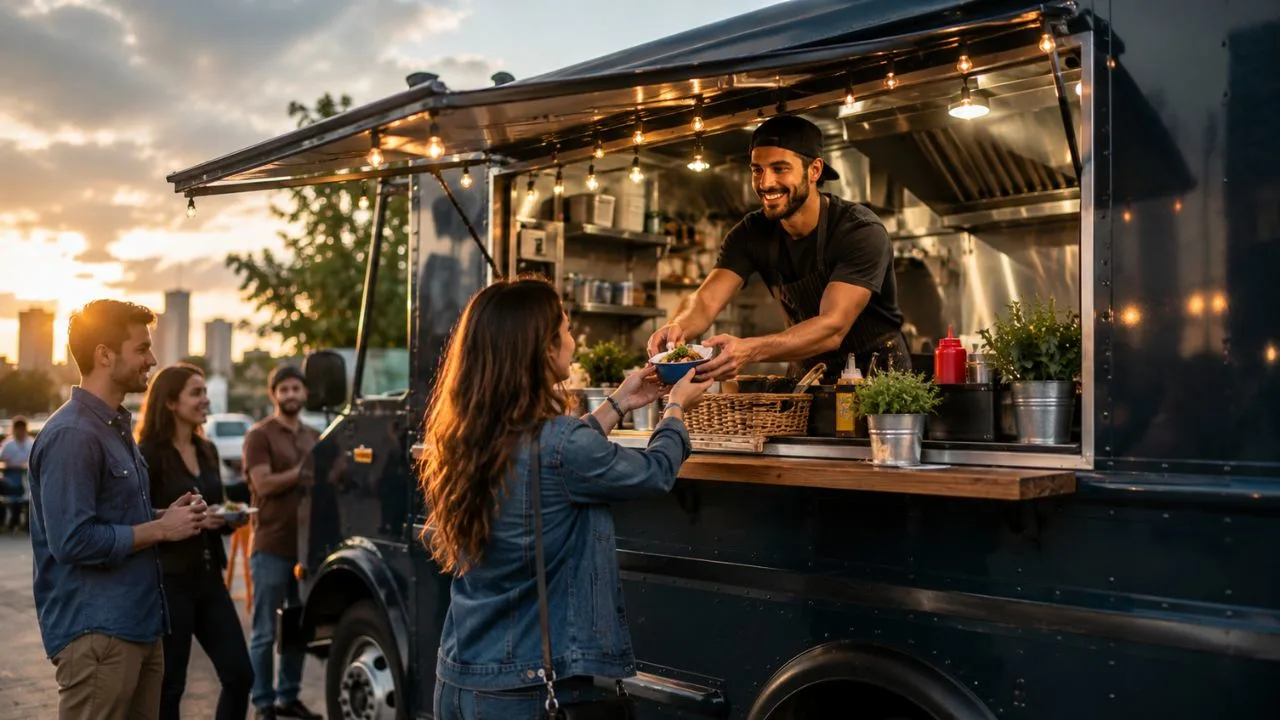

Starting a food truck business can turn a focused menu and a strong local following into a flexible food-service company. Compared with opening a full restaurant, a mobile food business may require less dining space, fewer front-of-house employees, and greater freedom to test different locations. It can serve office districts, breweries, private events, festivals, neighborhoods, and late-night customers.
However, a food truck is not simply a restaurant with wheels. The kitchen is smaller, storage is limited, equipment must survive road movement, and every service period depends on water, power, refrigeration, ventilation, waste handling, parking, and vehicle reliability. A successful operator must understand both food service and mobile business operations.
Legal requirements can also be more complicated than new owners expect. A food vendor may need business registration, a mobile food vendor license, inspections, food-safety credentials, a sales tax permit, fire approval, insurance, location permission, and access to an approved commissary or servicing area. Requirements depend on the menu, equipment, vehicle, and location.
Texas introduced an especially important change in 2026. Beginning July 1, every mobile food vendor operating a food vending vehicle in Texas must hold a state license issued by the Department of State Health Services. The new statewide system replaces the previous requirement to obtain separate health licenses from multiple local jurisdictions, although local fire, zoning, parking, event, and site rules can still apply.
Quick Answer: How Do You Start a Food Truck Business?
Begin with a compact food concept built around a recognizable customer and a menu that can be produced quickly inside a small kitchen. Test the food through pop-ups, catering, permitted temporary events, or another legally approved format before purchasing a truck. Customer demand should guide the vehicle and equipment plan rather than the other way around.
Next, write a business plan and calculate the complete food truck startup cost. Include the truck or trailer, commercial kitchen equipment, generator or electrical system, refrigeration, ventilation, permits, insurance, commissary fees, branding, point-of-sale software, initial ingredients, packaging, repairs, and working capital. The SBA recommends separating one-time startup expenses from continuing monthly costs.
Form the business, obtain an EIN when appropriate, open separate banking, and apply for the required tax and food vendor registrations. The IRS provides EINs directly and free of charge. In Texas, the food truck’s state license category and cost depend on whether the operation sells packaged food, handles prepackaged temperature-controlled food, or prepares and cooks food inside the vehicle.
Finally, complete the vehicle, health, and fire approval processes before opening. Secure compliant locations, supplier accounts, insurance, food-safety procedures, employee training, and a realistic service schedule. Launch with limited hours and a short menu so the team can improve speed, consistency, inventory control, and customer communication before pursuing large events.
Is a Food Truck Business a Good Idea?
A food truck can be a good business when the menu is differentiated, demand is proven, and the operation can produce food quickly at a sustainable margin. Mobility gives the owner access to several customer groups without maintaining a large dining room. Catering and private events may also provide revenue beyond ordinary street service.
The model still carries significant fixed costs. Vehicle financing, insurance, commissary rent, permits, parking, maintenance, software, and equipment payments continue even when rain, extreme heat, mechanical failure, or a cancelled event reduces sales. Mobility creates opportunity, but it also introduces transportation and scheduling risks that a fixed restaurant may not face.
The strongest food trucks normally behave like focused restaurants rather than oversized menus on wheels. They sell a small number of recognizable products, use overlapping ingredients, and create a service line that works under pressure. A concept that requires several cooking methods and dozens of ingredients may exceed the practical capacity of a compact mobile kitchen.
A food truck is most suitable for an owner who can manage cooking, purchasing, cleaning, maintenance, customer service, marketing, compliance, and unpredictable working hours. Culinary skill is valuable, but the business also depends on cost control, location strategy, fast decisions, and the ability to continue operating when equipment or staffing problems occur.
Step 1: Choose a Clear Food Truck Concept
A food truck concept combines the cuisine, customer, price range, service style, and personality of the business. “Tacos” is a menu category, not a complete concept. “Fast breakfast tacos for downtown office workers” identifies a customer, occasion, product, and operating period that can guide menu and location decisions.
Begin with food you can produce consistently rather than dishes that only work in a large kitchen. Consider preparation time, holding quality, cooking space, ventilation, refrigeration, assembly, packaging, and how the food tastes after several minutes. A visually impressive item may be unsuitable when it slows every order or becomes soggy before the customer eats it.
Study the market for similar food trucks, quick-service restaurants, delivery kitchens, and casual dining businesses. Examine menu prices, service hours, customer reviews, event participation, and common complaints. Competition is evidence that people buy the food, but the new business still needs a clear reason customers should select it.
Avoid making the concept so unusual that customers need a long explanation before ordering. A familiar product with a distinctive flavor, preparation method, dietary option, or local identity is often easier to market. The name, menu board, photographs, and truck design should communicate the offer within a few seconds.
Step 2: Identify Your Ideal Food Truck Customer
Choose the customer before choosing the truck. Office workers may need fast weekday lunches, brewery customers may want evening comfort food, and families at community events may prioritize familiar meals and simple pricing. Each audience creates different expectations for portions, packaging, speed, hours, and locations.
Think about the purchase occasion as well as demographics. A customer buying lunch during a thirty-minute break behaves differently from someone attending a weekend festival. Office service rewards predictable locations and speed, while event sales may involve long lines, temporary fees, uncertain attendance, and short periods of intense demand.
Build a practical customer profile containing location, spending range, order frequency, preferred food, dietary concerns, and the reason for choosing a truck rather than another restaurant. The profile should guide decisions without excluding every person outside the main audience.
Validate the profile through conversations and paid tests. Ask customers what they currently buy, how much time they have, what they dislike about nearby options, and what price feels reasonable. Actual sales at a properly permitted test event provide stronger evidence than online likes or compliments from friends.
Step 3: Validate the Menu Before Buying a Truck
A food truck is an expensive way to discover that customers do not want the menu. Begin with a lower-risk test through catering, shared commercial kitchen production, a farmers market, or a temporary food event that meets the relevant permit requirements. Temporary event applications and deadlines are separate from permanent mobile vendor licensing.
Use the test to measure more than taste. Record preparation time, orders per hour, food cost, packaging cost, waste, customer questions, average transaction value, and which products sell together. These details reveal whether the concept can function commercially rather than only producing good food.
Test the service sequence under realistic pressure. One person should be able to take payment while another prepares and hands over the order without repeatedly crossing the kitchen. Ingredients, utensils, packaging, and waste containers should be positioned according to the order in which employees use them.
Continue testing until the best-selling products and major production problems become clear. Removing a slow item before building the vehicle can eliminate unnecessary equipment and save valuable space. A menu proven through paid demand also creates stronger financial projections when seeking funding.
Step 4: Decide Between a Food Truck, Trailer, or Cart
A self-propelled food truck combines the kitchen and vehicle in one unit. It can move without a separate tow vehicle and may be convenient for operators changing locations regularly. The disadvantage is that a mechanical problem can disable both transportation and the entire kitchen at the same time.
A food trailer may provide more kitchen space for the purchase price, but it requires an appropriately rated tow vehicle, hitch, braking system, storage plan, and confident driver. Parking and maneuvering can be difficult in tight urban locations, while the truck and trailer must both be maintained and insured correctly.
A pushcart may suit hot dogs, coffee, snacks, or another limited operation. It can be less expensive and easier to position, but storage, water, preparation, and menu capacity are restricted. Texas defines food vending vehicles broadly enough to include self-enclosed trucks, trailers, roadside vendors, and qualifying pushcarts designed to remain readily movable.
Choose the format only after defining the menu, expected sales volume, cooking equipment, storage, water requirements, and target locations. Measure access points, parking areas, event spaces, and commissary facilities before purchasing. A larger unit is not automatically better when it cannot reach the locations where customers are available.
Step 5: Build a Menu for Speed and Profit
A food truck menu should normally contain a small number of core products with optional variations. Shared ingredients reduce inventory, preparation time, refrigeration demands, and food waste. For example, one protein may appear in a taco, bowl, and loaded-fries option without requiring three unrelated production systems.
Create a recipe and portion specification for every item. Record ingredient weights, yields, cooking loss, sauce amounts, garnish, packaging, and preparation steps. Without standard recipes, employees may serve inconsistent portions and the business cannot accurately calculate food cost or maintain quality.
Include items that can be assembled quickly during peak service. Slow-cooked components may be prepared in an approved kitchen and finished on the truck where permitted, while made-to-order items should not create a bottleneck. The menu must match the food vendor category and equipment approved for the operation.
Offer enough variety to accommodate common preferences without turning the truck into several restaurants. One vegetarian option, one mild option, and a simple children’s choice may broaden demand. Add items only when the kitchen can produce them without slowing the products that already sell well.
Step 6: Calculate Food Truck Startup Costs
Food truck costs vary widely according to the vehicle’s condition, kitchen design, menu, equipment, financing, and local compliance work. A used trailer with a limited menu may require much less capital than a newly built truck containing fryers, refrigeration, fire suppression, generators, and extensive stainless-steel preparation areas.
For planning rather than quotation purposes, an owner might model approximately $50,000 to $100,000 for a lean food trailer operation, $75,000 to $150,000 for a properly equipped used food truck, and $140,000 to $250,000 or more for a new custom unit. Every estimate should be replaced with written vehicle, buildout, and equipment quotations.
Keep a separate working-capital reserve. The business may need ingredients, payroll, fuel, propane, commissary rent, repairs, permits, parking, and loan payments before sales become reliable. SBA guidance recommends including equipment, licenses, insurance, inventory, marketing, professional expenses, and continuing monthly costs in the startup calculation.
Do not purchase a cheap truck without budgeting for inspection corrections. Electrical systems, plumbing, ventilation, fire suppression, refrigeration, vehicle weight, and washable surfaces may need expensive changes. A lower purchase price can become a higher total cost when the vehicle was not built for the current menu or applicable code.
| Startup Category | Illustrative Planning Range |
|---|---|
| Food truck or trailer and kitchen buildout | $45,000–$180,000+ |
| Cooking, refrigeration, and ventilation equipment | $15,000–$60,000 |
| Generator, electrical, propane, and fire systems | $5,000–$25,000 |
| Registration, permits, inspections, and training | $2,000–$8,000 |
| Commissary deposits and initial rent | $1,500–$6,000 |
| Insurance deposits | $2,000–$8,000 |
| POS, website, branding, menus, and wrap | $4,000–$20,000 |
| Ingredients, packaging, and smallwares | $3,000–$10,000 |
| Working-capital reserve | $15,000–$50,000 |
Step 7: Write a Practical Food Truck Business Plan
The business plan should explain the concept, customer, menu, service locations, competitive advantage, startup cost, funding, and expected sales. It should also identify which assumptions remain unproven. A realistic working document is more valuable than an impressive forecast unsupported by customer tests.
Build sales projections from transactions rather than general optimism. Estimate orders per service hour, average order value, operating days, event sales, catering revenue, and seasonal changes. Then reduce the projection to account for weather, cancellations, repairs, and slower-than-expected launches.
Estimate food, packaging, labor, event, payment, fuel, commissary, maintenance, insurance, and marketing costs. Include owner compensation rather than treating the owner’s labor as permanently free. The SBA describes break-even as the point at which total revenue equals total cost and recommends including fixed expenses in the calculation.
Create conservative, expected, and strong-sales scenarios. The conservative case should show whether the business can survive several weak months without relying on new debt. Update the plan after the first thirty, sixty, and ninety days using actual order volume, food waste, labor time, and location performance.
Step 8: Register the Food Truck Business
Choose a business structure such as a sole proprietorship, partnership, limited liability company, or corporation with advice suited to your financial and legal situation. A physical food-service business carries vehicle, product, employee, and customer risks, so structure should be considered alongside insurance and contracts.
A standard Texas LLC is created by filing a certificate of formation with the Secretary of State. The current state filing fee is $300. An LLC must also maintain its required state information and follow continuing tax and reporting obligations.
Apply for an EIN after forming the entity where appropriate. The IRS provides EINs directly without charge and advises LLCs, corporations, and partnerships to complete state formation before applying. Use the legal business name exactly as it appears on the formation documents.
Some older startup guides still tell every U.S. LLC to file a federal beneficial ownership report. Under current FinCEN rules, entities created in the United States and their beneficial owners are exempt from BOI reporting. Qualifying foreign entities registered in the United States remain subject to different requirements.
Step 9: Understand the New Texas Food Truck License
Beginning July 1, 2026, every Texas mobile food vendor must obtain a DSHS license before operating a food vending vehicle. A separate state license is required for each vehicle. New businesses without a previous qualifying local license cannot operate until they successfully complete the pre-licensing inspection.
Type I covers lower-risk operations such as vendors selling qualifying prepackaged foods. Type II covers certain prepackaged time-and-temperature-controlled foods involving limited handling, cold holding, thawing, or reheating. Type III covers trucks preparing, cooking, holding, and serving foods such as hamburgers, tacos, barbecue, sushi, and gyros.
The current Type I application fee is $309. Type II requires a $618 application fee and $400 pre-licensing inspection fee, while Type III requires an $876 application fee and $500 pre-licensing inspection fee. Routine or complaint inspections may create further charges according to the license category.
The classification should be confirmed before building the truck because it affects sinks, water, wastewater, holding equipment, servicing records, and preparation facilities. Changing from packaged snacks to cooking raw meat is not a small menu update; it can change the license type, physical requirements, equipment, fire system, and inspection process.
Step 10: Design the Vehicle for Inspection
Texas requires the food vending vehicle to remain readily movable rather than becoming permanently attached to a site. Self-enclosed units must protect food from weather, pests, rodents, and contamination. Interior walls and ceilings should be smooth, light-colored, and easy to clean.
Type II and Type III units generally need water and wastewater tanks, pressurized hot and cold water, handwashing facilities, and warewashing sinks appropriate to their operation. The inspection checklist also calls for soap, paper towels, detergent, sanitizer, suitable hot and cold holding equipment, and food from approved sources.
The wastewater tank must be permanently installed and have a capacity at least 15% greater than the potable-water tank. Inspectors may also verify the driver’s license, license plate, food source, serving area, certified food manager, and connection with a licensed central preparation or storage facility.
Have the proposed menu, equipment list, vehicle dimensions, plumbing plan, electrical load, propane layout, and ventilation design reviewed before construction. It is far easier to change a drawing than to move a fryer, add a sink, resize a tank, or rebuild a wall after an inspector identifies a problem.
Step 11: Arrange a Commissary or Approved Preparation Facility
A commissary is a licensed food facility supporting the mobile operation. Depending on the truck and approved exemption, it may provide food preparation, storage, potable water, utensil washing, waste disposal, grease handling, cleaning, and overnight servicing. A private home cannot simply function as the truck’s commercial kitchen.
Texas Type II and Type III vendors must address central preparation facility requirements or qualify through the state’s exemption checklist. The state evaluates whether the vehicle has sufficient refrigeration, heating, water, wastewater, food sources, storage, and servicing capacity to operate safely without ordinary commissary dependence.
In Austin, utensil-washing wastewater must go to an approved drain connected to a properly maintained grease trap at a permitted commissary. When that option is unavailable, the operator must use an authorized liquid-waste hauler and retain the relevant manifest for at least three years.
Tour several commissaries before signing. Check access hours, storage, parking, water filling, grease disposal, dishwashing, security, loading space, shared-equipment rules, cleaning standards, and travel time from service locations. A cheap facility far from the route can create significant fuel and labor costs.
Step 12: Complete Food Handler and Manager Training
Every employee who prepares or handles food in Austin must complete an accredited food handler course. The establishment must maintain training records at the operation, although employees no longer register course completion directly with the City of Austin.
Food establishments must also have at least one employee with a food manager certification. The manager must pass an approved examination, and the certificate must be posted prominently. State rules may require certified management when exposed time-and-temperature-controlled foods are handled.
Training should become part of daily operations rather than a certificate stored in a folder. Employees need clear procedures for handwashing, illness reporting, glove use, cross-contamination prevention, cooking, cooling, reheating, temperature checks, cleaning, sanitizing, and allergen communication.
Create opening, service, and closing checklists. Record refrigerator temperatures, hot-holding temperatures, sanitizer concentration, water availability, employee health concerns, and corrective actions. Consistent records help employees notice developing problems before they result in unsafe food or a failed inspection.
Step 13: Pass the Austin Fire Inspection
Austin requires a mobile food vending fire permit when the unit uses propane or has any appliance, including electric equipment, that produces grease-laden vapors. Trucks with no propane and no cooking equipment, such as certain coffee or packaged ice-cream operations, may not require this particular fire permit.
The current Austin mobile food vendor fire inspection fee is $222. A successful inspection produces an annual permit. A failed, missed, or significantly late appointment requires payment of another inspection fee before the unit can be rescheduled.
Fire requirements can affect propane cylinders, piping, shutoffs, generators, fuel separation, ventilation hoods, suppression systems, extinguishers, cooking equipment, and clearances. Use experienced licensed contractors for gas, electrical, hood, and suppression work rather than depending on an ordinary vehicle mechanic.
Inspect the system before every service. Look for damaged hoses, grease buildup, blocked exits, unsecured cylinders, overloaded circuits, leaking fuel, and expired extinguisher service. A permit confirms the unit passed at a specific point; it does not replace daily fire prevention.
Step 14: Obtain a Texas Sales Tax Permit
Prepared food and beverages sold by a food truck are generally taxable in Texas. Apply for a Texas sales and use tax permit before opening. The Comptroller currently charges no fee for the permit, although some applicants may be required to provide a security bond.
Texas imposes a 6.25% state sales tax, and local jurisdictions may add up to 2%, creating a maximum combined rate of 8.25%. Vendors operating at different locations should determine the appropriate local rate for each place of sale.
Configure the point-of-sale system to calculate tax correctly and retain accurate sales records. Permit holders must collect tax on taxable sales, report and remit it on time, and file required returns even during a reporting period with no taxable sales.
Do not confuse sales tax collected from customers with business revenue. Transfer it into a separate reserve so it remains available when the return is due. Ask a Texas tax professional how catering, delivery charges, tips, event sales, complimentary food, and bundled products should appear in the bookkeeping.
Step 15: Secure Legal Food Truck Locations
A state mobile food vendor license does not give the truck permission to park and sell anywhere. The operator still needs the property owner’s approval and must comply with zoning, traffic, right-of-way, park, event, and fire requirements affecting each site.
Austin identifies mobile vending on residential private property and property zoned Limited Office, Neighborhood Office, or General Office as a common code violation. Verify the zoning and approved use before signing a long-term site agreement or paying a food truck park deposit.
Stationary vending in the public right-of-way requires a separate process. Austin currently asks applicants for insurance, a location diagram, a state sales tax permit, a valid mobile food vendor permit, and notification of adjacent businesses. The city advises allowing up to 45 days for location and document review.
Parks, festivals, farmers markets, breweries, offices, schools, and private events may each have separate contracts or permits. Austin parks require authorization for vending or temporary concessions. Confirm fees, attendance history, electricity, water, waste, exclusivity, cancellation, and weather terms before accepting a location.
Step 16: Purchase the Right Food Truck Insurance
General liability and product liability coverage can help protect the company against claims involving customer injury, property damage, or food-related illness. Property owners and event organizers may require specific limits and ask to be named as additional insureds before allowing the truck to operate.
Commercial auto coverage is important for a self-propelled truck because an ordinary personal vehicle policy may not cover commercial operations or the specialized kitchen buildout. A trailer business should discuss the tow vehicle, trailer, equipment, drivers, operating radius, and overnight storage with the insurer.
Property, equipment breakdown, inland marine, spoilage, cyber, workers’ compensation, and business interruption coverage may also be relevant. The appropriate combination depends on equipment value, staffing, refrigeration risk, online ordering, catering contracts, and whether the operation sells alcohol.
Provide the insurer with complete information. Hiding propane, fryers, late-night operations, festivals, catering, or inexperienced drivers may produce a cheaper quotation but create serious problems during a claim. Compare exclusions, deductibles, valuation methods, and interruption coverage instead of selecting only by premium.
Step 17: Build Reliable Supplier and Inventory Systems
Use approved food sources and maintain invoices so the origin of ingredients can be verified. Texas inspection requirements specifically include food products obtained from approved sources. Informal purchasing may create food-safety, consistency, and traceability problems.
Create a supplier list for proteins, produce, dry goods, beverages, packaging, cleaning chemicals, propane, ice, and emergency replacements. Avoid depending on one supplier for every essential ingredient. A delayed delivery should not automatically cancel the day’s service.
Establish minimum and maximum inventory levels. Limited truck and commissary space makes over-ordering expensive, while under-ordering creates menu outages during peak hours. Use sales data, shelf life, preparation yield, and upcoming events to guide purchasing.
Count high-value and high-waste ingredients frequently. Record spoiled food, incorrect portions, complimentary items, employee meals, and preparation loss. A food cost percentage cannot identify the cause of poor margin unless the underlying inventory movement is documented accurately.
Step 18: Price the Food Truck Menu Properly
Begin with the complete recipe cost, including sauces, garnishes, cooking oil, condiments, and expected preparation loss. Add packaging, card fees, labor, location commissions, event fees, commissary expenses, and overhead. Ingredient cost alone does not determine whether the selling price is profitable.
Calculate contribution margin for each menu item by subtracting variable costs from its selling price. An item with a higher food cost percentage may still contribute more dollars than a cheaper item, while a popular product with excessive preparation labor may reduce the truck’s total output.
Use menu engineering to compare popularity and profitability. Position strong items prominently, rename confusing choices, adjust portions, simplify low-selling products, and create combinations that increase average order value. Avoid using constant discounts to attract customers when the normal price cannot support operations.
Review pricing whenever ingredient, labor, packaging, fuel, or event costs change. Small cost increases across several components can remove the profit from a previously successful dish. Explain price updates confidently rather than silently reducing portions or quality until customers notice.
Step 19: Choose a Food Truck POS System
A mobile point-of-sale system should support quick ordering, card and contactless payments, tax calculation, modifiers, receipts, refunds, sales reporting, and offline operation. Internet connectivity may be unreliable at outdoor events, making offline payment and synchronization especially important.
The menu screen should follow the service workflow. Group common modifiers logically, prevent impossible combinations, and place best-selling products where employees can find them quickly. Too many button presses create slower lines and more order errors.
Track sales by item, hour, location, event, and payment type. This data can show whether a busy location is actually profitable after fees and travel. It also helps forecast preparation quantities and reduce waste.
Protect customer and business data. Use unique employee logins, multifactor authentication, limited permissions, secure networks, and prompt software updates. Do not store card details manually or share the owner’s main account across the entire team.
Step 20: Create a Memorable Food Truck Brand
The brand should help customers understand the food quickly. Choose a name that is easy to hear, spell, search, and remember. Check state registrations, domains, social handles, and possible trademark conflicts before paying for a full vehicle wrap.
The truck design needs visibility at both close and moderate distances. Use readable lettering, a clear service window, an uncluttered menu board, and professional food photographs where helpful. Customers should understand the cuisine and price range before reaching the front of the line.
Packaging, employee clothing, menu language, social content, and customer service should reinforce the same identity. A playful concept may use informal wording, while a premium catering truck may require a cleaner and more restrained presentation.
Avoid spending the full marketing budget on the wrap. The business also needs signs, menu boards, website updates, location posts, photography, event materials, and replacement graphics. A beautiful vehicle cannot compensate for an unclear menu or unreliable schedule.
Step 21: Market the Food Truck Locally
Create a mobile-friendly website or landing page containing the menu, schedule, catering information, service area, contact method, and social links. Update locations consistently so customers do not travel to an outdated address and find the truck absent.
Use Google Business Profile and social media to share confirmed locations, opening times, sold-out notices, menu changes, and event appearances. Short videos showing food preparation can create interest, but operational information should remain easy to find without watching several posts.
Build partnerships with breweries, offices, apartment communities, event planners, schools, venues, and local businesses. Recurring weekday service can be more valuable than occasional viral attention because it creates predictable purchasing and preparation routines.
Develop catering packages for private events and workplaces. Specify minimum order, guest count, travel, service time, menu choices, staffing, deposits, cancellations, power, parking, and leftovers. Catering revenue can stabilize the business when ordinary street traffic is less predictable.
Step 22: Build a Fast Daily Operating System
The opening checklist should cover vehicle condition, permits, water, wastewater capacity, propane, power, refrigeration, food temperatures, sanitizer, packaging, payment equipment, cash, and the planned location. Discovering a missing item after parking can ruin the service period.
Create a preparation sheet based on expected sales. It should state the quantity of each component, who prepares it, where it is stored, and when it must be completed. Overproduction creates waste, while underproduction leads to sold-out items and lost sales.
During service, assign clear stations for order taking, cooking, assembly, packing, and handoff. In a small crew, one person may handle several stations, but responsibilities must remain clear. Use order numbers or names consistently to prevent customers from receiving the wrong food.
The closing process should include inventory, temperature records, waste, cleaning, cash reconciliation, POS review, water and grease disposal, equipment shutdown, and secure storage. Record breakdowns and shortages immediately so they are corrected before the next opening.
Step 23: Hire and Train Food Truck Employees
Hire according to the service process rather than simply adding people when the line grows. One fast cook may not solve a delay caused by order entry, packaging, or an inefficient menu. Observe where orders stop moving before creating a position.
Evaluate food-safety awareness, reliability, communication, physical stamina, and comfort working in a confined hot environment. Employees should understand that food truck work includes loading, cleaning, driving support, setup, service, and closing—not only cooking.
Restaurant employees face risks involving hot oil, steam, knives, wet floors, lifting, and heat. OSHA guidance emphasizes burn prevention, proper equipment use, dry and slip-resistant work areas, and safe cooking and cleaning practices.
Train every employee on recipes, portions, allergens, food temperatures, handwashing, illness reporting, fire response, customer complaints, refunds, and emergency procedures. Document training and supervise new workers before assigning them to operate cooking or vehicle systems independently.
Step 24: Be Cautious About Selling Alcohol
A food truck cannot add beer, wine, or cocktails simply because customers request them. Alcohol sales in Texas require the correct TABC license or permit, control of an approved premises, compliance with purchasing and service rules, and age-verification procedures appropriate to the authorization.
Texas uses different licenses and permits for different alcohol activities. A Food and Beverage Certificate is associated with specific qualifying retail permits and restaurant requirements; it is not a general food truck add-on. TABC advises operators to confirm the authority of the exact license or permit before selling alcohol.
An event may have alcohol authorization controlled by the venue, organizer, caterer, or another permit holder. Do not assume the truck can sell under someone else’s authority. The contract should identify who purchases, stores, sells, serves, secures, and reports the alcoholic beverages.
Alcohol can also require liquor liability insurance, additional training, stronger age controls, and different operating procedures. Unless alcoholic beverages are central to a carefully reviewed concept, beginning with food and nonalcoholic drinks usually creates a simpler launch.
Step 25: Follow a 90-Day Food Truck Launch Plan
During the first 30 days, define the customer, concept, menu, and operating format. Test several products through a legally compliant channel, research locations, estimate startup costs, and confirm the likely Texas license category. Do not purchase a truck before understanding the approved workflow.
During days 31 to 60, form the business, obtain tax registrations, arrange funding, select the vehicle, and prepare plans for health and fire requirements. Secure a commissary or determine whether the vehicle may qualify for an exemption. Obtain insurance quotations before finalizing the purchase.
During days 61 to 90, complete the buildout, inspections, certifications, supplier setup, POS configuration, recipes, pricing, branding, and staff training. Secure several approved locations and test every system under a simulated busy service.
Launch with a controlled schedule rather than accepting every opportunity. Review sales, ticket times, food cost, waste, labor, location fees, and customer feedback after each service. Fix the largest operational problem before increasing hours or adding another event.
Common Food Truck Startup Mistakes
The first mistake is buying the vehicle before validating the food and understanding regulations. The owner may discover that the truck lacks the required sinks, water capacity, ventilation, suppression system, refrigeration, or space for the approved menu. Correcting these problems can consume the remaining startup capital.
The second mistake is offering too many items. A large menu increases storage, preparation, waste, training, and service time. Customers may see greater variety, while the business experiences lower consistency and slower output.
The third mistake is choosing locations based only on crowds. High foot traffic does not guarantee permission, suitable customers, parking, visibility, or profit after commissions and event fees. Measure sales and costs for every location rather than assuming a long line means a successful day.
The final mistake is spending every dollar on the truck. Repairs, commissary rent, inventory, insurance, payroll, and permits begin before revenue becomes stable. A food truck without working capital may stop operating after an ordinary mechanical failure or several weak weeks.
Final Verdict: What Is the Best Way to Start a Food Truck Business?
The best approach is to prove the concept before purchasing the vehicle. Test a focused menu, identify the strongest customer, and measure actual preparation time, sales, and food costs. Use those findings to design the smallest truck or trailer capable of delivering the approved menu efficiently.
Treat permits and inspections as part of the design process. In Texas, the new statewide DSHS license category affects fees and physical requirements, while Austin may still require fire approval and location-specific authorization. Confirm the complete compliance path before construction begins.
Launch with a short menu, reliable suppliers, written recipes, suitable insurance, adequate working capital, and several approved locations. Track profitability by product and location instead of judging success only by total sales or social media engagement.
A profitable food truck is not merely a popular kitchen on wheels. It is a disciplined mobile restaurant that controls food safety, speed, waste, labor, taxes, maintenance, and customer communication while delivering a memorable meal consistently.
Frequently Asked Questions
How much does it cost to start a food truck business?
A practical launch may cost from approximately $50,000 for a lean trailer to more than $200,000 for a new custom truck. The final amount depends on the vehicle, kitchen equipment, permits, commissary, insurance, branding, inventory, and working capital.
What permits are needed for a food truck in Texas?
Beginning July 1, 2026, every Texas mobile food vendor needs a DSHS state license for each vehicle. Sales tax registration, food-safety credentials, fire approval, location permission, and event or right-of-way permits may also apply.
Can I prepare food at home for my food truck?
Generally, food truck meals cannot be prepared in an ordinary private home. Preparation must occur inside the approved vehicle or an authorized commercial facility, subject to the license type and approved operating plan.
How many items should a food truck menu have?
There is no universal number, but a focused opening menu of approximately five to ten core choices is often easier to produce consistently. Items should share ingredients and fit the truck’s storage and cooking capacity.
Are food trucks profitable?
A food truck can be profitable when it controls food cost, labor, waste, location fees, and overhead while maintaining strong sales. Profit depends more on disciplined operations and recurring locations than on the popularity of the concept alone.